Moon Pies and Moon Landings (Modern History and the German Grocery Store)

DSC_0960

I began writing this post under the title “The Perks and Perils of Shopping Abroad.”  However, I soon realized that the insights you are about to read are much broader than my mishaps in the grocery aisles.

The larger story starts in the years after the Second World War.  (Or even after the First World War and the Bolshevik Revolution.)  It gains steam in the Cold War and the Race for Space.   However, the more immediate story starts in the aisles of my local German grocery store, Edeka.  And like the larger story of political machinations, it’s fraught with perks and perils.

For example, it was recently brought to my attention that the lovely, fragrant German laundry detergent I’ve been using for about three months is actually fabric softener.  Who knew?  Well, in fact, I had suspected for a few weeks.  My clothes were so fragrant and soft!  But were they clean?  Well, they weren’t not clean.

These things happen when you shop abroad.

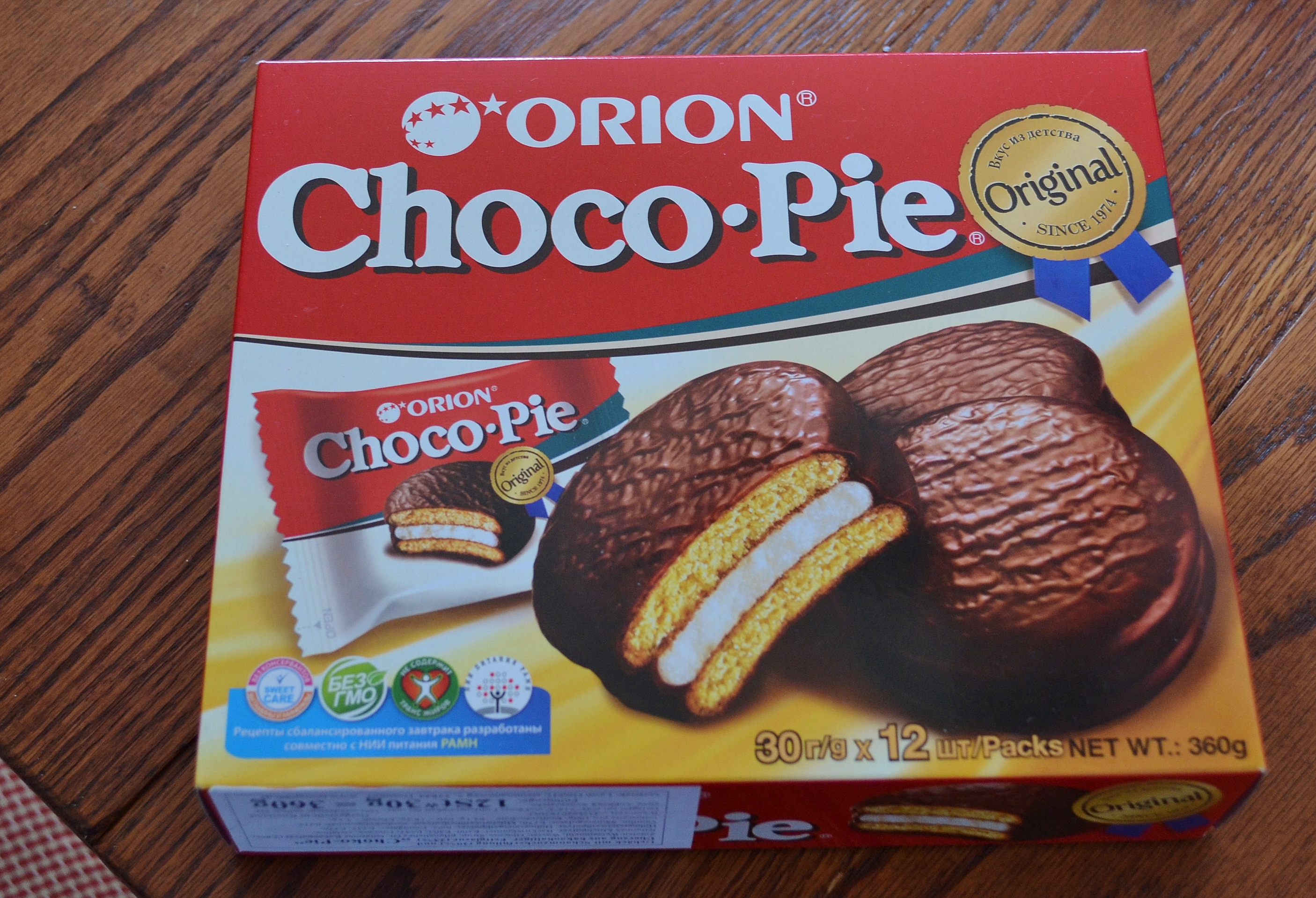
But great things happen too.  This morning, I was meandering the aisles of our grocery store, picking up jam, sorting through coffee, and pondering fish, when I stumbled upon the most amazing thing on an Eastern European/Russian shelf.  Moon Pies!   moon pie real Well, okay, Choco-Pies–but they were Russian Moon Pies!    Eureka!   For all of you non-American (or non-Southern) folks out there, here’s a little lesson:  Moon Pies are chocolate, graham, and marshmallow pies that are a Southern staple and made in Tennessee.  Before the markets were flooded with snack cakes and convenience food, there was the Moon Pie.  Apparently, they were produced beginning in the 1920’s and they were certainly big stuff in the sixties and seventies.  (My mother loved to pack my lunch with Little Debbie Oatmeal Cream Pies, but my heart, and my taste buds, yearned for Moon Pies.)   They were iconic.  And delicious.
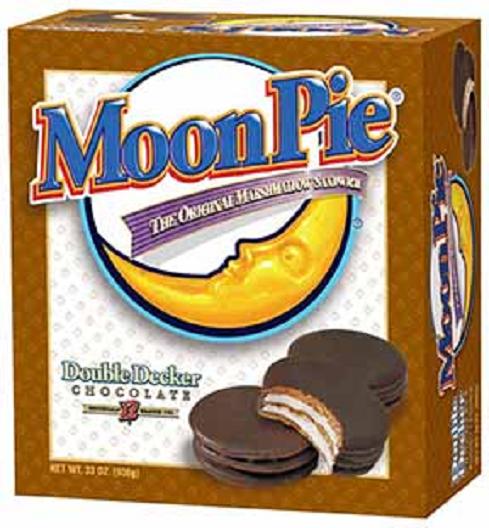
And here I was, in Germany, staring down a Russian doppelganger!  At first I laughed, and then I greedily stuffed a box into my shopping cart!  I considered my good fortune as I walked the streets of town, heading home with my grocery bag and its treasure.  But as I walked, I started thinking about more than my good fortune.  I started thinking about the doppelganger-ness of the little chocolate pie: the shadowy counterpart, the ghostly (and ominous) double.  The American Pie/the Russian Pie:  forever locked in a shadowy dance.

For sure, I’ve watched too many episodes of “The Americans,” the Cold War spy drama, lately.  But my odd brain was playing out this Spy v. Spy (Pie v. Pie) drama  and finding it fascinating.

By the time I got home, I was mad to know more.  I ripped out the Choco Pie box and scanned the label for clues–amongst the Cyrillic  (Russian) script and German sticker stood out something I could decipher.  Original since 1974.  Ha!  It wasn’t the original then–we got there first.  Not only did we get to the moon first*, but we got to the moon pie first.  I chuckled as I opened the box and saw that the pies were smaller than their American counterpart.  Well, what did I expect?

But then I took a bite.  Oh my.  I took another bite.  They were delicious.  So fresh, so chocolaty.  I felt conflicted in my patriotic soul.  There had to be an explanation for this;  no way the shadowy double could rival the Southern staple.  Think, think!  (Take another bite.)  Think some more!   Oh–of course–the problem is that too many of the American Moon Pies I’ve eaten have been plucked from dusty lower shelves of rundown convenience stores or seedy Stuckey’s truck stops.  Who knows how long they had lingered there, gathering dust and grime?  That’s it.  That must be it.
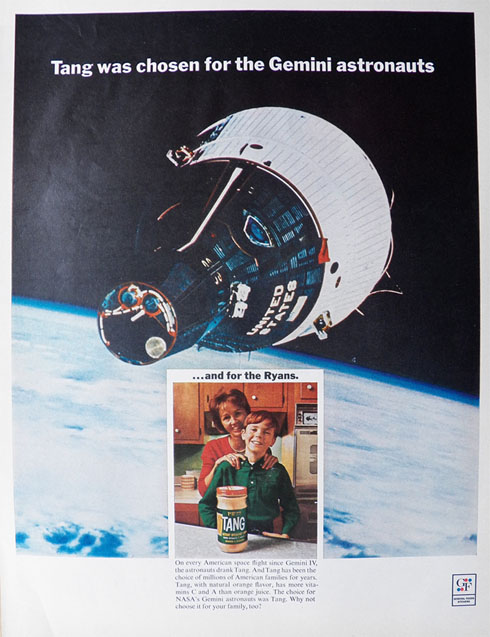
 

Tang ad, 1966
Tang ad, 1966

I was raised in the 70’s with a taste for Moon Pies and Tang.   In my mind, that era will always be  about playing kick the can, catching fire flies, eating Moon Pies, and drinking Tang like the astronauts.  I remember some of the Apollo missions; I coveted the GI Joe astronaut dolls (Barbie never had the astronaut get up, although her house and pink convertible weren’t too shabby); and I marveled when Skylab sustained people and research in space.

I didn’t cheer on the Cold War or Nuclear Proliferation– they scared the hell out of me– but I was  a product of a culture and a time.   I didn’t know whether I was an observer or participant, but I felt the adrenaline of the Race.  The Race for Hearts and Minds, the Race for Space, for Superiority, for Survival.   And then I tucked my head down into a Moon Pie  or  Mad Magazine and took refuge from the noise of it all.

Only to find today that, maybe– just maybe– my youthful Soviet doppelganger was doing the same thing in 1974.

Only she couldn’t call her treat a “Moon Pie”. . . because we got there first.

Just another lesson learned at my German grocery store.


*Sort of.  We put a man on the moon first.  But before that, the  Soviet Sputnik program beat us into outer space and the Soviet Luna program reached the moon with unmanned crafts.
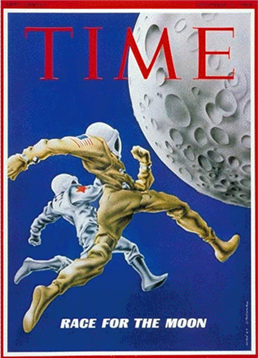

Time Magazine cover, Dec. 6, 1968


Achtung! Es ist Hexennacht!

DSC_0019And, as my dog knows, this means trouble!

Tomorrow is May 1st, and May Day is still celebrated in Germany (and most of Europe, as best I can tell).  The beginning of May is observed with a Tanz in den Mai (“dance in to May”)– streets fairs, maypoles, festivities.  Schools are out and celebrations are afoot.  And so, you know, is mischief.

The evening of April 30th is Hexennacht (Witches’ Night), and tricksters are out in force.  We’ve been told to hide our trash and recycling cans, bring in our potted plants, and garage our cars (really?  have you seen the state of my garage?)

I will try to do all of the above, and hope that the tricksters are kept at bay by rainshowers.  But still, I’ll brace for ketchup, mustard, and toilet paper on my house or cars or shrubbery.  Our neighborhood is quiet, but not lacking in youthful tricksters!

The origin of this mischief lies in medieval and pagan lore.  The Queen of Spring was set to enter the county come May 1st, but evil ghosts and spirits (and their cold and dark) would try to keep her at bay. (And barring any success at that, apparently they liked to toilet paper cars and turn over garbage cans to show their displeasure.)

©2014 Ann G. Stephenson


Engineers and Van Goghs–The Cogs and Brushstrokes of Language

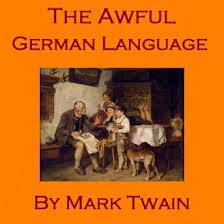
m twain awful german lang


Another chapter in my struggle with the German language–a tragicomedy.

I’m back in a rudimentary German class and progress is slow.  I am learning. . . just not quickly.  And it doesn’t help that I spent the first two months sitting next to a Scotsman who looked like a young Paul Newman.  Honestly, Deutsch can’t compete with that.   So I’ve moved seats.

I sit closer to the back of class now, and I find it very interesting how different people react differently to class exercises.  There are only a few of us left in the class–where we started out with 25 or 30 in October.  That number was cut in half by Christmas, and has shrunk even more now.  (Apparently, I’m not the only one who finds German difficult.)  But here’s what I’m seeing:  Some people take nary a note and just listen to the exercises and explanations. Other people write down every syllable spoken in class, never lifting their heads from their notebooks.  Some fall in between (like me)–but each with their own quirks.  One classmate has made copious “cheat sheets” to refer to to help him with articles in various cases (nominative, genitive, accusative, dative); one has written down every vocabulary word we’ve ever spoken and highlighted the genders of nouns; one rocks back and forth slightly whenever trying to remember the gender of a noun.

Me?  I fall in the middle ground lot–writing and pausing to listen; listening and then trying to catch some notes on paper after the fact.  But my quirk is spacing out.  Now that Paul Newman is less of a distraction, I’m people watching my fellow students’ classroom habits.  But I’m also constantly pausing over the whimsy of the language.  I lost a good ten minutes in class the other day after learning the word “Fernseher“–TV set.  The minute it fell from my teacher’s lips, my hand shot up.  “How does that translate literally?”  “Far see-er.” she said.   How fabulous and retro!  The TV set, that box in the corner of the room that opens a window into other people’s worlds or other cities’ news–the far see-er box.  I was consumed for a few minutes by images of people sitting around the earliest TV’s, like characters in a sci-fi B-movie, gazing at far away places through static and wiggly lines.  Magic!   How great is that?!  I suddenly liked the German language again. . . and then I started wondering about other funny words.   There’s the stuabsauger (dust sucker–the vacuum).  And , oh–Kindergarten!   That would literally mean “children’s garden.”  A place for all of the little buds to grow tall and bloom!  How funny–perfectly logical and spectacularly whimsical and visual all at once.   And then, I started wondering about other words in English that I’ve never really thought about.  Well, “television,” for one.  I suppose that means “seeing from a distance.”  Well, there you go.

And there I went–having missed 5 or 10 minutes of what was going on in class while I pondered the whimsy and logic of language.  And while my classmate studiously referred to his charts and cheat sheets on cases and declensions, while the person to his left concentrated and rocked slightly.

And so it seemed crystal clear to me that there are two basic types of people in a language class:  the engineers and the Van Goghs.  The engineers get the specifics down precisely and probably become very efficient at running the language in the direction and at the speed that it should best run.  They build their language skills cog by cog.    The Van Goghs are a different beast.  We enjoy the broad brush strokes of language.  We are intent on communicating, and would like to do it well–we are just less geared (excuse the pun) toward the efficiency of communication and more toward the bright colors, the swirl and flow.  I tend to fall into the structure of German fairly well (okay, rudimentarily well)–the crazy, slipperiness of German verbs that like to come first, last, or middle of a sentence, depending on the sort of message you convey.  I get that on an intuitive level.  But noun genders, and German cases and article and adjective endings, they are less intuit-able to me.  They take a chart, or a precise cog in the brain (cut to measure and carefully placed just so).  They take a mind that sticks to its charts and does NOT slip, trip, and travel over the whimsy of a word in the middle of class.

It might be nice to have an engineer’s mind when you are trying to communicate with the travel agent or sort out your power bill at the municipal power office, under the stern gaze of the German office worker.  But, all in all, I wouldn’t trade it for the slips, trips and whimsy of the brain I have.    Efficient?  Hardly!  Amusing?  To me . . . and that’s enough to keep me happy, and to keep me going back to German class for the time being.


What’s in a Name? (A Whale of a Tale)

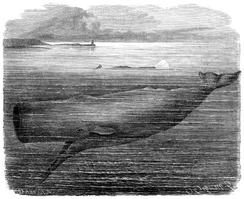
244px-Pottwal_brehm_m

This is a traveler’s tale, believe me.  Just suspend your disbelief for a few minutes, and you’ll see how it all comes around.

“What’s in a name? That which we call a rose
By any other name would smell as sweet.”  –so says Juliet in Shakespeare’s play.

Of course, the Bard is right when it comes to the star crossed lovers of his play, but other times it seems that there is something in a name.  Some hint of the stars, indeed, the trajectories of fate.  I offer up my husband’s family for closer inspection.  (Sorry guys!)

When we had our first child, I dabbled with dozens of name combinations.  I wanted to use family names, especially for my children’s middle names.  As it turned out, both of my kiddoes have middle names that come from my family.   I tried to be fair minded, but a quick look into my husband’s family tree sent me running scared.  The first three names to appear in the foliage of that tree?

Butcher.  (NO thank you.)

Butts.  (Funny, but not for my children.)

Coffin.  (Oh, dear Lord.)

Those names weren’t destined to go down in my family, except anecdotally, as the names which shall NOT go down in my family.

But then. .  .

(That’s where so many stories begin, isn’t it?  “Everything was just fine.   But then…”)

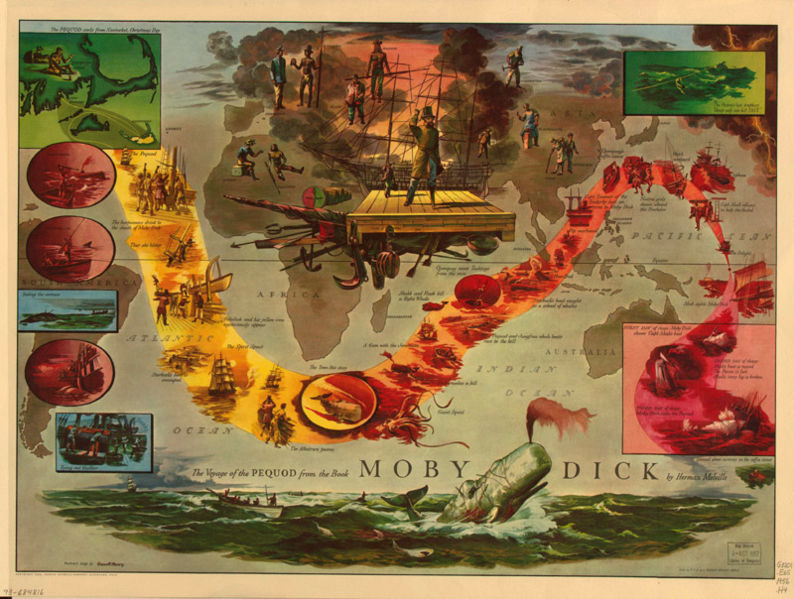
But then I picked up Nathaniel Philbrick’s book  In the Heart of the Sea: The Tragedy of the Whaleship Essex.  I picked it up because I’d loved his book Mayflower and I looked forward to hearing his voice again; I didn’t have any particular love of sea-faring tales.  But what a crazy tale opened up to me when I opened Philbrick’s book.  His story of the tragic wreck of the Whaleship Essex was a tale I already knew, in some measure, from  Moby Dick, Herman Melville’s long winded but brilliant tale of mania, fate, superstition, life and death, good and evil: the motherload of English Department themes.

????????????????????????????????????????????????????????????????????????????
The Voyage of the Pequod,” illustrated by Everett Henry (Wikimedia Commons

Who knew that Melville had founded his story in the circumstances of an actual whaleship–The Essex–that had been sunk by an angry whale?  And the wreck of the Essex both fascinates and horrifies not only in the circumstances of the wreck, but even more in the horrifying tale of survival, and attempted survival, of her crew.

The Essex was small, but she was known as a lucky, profitable ship when she left Nantucket in 1819.   Her voyage to the west coast of South America would take over two years, and things got rough for this lucky ship even in the first week of the voyage.  A squall hit and the ship was damaged.  But that was just the beginning.  By November of 1820, her luck ran out entirely.

I’d love to recount the entire story for you here, because it is horrifying and fascinating all at once, but Philbrick tells it best, and a blog post isn’t the right vehicle for an epic tale.  (Yes, I hear you thanking me.)  The half penny version is that the crew members were afloat in three small boats, with little water or food (much of which became salt-soaked and only increased their thirst).  They were about 2,000 miles off of the South American coast at the time.    The boats were separated in a squall.  Starvation and dissociative madness ensued, and death picked them off one by one.

Nearly 100 days after the Whaleship Essex sank, the very few survivors (about 5 men) were rescued.

The Essex had started out with 21 men.  She had started out a lucky ship.  Her journey took an awful turn.  But also an awe-full turn.

That turn went like this:

1-The first mate, Owen Chase, was one of the survivors, and he wrote an account of the tragedy: The Wreck of the Whaleship Essex.

2- That account fell into the hands of Herman Melville while he was at sea on a whaling voyage.  In fact, legend has it that Melville met Owen Chase’s son on that voyage.  Chase reportedly gave Melville a copy of his father’s story.

3- Melville’s copy of the story indicates his deep connection with the surviving Essex men, as he scribbled in the pages, “Met Captain Pollard [who had captained the Essex] on Nantucket. To most islanders a nobody. To me, one of the most extraordinary men I have ever met.”

And so the story of the Essex has lived on in American literary culture–in spirit, if not in detail-for-detail fact.

But why do I offer it up here?  Because the Whaleship Essex was carrying a young boy named Owen Coffin.  Yes, Coffin:  one of the leaves in the foliage of my husband’s family tree.*  And one of the most gruesome, but absolutely necessary, links in bringing you the tale of the Essex and the novel Moby Dick. Without Owen Coffin, Captain Pollard and another boatmate would not have survived.

In the most desperate last days of their desperate ordeal, the men of the Essex survived only by resorting to cannibalism.  Disturbing enough that they had to cannibalize their dead shipmates, but in the final days they resorted, just this once,  to “drawing straws” to make the ultimate sacrifice.  One of their own would be killed to save the others.  Owen Coffin drew a bad lot.

Well, what is in a name, indeed?

I don’t regret bypassing the gloomy monicker for my own children, but then. . .

I also thrill to this odd link to American history –both in the Essex and in Melville’s near-Biblical tale of struggle and mania and survival.

I’ve traveled an awful lot of roads in life, in a journey not only over geographic terrain, but over cultural and temporal peaks as well–that’s the nature of our lives’ stories.  So if my children’s stories reach back to a heritage that includes Owen Coffin’s tale–Owen Coffin’s horrible, gruesome, but somehow resilient tale (in the survival of Chase and under the pen of Melville)–then I am thrilled.

It’s a very long view of the journey, isn’t it?

Owen Coffin suffered a horrible fate.

But Owen Chase lived to tell.

And he told Herman Melville, whose book bombed in his own  time .  . .

But became a classic of literature in the 20th century.

And I scoffed at the name Coffin. . . only to find that I admire it more than I could have imagined.

As we travelers always say,  “What a long, strange trip it’s been.”

*My husband’s ancestor left Nantucket for the coast of Canada in the years following the American Revolution.  It’s not clear whether he was also a whaler, but he may have been a loyalist in the King’s Navy during the war.