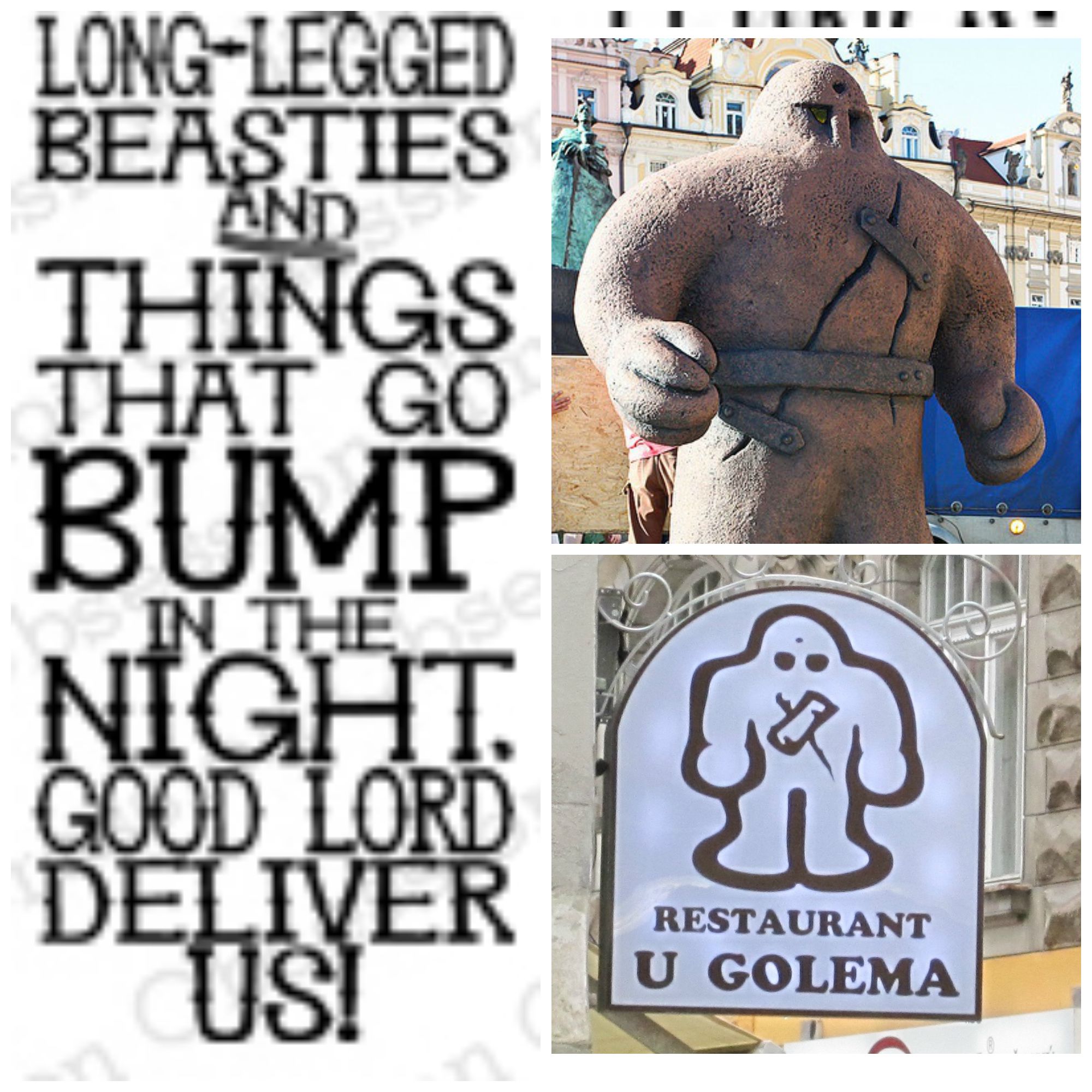
Prague’s Golem, retold

golem picmonkey


There are things that go bump in the night, and, then again, there are things that go bump in our psyches and rattle around with such fury that they can’t be quelled by any night light. In fact, at some point and in the full light of day, they will trip from our tongues or scurry across the pages of our books—out into the world, across eras, and even across cultures. These monsters may prove themselves useful to us, even noble at times—our defenders from the monsters that show up at our doors in human flesh– but they are problematic nonetheless. They are never really controllable.

To wit—the golem.

Long before Prague was Prague, “the Golem” began rattling around our psyches as a shadowy form in Hebrew lore. The word references an unshaped form, or possibly an unrefined person—someone who is clumsy. A clod.

Yes, a clod of dirt and dust . . . like Adam before Eden. But without the divine breath, the breath of life.

So, how did this golem come to be animated?  Scholars can point to moments in the Talmud or the Hebrew Book of Formation when a golem was brought to life by use of a shem—a name of God. If one of the names of God was inscribed on paper and placed in the mouth of the mud man, or perhaps inscribed upon its forehead, then the golem became animated.

Something to remember: the name of God represented the reality and power of God. To invoke God’s name meant to invoke a truth and a power beyond any a mortal could/should wield. But this doesn’t stop mortals from prying in business beyond their wisdom, does it? (The atom bomb comes to mind.)

Prague
Prague

And so, tales of the golem took foot like so many clay men, trodding the shadows but living beyond a world they could understand or be understood in. Glimpses were reported in tales from Poland, Russia, Germany (at the hands of Jakob Grimm), and Prague.

Prague. There was a city ripe for things that go bump and holy incantations both. In 16th century Prague, these elements mixed to create a famous tale in which the golem was a being animated to protect the Jewish ghetto from oppressors.

Although tales of the golem had been around centuries before, this famous tale of the golem was created by  Rabbi  Yehudah Levi ben Betzalel (aka, Rabbi Loew) .   Rabbi Loew had his reasons: anti-Semitic attacks were a fact of life, and rumors abounded that a local priest was about to launch a new accusation at the Jewish community in Prague.  They were to be wrongly accused of ritual murder of Christian children.  To avert this disastrous situation, Rabbi Loew formed his golem from the mud of the Vltava River and, in a god-like act, placed life into its mouth with the Shem Hameforash.

The golem was named Joseph, and he served as the protector of the Jewish Quarter. He was a hero, but he was also a monster–human-like, but not human.  Created from the machinations of a man who, though holy, was less than God.  And what happens when man meddles with the power of God?  The story always turns dark.
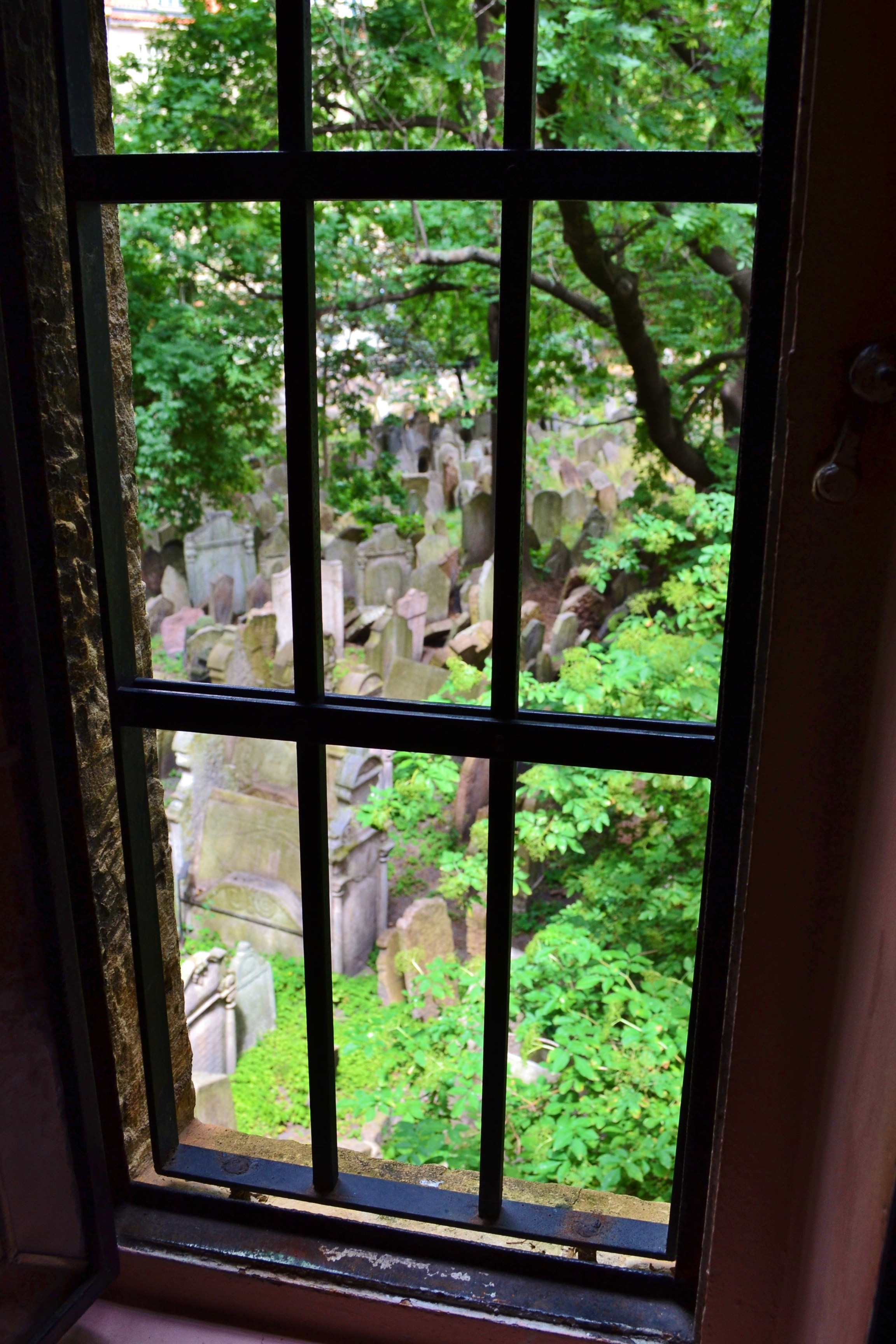
Attic view of the Old Jewish Cemetery in Prague

The golem grew stronger and stronger as time passed, and more violent too.  He couldn’t be controlled.  And so, the shem had to be removed from his mouth and the noble monster had to be “decommissioned.”  The clay figure was locked away in the attic.

If you are starting to think that Mary Shelley’s Frankenstein’s monster has eerie undertones of the golem, then I agree 100%.  Sure, Rabbi Loew had more noble intentions than Dr. Frankenstein, but nobody ever really controls these monsters once they come to life.  And no one really understands them, either.  There is something poignant and lonely about these beings–despite the danger and the grotesque qualities they possess, they are almost us.  Oddly, they are better than us in moments–they have the physical power to protect and they have remarkable innocence despite their power.   Until the story turns.  But it turns, at least in part, because of the violent world they must confront.

Life is complicated, no?

And, having trod through the ages– from hints in the Garden of Eden, to full power in 16th century Prague, to the quintessential monster of British horror tales–the golem now prowls the streets of modern America in our dime store comics.  Remember The Thing?

The Thing, copyright Marvel Comics

He was a rock-man.  The character’s real name was Benjamin Jakob Grimm (hello!), and he was a Jewish New Yorker.   Ben Grimm was a test pilot turned astronaut who was transformed by cosmic radiation.  Bummer.  Of course, he’s a good guy (like the golem Joseph), but he does have a temper (like Joseph).  Uncontrollable?  Not necessarily, but the golem influence is undeniably strong here.  In fact, there is apparently even one story line in which Benjamin Grimm reanimates the dead body of an innocent neighbor by reciting a Shem or a Jewish prayer.

We’ve heard this tale before–at different times, in different places, for different cultures and eras–but it never fails to catch our attention.  How could it?  It’s one of those stories that looks outward: to a world we live in that’s dangerous, and where we need protectors from violent forces (forces that are usually all too human themselves).  But it also looks inward at human nature as a story of incurable meddlers:  we dabble in things when we think we have a little technical knowhow, but we are radically lacking in the wisdom to wield the power that knowhow brings.  (It’s the classic tale of hubris, and it’s our specialty as a species.)
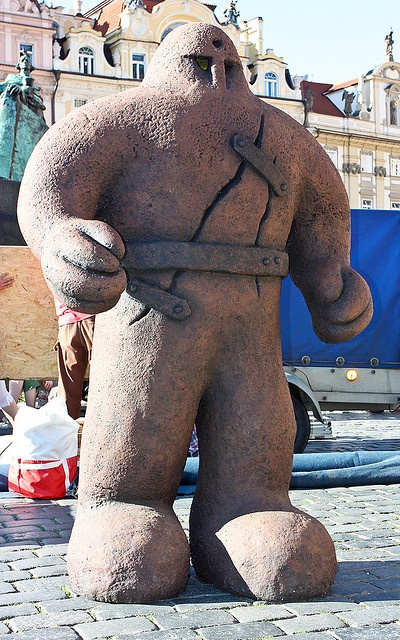
Golem Statue, Prague

Prague claims the golem as one of its famous tales, and it should–that history is rich and deep.  But we all know that the golem didn’t stay locked in that attic in Prague.

No, it’s afoot and will always be.  Told and retold, as long as there is mud and there are meddlers.



This Old House, This Storied Country, and One Mysterious Apple


apple 2

We are, each of us, a product of place, so sometimes our environment creeps into our psyche more than we care to admit–I was reminded of this fact by an unassuming apple in my front flowerbed.   A flowerbed that sits before a very old house, built of red stone, hand-hewn and crooked; a house that is, by turns, lovely and eerie.

I walked out the front door of my house and saw the apple  there–red and vibrant among the few green leaves that still cling to the frozen branches of those front bushes.  A bright spot of color in the largely barren tones of winter, it was a welcome sight.

But how did it get there?  There is no apple tree in the front yard, and the apples from the back yard are small and earth-toned by comparison.  Where did this gem come from?

Where my mind should have wandered in its answer is to my children.  “Who walked out the front door and threw their lunch apple into the bushes?”  That’s the logical question.

But I’ve been reading that German classic, the Brothers Grimm, and traveling to the Black Forest and various sundry towns mapped out in labryinthine streets of half timbered houses.  The sorts of places that both delight and unsettle the pysche as night falls. . .the sorts of places where Santa makes the rounds with his sinister cohort Krampus in tow.

So where did my mind go as my eyes fell on the apple?

The gypsy woman who had knocked on our front door the weekend before.  That had never happened before, and it was a little unsettling.  My husband answered the door, but couldn’t understand anything she was saying.  Was it German?  Was it some other language, something Eastern European?  Who knew?  He kindly, firmly sent her away without whatever she had come for.

And here we were the next day, with a lone apple in our front flower bed–red, shiny, seductive in the barren patch.  Like a riddle she left behind.

It’s still sitting there.  Part of me knows that this is a silly flight of fancy.

But part of me wants to run out and take a giant bite of it, just to see what magnificent story would begin to untangle in the moment of that fateful taste.

snow_white_and_the_poison_apple-t2


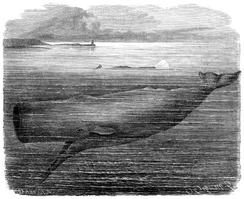
What’s in a Name? (A Whale of a Tale)

244px-Pottwal_brehm_m

This is a traveler’s tale, believe me.  Just suspend your disbelief for a few minutes, and you’ll see how it all comes around.

“What’s in a name? That which we call a rose
By any other name would smell as sweet.”  –so says Juliet in Shakespeare’s play.

Of course, the Bard is right when it comes to the star crossed lovers of his play, but other times it seems that there is something in a name.  Some hint of the stars, indeed, the trajectories of fate.  I offer up my husband’s family for closer inspection.  (Sorry guys!)

When we had our first child, I dabbled with dozens of name combinations.  I wanted to use family names, especially for my children’s middle names.  As it turned out, both of my kiddoes have middle names that come from my family.   I tried to be fair minded, but a quick look into my husband’s family tree sent me running scared.  The first three names to appear in the foliage of that tree?

Butcher.  (NO thank you.)

Butts.  (Funny, but not for my children.)

Coffin.  (Oh, dear Lord.)

Those names weren’t destined to go down in my family, except anecdotally, as the names which shall NOT go down in my family.

But then. .  .

(That’s where so many stories begin, isn’t it?  “Everything was just fine.   But then…”)

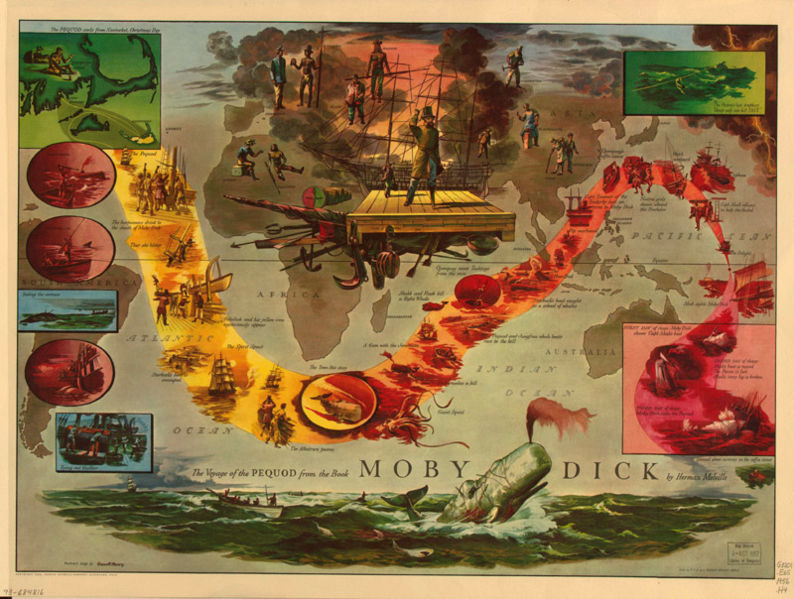
But then I picked up Nathaniel Philbrick’s book  In the Heart of the Sea: The Tragedy of the Whaleship Essex.  I picked it up because I’d loved his book Mayflower and I looked forward to hearing his voice again; I didn’t have any particular love of sea-faring tales.  But what a crazy tale opened up to me when I opened Philbrick’s book.  His story of the tragic wreck of the Whaleship Essex was a tale I already knew, in some measure, from  Moby Dick, Herman Melville’s long winded but brilliant tale of mania, fate, superstition, life and death, good and evil: the motherload of English Department themes.

????????????????????????????????????????????????????????????????????????????
The Voyage of the Pequod,” illustrated by Everett Henry (Wikimedia Commons

Who knew that Melville had founded his story in the circumstances of an actual whaleship–The Essex–that had been sunk by an angry whale?  And the wreck of the Essex both fascinates and horrifies not only in the circumstances of the wreck, but even more in the horrifying tale of survival, and attempted survival, of her crew.

The Essex was small, but she was known as a lucky, profitable ship when she left Nantucket in 1819.   Her voyage to the west coast of South America would take over two years, and things got rough for this lucky ship even in the first week of the voyage.  A squall hit and the ship was damaged.  But that was just the beginning.  By November of 1820, her luck ran out entirely.

I’d love to recount the entire story for you here, because it is horrifying and fascinating all at once, but Philbrick tells it best, and a blog post isn’t the right vehicle for an epic tale.  (Yes, I hear you thanking me.)  The half penny version is that the crew members were afloat in three small boats, with little water or food (much of which became salt-soaked and only increased their thirst).  They were about 2,000 miles off of the South American coast at the time.    The boats were separated in a squall.  Starvation and dissociative madness ensued, and death picked them off one by one.

Nearly 100 days after the Whaleship Essex sank, the very few survivors (about 5 men) were rescued.

The Essex had started out with 21 men.  She had started out a lucky ship.  Her journey took an awful turn.  But also an awe-full turn.

That turn went like this:

1-The first mate, Owen Chase, was one of the survivors, and he wrote an account of the tragedy: The Wreck of the Whaleship Essex.

2- That account fell into the hands of Herman Melville while he was at sea on a whaling voyage.  In fact, legend has it that Melville met Owen Chase’s son on that voyage.  Chase reportedly gave Melville a copy of his father’s story.

3- Melville’s copy of the story indicates his deep connection with the surviving Essex men, as he scribbled in the pages, “Met Captain Pollard [who had captained the Essex] on Nantucket. To most islanders a nobody. To me, one of the most extraordinary men I have ever met.”

And so the story of the Essex has lived on in American literary culture–in spirit, if not in detail-for-detail fact.

But why do I offer it up here?  Because the Whaleship Essex was carrying a young boy named Owen Coffin.  Yes, Coffin:  one of the leaves in the foliage of my husband’s family tree.*  And one of the most gruesome, but absolutely necessary, links in bringing you the tale of the Essex and the novel Moby Dick. Without Owen Coffin, Captain Pollard and another boatmate would not have survived.

In the most desperate last days of their desperate ordeal, the men of the Essex survived only by resorting to cannibalism.  Disturbing enough that they had to cannibalize their dead shipmates, but in the final days they resorted, just this once,  to “drawing straws” to make the ultimate sacrifice.  One of their own would be killed to save the others.  Owen Coffin drew a bad lot.

Well, what is in a name, indeed?

I don’t regret bypassing the gloomy monicker for my own children, but then. . .

I also thrill to this odd link to American history –both in the Essex and in Melville’s near-Biblical tale of struggle and mania and survival.

I’ve traveled an awful lot of roads in life, in a journey not only over geographic terrain, but over cultural and temporal peaks as well–that’s the nature of our lives’ stories.  So if my children’s stories reach back to a heritage that includes Owen Coffin’s tale–Owen Coffin’s horrible, gruesome, but somehow resilient tale (in the survival of Chase and under the pen of Melville)–then I am thrilled.

It’s a very long view of the journey, isn’t it?

Owen Coffin suffered a horrible fate.

But Owen Chase lived to tell.

And he told Herman Melville, whose book bombed in his own  time .  . .

But became a classic of literature in the 20th century.

And I scoffed at the name Coffin. . . only to find that I admire it more than I could have imagined.

As we travelers always say,  “What a long, strange trip it’s been.”

*My husband’s ancestor left Nantucket for the coast of Canada in the years following the American Revolution.  It’s not clear whether he was also a whaler, but he may have been a loyalist in the King’s Navy during the war.

In Praise of the Random… or, How I stumbled on Frankenstein Castle

frk castle

Sometimes days don’t turn out quite the way you planned.  And those unexpected things that crop up…well, in Europe, they can take an interesting turn.

A few days ago we hopped in the car to head off to a wine festival just 50 minutes away.  We went early with kids in tow, expecting to catch a little wine and food and a few rides for the kids, but not the raucous, full-on wine lover’s equivalent of Oktoberfest.  “Fest-light” was our goal.

What we got was “Fest-Ultra-Light.”  It seems we arrived the morning after the big parade, and the morning before the evening’s concluding fireworks gala.  The place was a ghost town.  A few other early risers were taking in the food and drink, and we had the rides all to ourselves.  Sure, there are advantages to skipping the crowds, but it felt like we’d missed the party and showed up for the hangover.  Hmmm…

The fest was a bit of a wash for us.

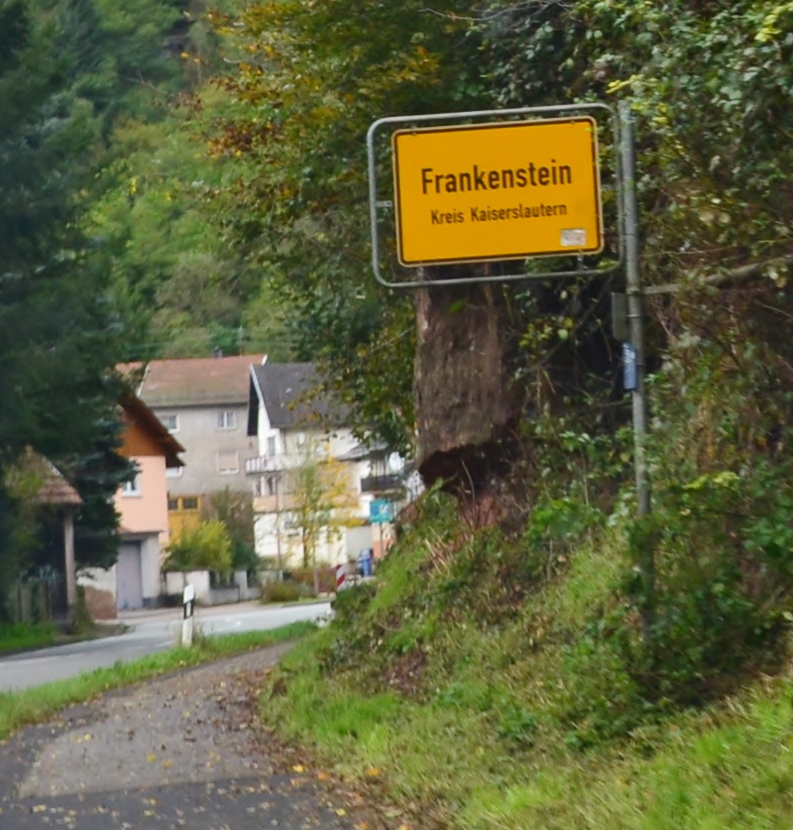
But that didn’t matter to me  because on our way over the river and through the woods to the Fest that wasn’t, we drove through Frankenstein village.  Are you listening?  We drove through Frankenstein Village!   Who knew?DSC_1037 - Copy

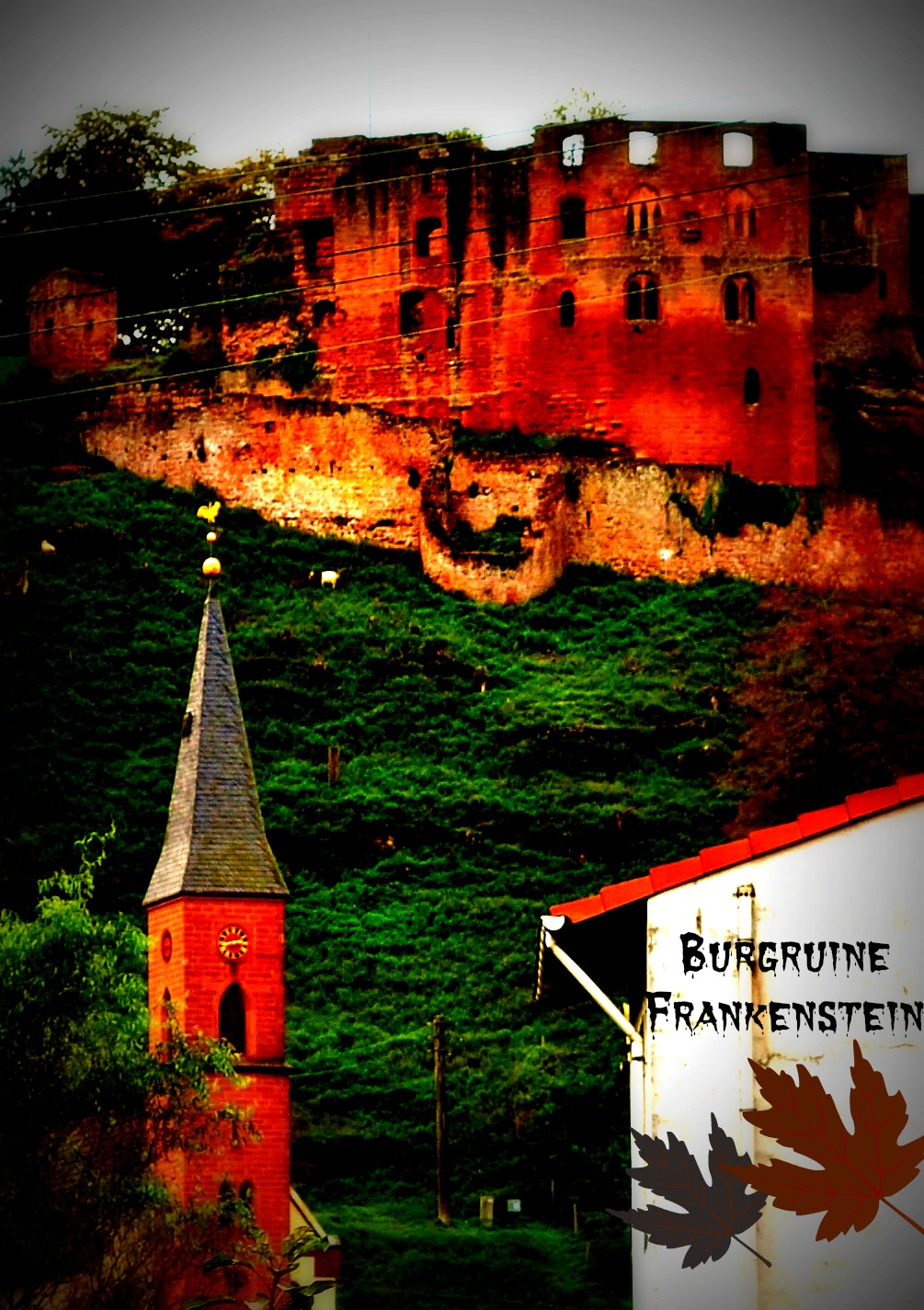
This humble village lies on a winding road, cozied in tight between hills and streams, high trees, and old homes.  It is close to Durkheim and Speyer in the Palatinate Forest of Germany.   And as we drove through the Palatinate Forest, the fog just beginning to lift, the road twisting  us until we were dizzy, we saw a flash of sign reading “Frankenstein,” and then looked up to see this:

DSC_1042

If that isn’t a great October morning eye opener, then there’s no such thing!   You can keep your tootsie rolls, candy corn, and bit-o-honey–I’ve had my Halloween treat!!!!

(But I’d still take some wax lips, if you’re handing them out. . .)

Here are a few notes on Frankenstein Castle:

*It dates from the 12th century, and was under the administration of the von Frankensteins.

*It lies on a strategic outcropping, began as a fortified tower, and was added to and then damaged in many skirmishes from the 1200’s through the 1500’s.

*The castle is presently more of a ruin than a castle, but it’s now owned by the Rhineland-Palatinate state and some foundational restoration has been done.

**HERE’S THE THING: A lot of confusion arises because there is another, more intact, castle near Darmstadt (in Muhltal) that bills itself as Frankenstein Castle.  It seems likely that it was an inspiration for Mary Shelley’s story.  A man named Dippel was born in that castle, and stories surrounded Dippel and his claims to have created an oil that was an “elixir of life.”   An earlier owner of this house was the founder of the Barony of Frankenstein, but now this castle hosts Halloween parties and capitalizes on the Frankenstein tale.   Both castles, however, trace back to the Frankenstein name.

Ultimately, the name Frankenstein was chosen by Shelley for her fictional tale.  If it took these German rumors or atmosphere as its starting point, that’s great, but Shelley was the doctor who breathed  life into the story.

Maybe the inspiration struck her on the way home from a wine fest.   Maybe.


One more photo for you.  This has got to be one of my favorite sign-clusterings.  Ever.

DSC_1045 - Copy Frankenstein’s Castle.  

Cemetery.  

Protestant Church.  

Pedestrian Path.

Because what pedestrian wouldn’t want to walk past the church, the cemetery, and Frankenstein’s Castle ruins as dark falls?