Yesterday, in Bitche, France/Hier, a Bitche/ Gestern in Bitche
Click on the photo if you wish to expand it.
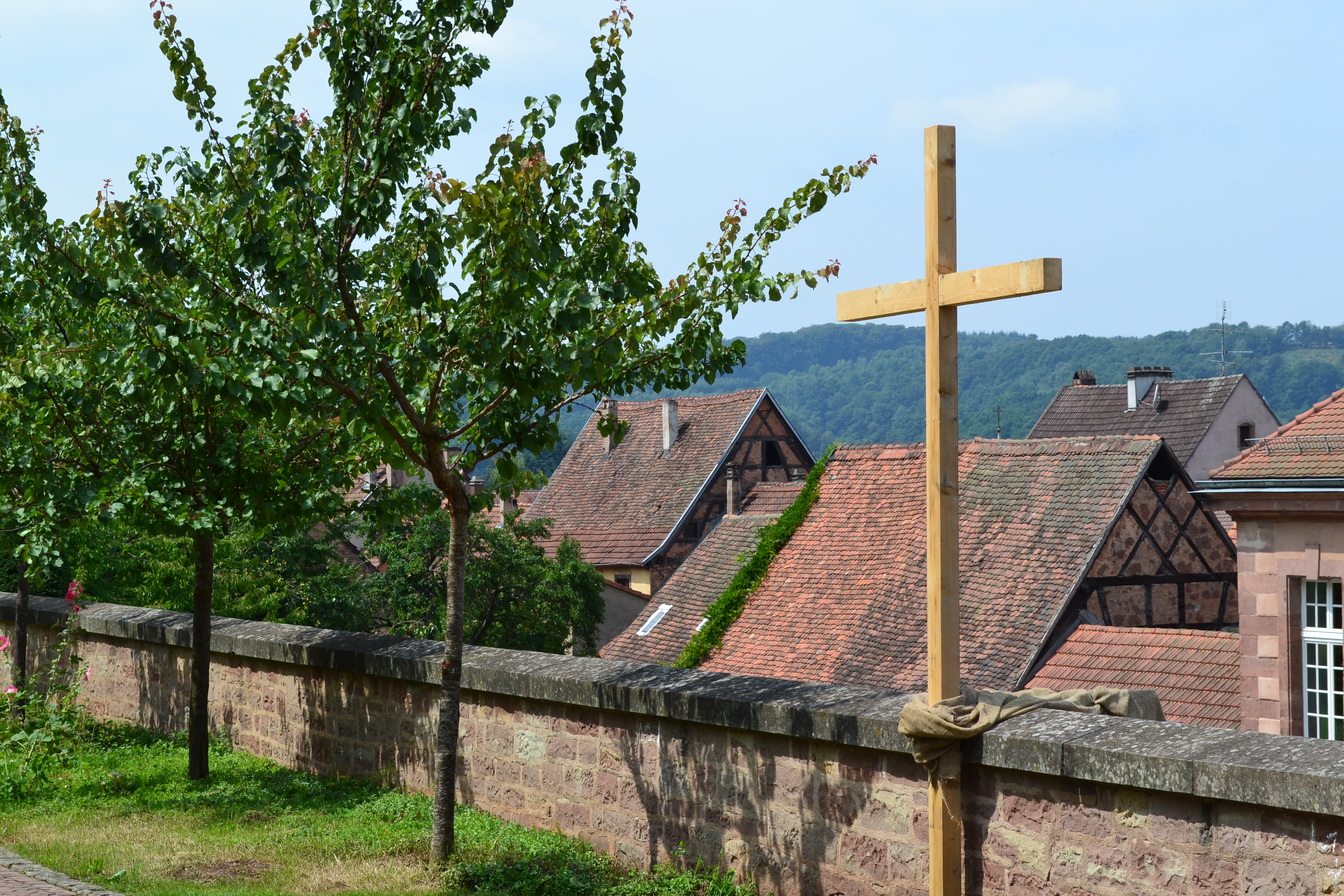
I stopped to look out over the rooftops of Bitche–which were so beautiful, serene, and orderly in a charming, hodge-podge way. (Like all the most beautiful things–with just a hint of asymmetry to keep the eye interested.) It took me a few moments to realize that I was standing by a simple wooden cross, and I wondered how long it had been standing there, keeping its own unwavering watch over the rooftops of the citizens of Bitche. And if those citizens had, like me, been largely oblivious to its presence.
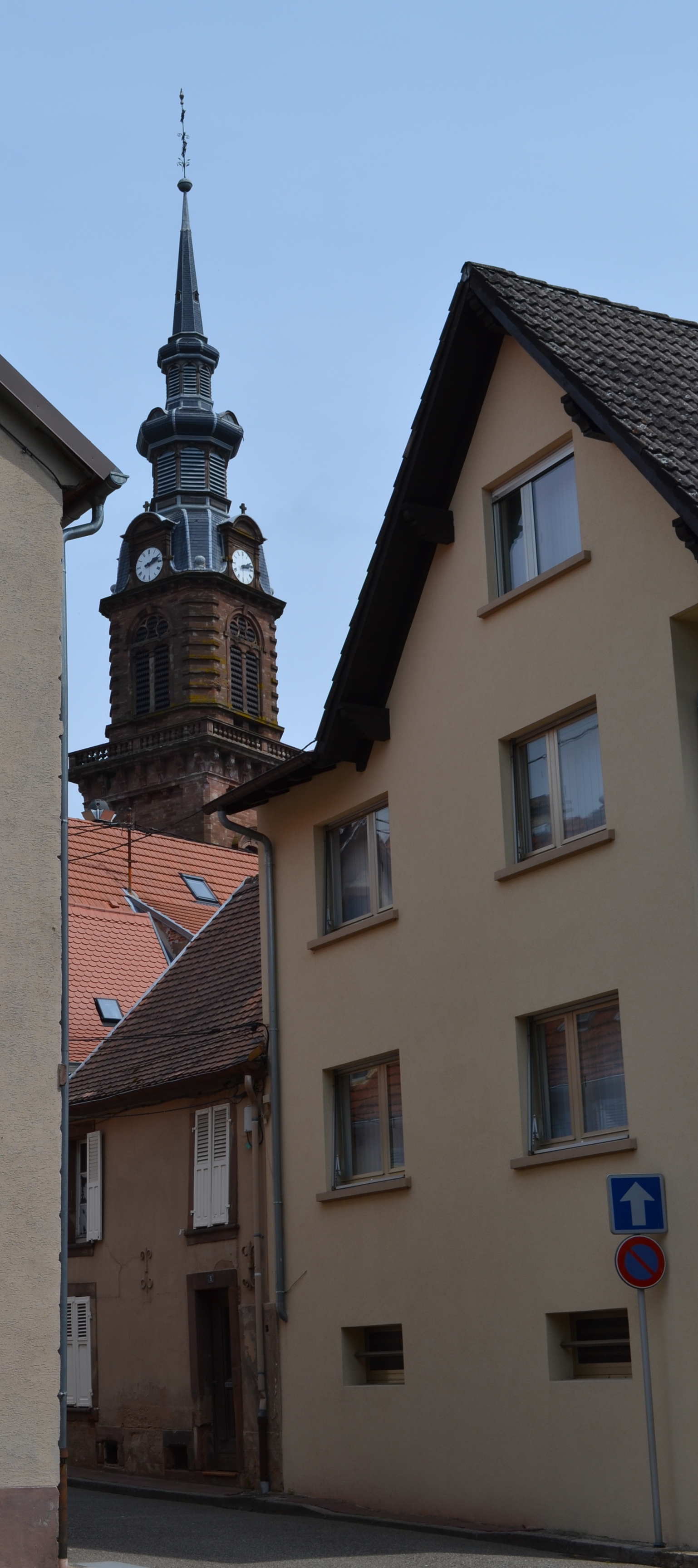
At the center of town, the church steeple kept peeping through the rooftops to note our progress through the streets.
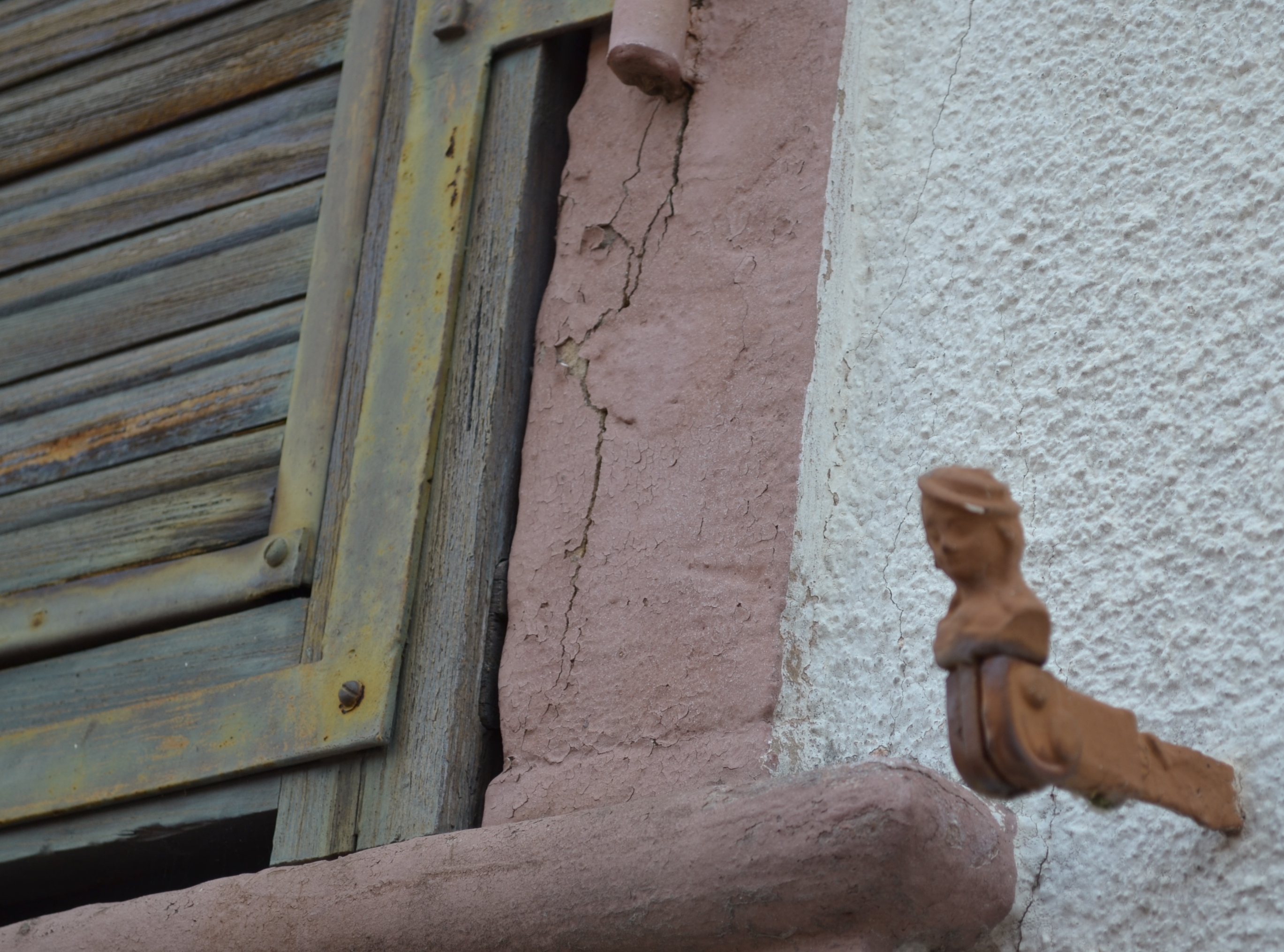
But the watchers in Bitche were not only of a religous ilk: along many rows of old houses, the iron shutter stops (“shutter dogs”) were decorative women’s heads…some still distinct, others weathered or rusted to a ghostly decay. Charming, haunting, and resiliently functional. The story of life, n’est-ce pas?
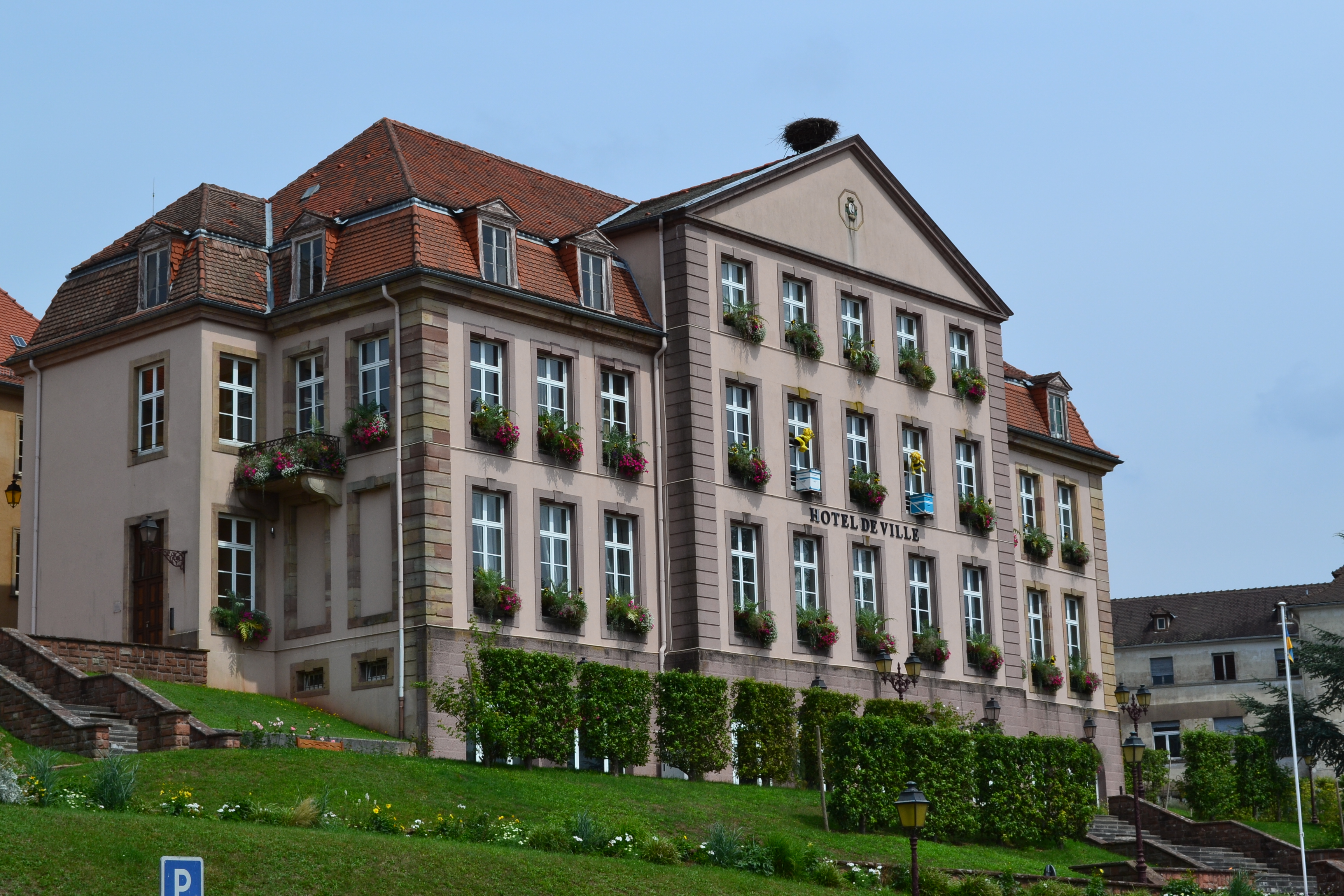
And when all of the watching eyes had seen our small procession of four through the streets of the city, here is where we popped out on the other side: (The small photo doesn’t do it justice; click on the photo to expand it to a larger size.)
Hotel de Ville, Bitche, France
A day of small wanderings, but a fabulous journey. Surely the French have a phrase that captures this. Perhaps, “petite promenade, grand voyage”?
A few notes on Bitche:
*It’s located in Northeastern France, on the German border
*From the 17th century on, Bitche was a stronghold and much of the old citadel still stands
*If you are a modern history buff, Bitche sits very close to sections of the Maginot Line
I’m sure there is some sort of Universal Karmic connection between my children’s behavior and the long history of border disputes between France and Germany. Just hear me out.
We made another jaunt over the border into France this weekend. (I’ll write more about that soon.) We live less than an hour’s drive from the border…but the border wasn’t always the border. In fact, given the history of the French-German border, I think they should just call it the Sorta-Borda, because (if history is any predictor) it will be shifting again any decade now. It’s like the San Andreas Fault in California—once the pressure builds, it will shift. It’s like my kids that way too…but more on that later.
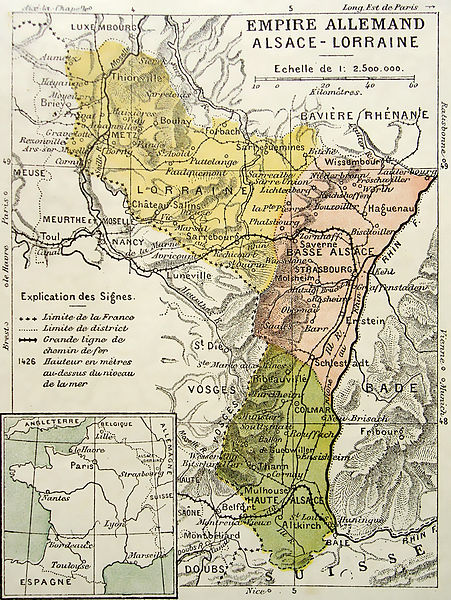
About the “borderlands” of Germany and France: I recall some long-ago history class lecture about the Alsace-Lorraine region of France being passed back and forth between German and French hands over the centuries. The cuisine, town names, and architecture make this blatantly obvious.
But I’ve only just learned that this geographic game of “hot potato” has continued into the 1900’s, and included some areas of the Rhineland-Saarland in Germany. In the 1870’s, the French lost much of the Alsace region—as far in as Metz—to the Germans, and it wasn’t returned again until 1918. On the flip side, my husband tells me that parts of the present-day German Saarland were only “re-Germanated” in the 1950’s.
About Snarky Siblings: This historical perspective makes me feel a little better about the “border disputes” that have been going on in our family since we moved into our Scooby Doo castle-house—we seem to be stuck in the “Hassle in the Castle” episode. The kids are constantly arguing about which room is better, who gets which room, who then lays claim to the room that falls between the two rooms, who gets dibs on the top floor of the house, etc.
Holy Crum! I think we are heir to two legacies here—the teen/preteen gimmees, and the French/German borderland disputes. That equals “land-grab squared,” and it ain’t pretty. Whatever developmental/hormonal forces are at play with my kids are ramped up by some sort of historical/geographic energy field that is beyond our control.
That’s how it seems… and it makes for the better story. Who’s to say that it’s not true? With a little parental intervention, our in-house border disputes seem to be slowly working themselves out. Let’s hope they hold more firm than their European historical precedents.
You have to draw a line somewhere, right? And we’re a funny species…we draw lines everywhere. But lines, once drawn, just ache to be crossed. I’m not excusing this conduct, I’m just saying it seems to be a pattern of human behavior, or human misbehavior anyway.
So when you build a massive defensive fortification on your country’s border–though it may be a project of mind-boggling innovation and preparation, though it may seem impenetrable–well, it just seems like pressing your luck to call it The Maginot Line. You are just begging for trouble.
But, of course, no one had to go begging for trouble in Europe in the late 1930’s. Trouble sat on your doorstep with a capital T. And I’m sure all of France slept better at night knowing that the Maginot Line held its eastern border safe when the Third Reich escalated its rumblings in Germany. Slept. . . until the rumblings got louder and louder. Until countries to the east fell: Austria, Czechoslovakia, Poland. Then the north: Norway, Denmark. The border: Belgium. Until the line did not hold.
For the most part, our local expeditions these first two weeks in Germany have been uncomplicated: vintage car shows and pastry shops. . . and more pastry shops. Mindless, sleek, or sugar-and-cream-filled offered a nice counterpoint to the stress of the frantic first two weeks: jet lag, radical re-orientation, frantic house hunting, and a litany of drivers’ tests, briefings, and meetings. But as life is beginning (just beginning) to normalize, it seemed time to pull our heads out of their eclair-induced stupors and really SEE something. And the first something that we really ventured out to see was pretty heavy stuff–perhaps not so much as a statement of gravitas on our part, but just owing to proximity and rainy weather.
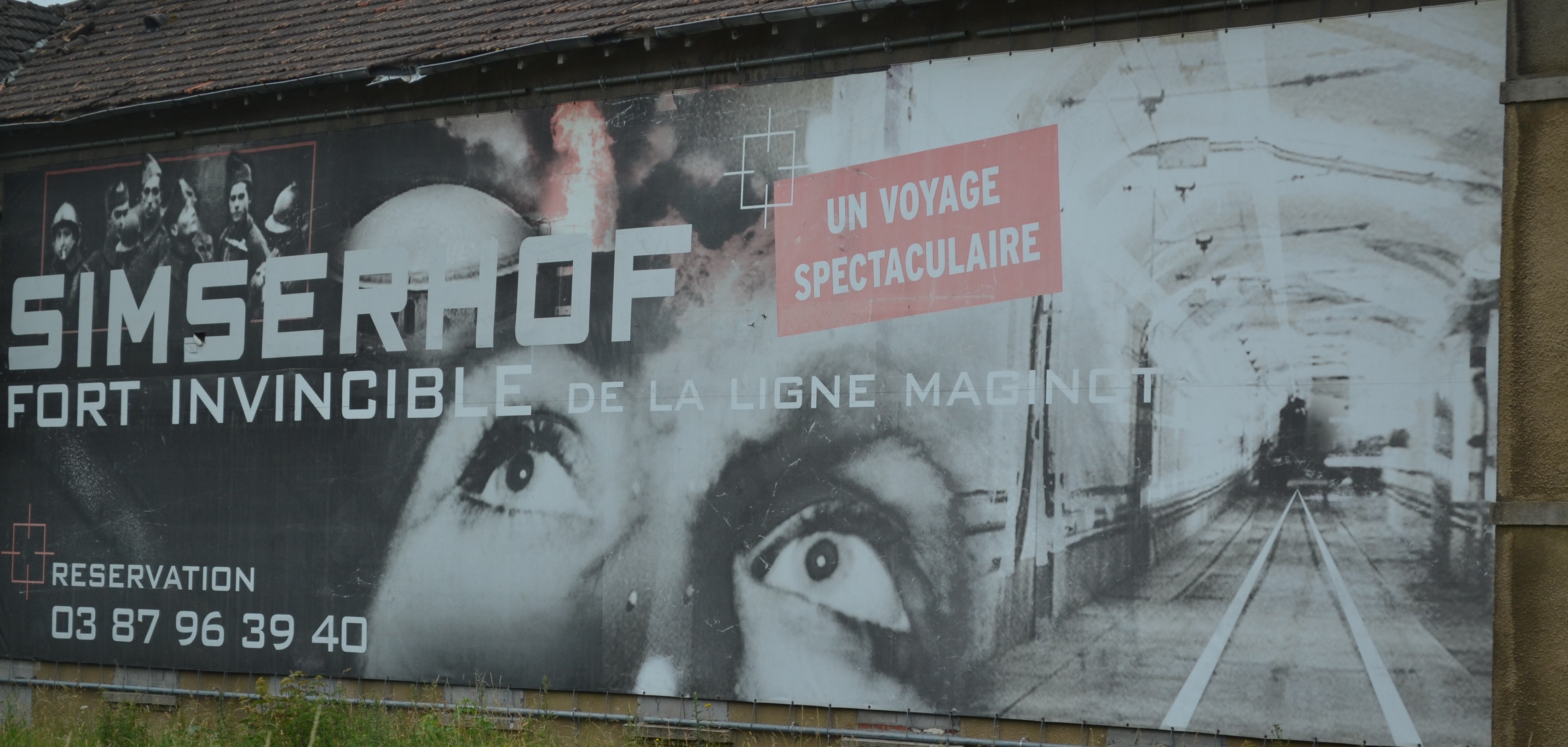
We ventured just over the French border to Simserhof, to tour a fabulously intact section of the Maginot Line: a series of unfathomably huge underground fortifications that were built to defend the French border from the sort of threat that had manifest itself in the nightmarish realities of World War I.
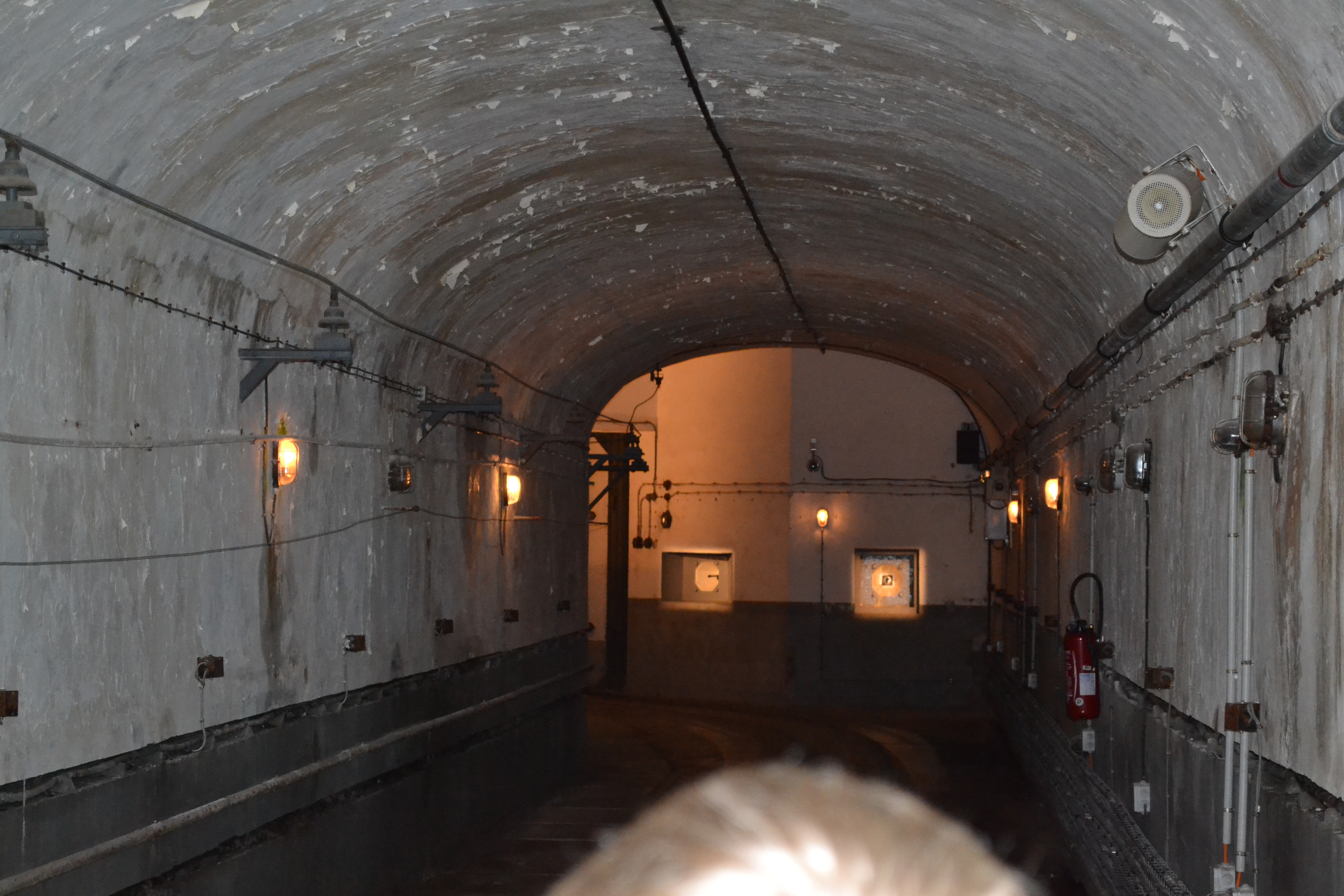
A tunnel into the living and working areas underground at the Maginot’s Simserhof location.
For all of the brilliance of these fortifications–and they are truly amazing–the battle that arrived at their doors was not the First World War’s long drawn out trench warfare, but some new beast. Where “the line” was static and uber-hardened, the blitzkrieg was fast, arguably precise, and offered an element of surprise. And surprises abounded: many thought the Ardennes Forest of Belgium was impassable to German tanks. Mistake. The Ardennes proved passable, and because of the break in Maginot line (it did not run along the border of Belgium), the Germans simply came around the fortifications.
It doesn’t pay to judge: hindsight is always 20/20. But foresight is harder won. (It’s true in our national foibles, and it’s true in our individual lives. Personally, I’m questioning the decision to buy an entire box of eclairs at Cora Market in France–it’s calling to me as I drink my morning latte and just begging to be polished off before lunchtime. Ouch.)
I wish I had taken more photos inside the facility, as it was fascinating and extravagant— not in it’s lavish interior (the interior was austere) but in the audacity of its scale and hopefulness. It is like a military base built underground–with weapons and munitions, electrical generators, a “trolley system,” a filtration system for gas attack defense, multiple levels and elevators, chow halls and a modern (for its time) kitchen for officers, a pantry stocked with wine and cheese, bunk rooms, a state-of-the-art infirmary, etc. It was optimistic: after the hellacious First World War, this facility contained the hopes and promises of a secure border and a fighting force that could be effective from the shelter of a secure and dry “trench” stocked with coffee and wine, with relatively warm beds, with fresh air to breathe, full bellies, dry limbs, etc. It was a desirable set up, but flawed. War is a trickster and a shape shifter, and the Maginot Line was inflexible.
I didn’t take more photos because my hands were shoved into my pockets and shaking. This underground facility is very cold! Our walking tour lasted maybe an hour, and the chill had plenty of time to seep into my bones. If one hour of subterannean life and lack of sun can do this to you, what would it be like to be underground for months on end, even without a battle raging above and around you? Mmm, I shudder just thinking about it.
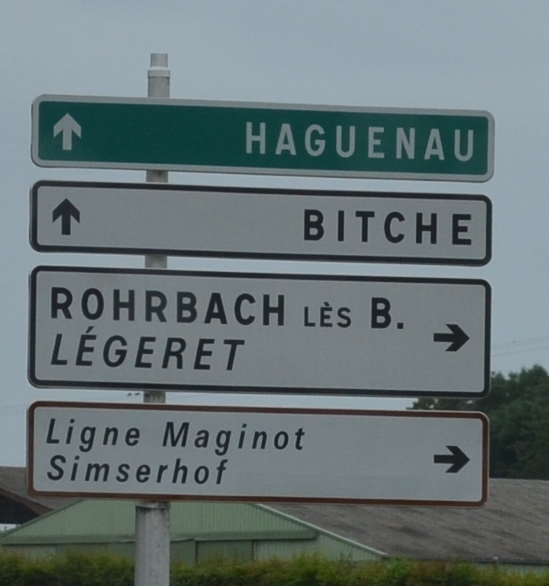
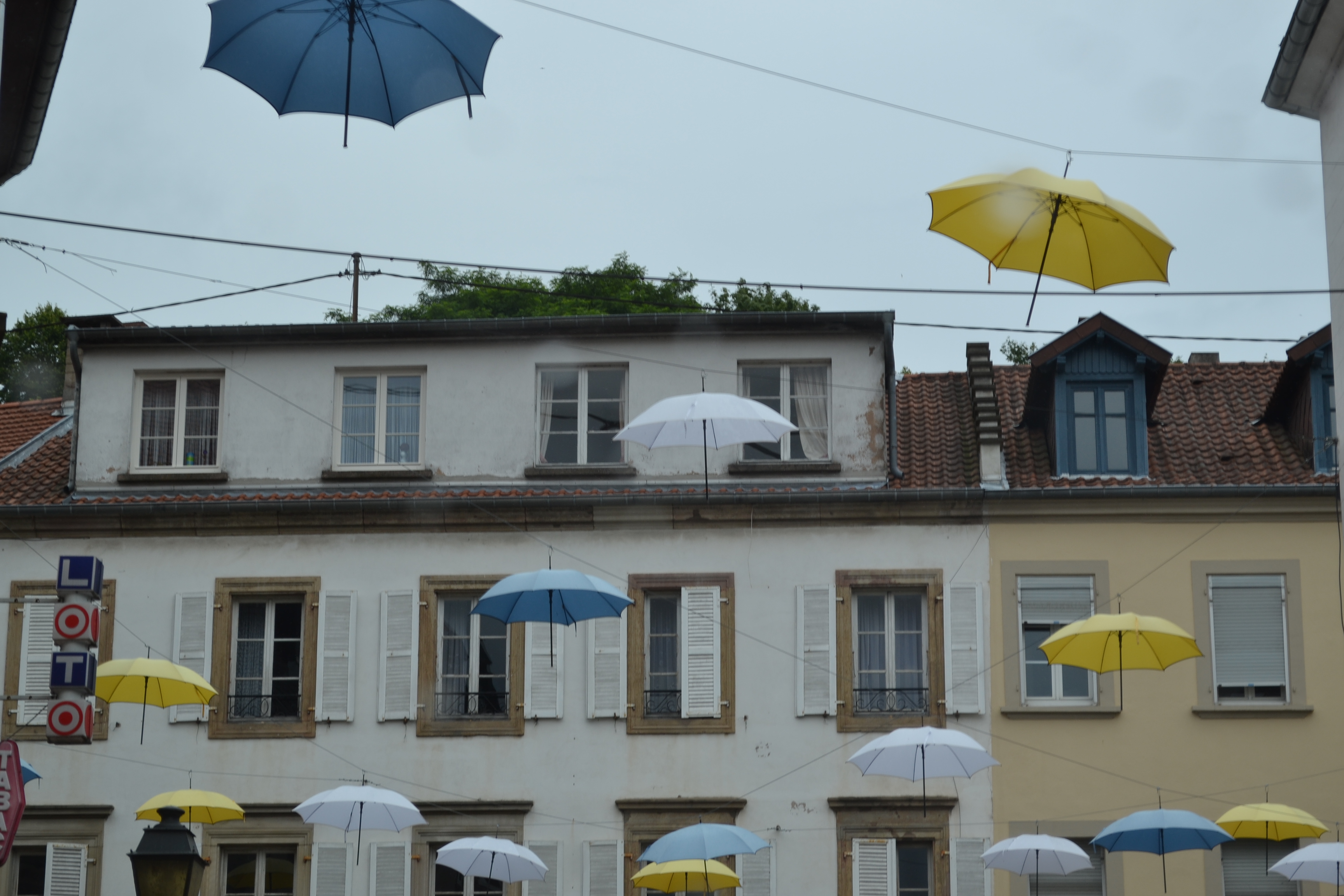
It’s a somber subject, but a fascinating place to visit. Simserfhof is located in Northeastern France, near Bitche (yes, Bitche) just over the border with Germany. Bitche offers it’s own sights to see–most notably its citadel on a hill. It was too rainy for us to tour the Citadel yesterday, but we drove through the town on our meandering way back home, and were delighted to see the following art above one of the town’s squares. A little levity was just what we needed as we left the Maginot Line and planned our own attack on the pastry counter of the Cora Market.


 Travels and Tomes: One Expat's Amblings and Ramblings