Candlemas and Groundhog Day–a belated primer

You and I tend to know February 2nd as Groundhog Day, candlemas riponbut it’s been a festival day for a long time, and its roots go back deep into the calendar of the Christian church, and far deeper still.  The day marks the midpoint between  the winter solstice and the spring equinox, so it’s considered the beginning of spring, or at least (if you live where it is still remarkably cold, like I do) the tipping point where winter and dark begin making way for warmth and light.
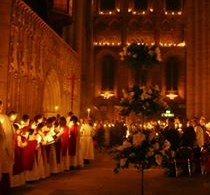
Candlemas is rarely observed in the church these days, but our old hometown of Ripon, England still honors the day.  The cathedral hosts a Candlemas service in the evening, and the cathedral is lit by thousands of candles.  To clarify–it is lit by thousands of candles only.  It is brillliant.  The first time I walked into one of these services, my children in their winter pajamas (they were young, and it was late and cold out), we all gasped and immediately whispered “Harry Potter!”   This is the best way I know to describe the look of the cathedral to a Candlemas novice or a wizard fan–think of Hogwarts’ great hall and its floating candles.  In Ripon Cathedral, the thousands of candles are set around the edges of the ground, in the clerestory ledges, and in every shelf and cubby along those ancient stone walls.  They appear to float and rise.  It’s heady stuff, and it’s one of the most beautiful sights I’ve ever seen.
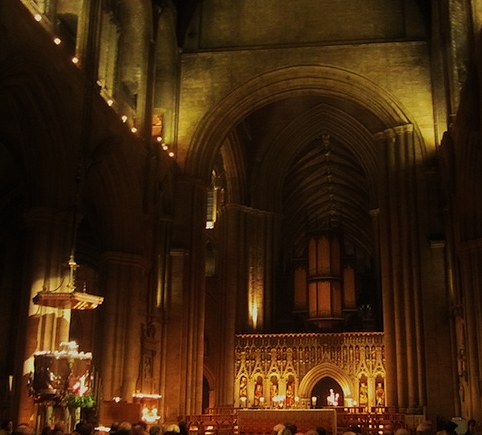
candlemas 2The Ripon Cathedral website posted the following blurb about Candlemas last year:

Candlemas is one of the most ancient feasts of the Church, and occurs 40 days after Christmas, on the 2nd February. It is also known as the Presentation of Jesus at the Temple, in reference to the episode in Luke’s gospel (2:22-40).
This ancient festival has been celebrated at Ripon for centuries. A visitor to the Cathedral in 1790 declared that the whole building was “one continued blaze of light all afternoon”.
This year, the Cathedral will once again shine with the light of thousands of candles, symbolising Jesus as the light of the world.

It’s good to know that, dark and cold as it still is (whether we are speaking of the weather and season, or of world events), we can look to a tipping point and the hope of spring.   (Even if Punxsutawney Phil is right and the next few weeks will be chill, spring must come some day.)  It is also good to know that, in a world of cultural globalization, where McDonalds is edging its way into every corner, you can still stumble on those few enclaves where something ancient, unusual, and beautiful will make you catch your breath. . . even if you find yourself whispering “Harry Potter” in the aftermath.


TBT: A Lucky Moment at the Tower Bridge, London

Raising the Bridge: London

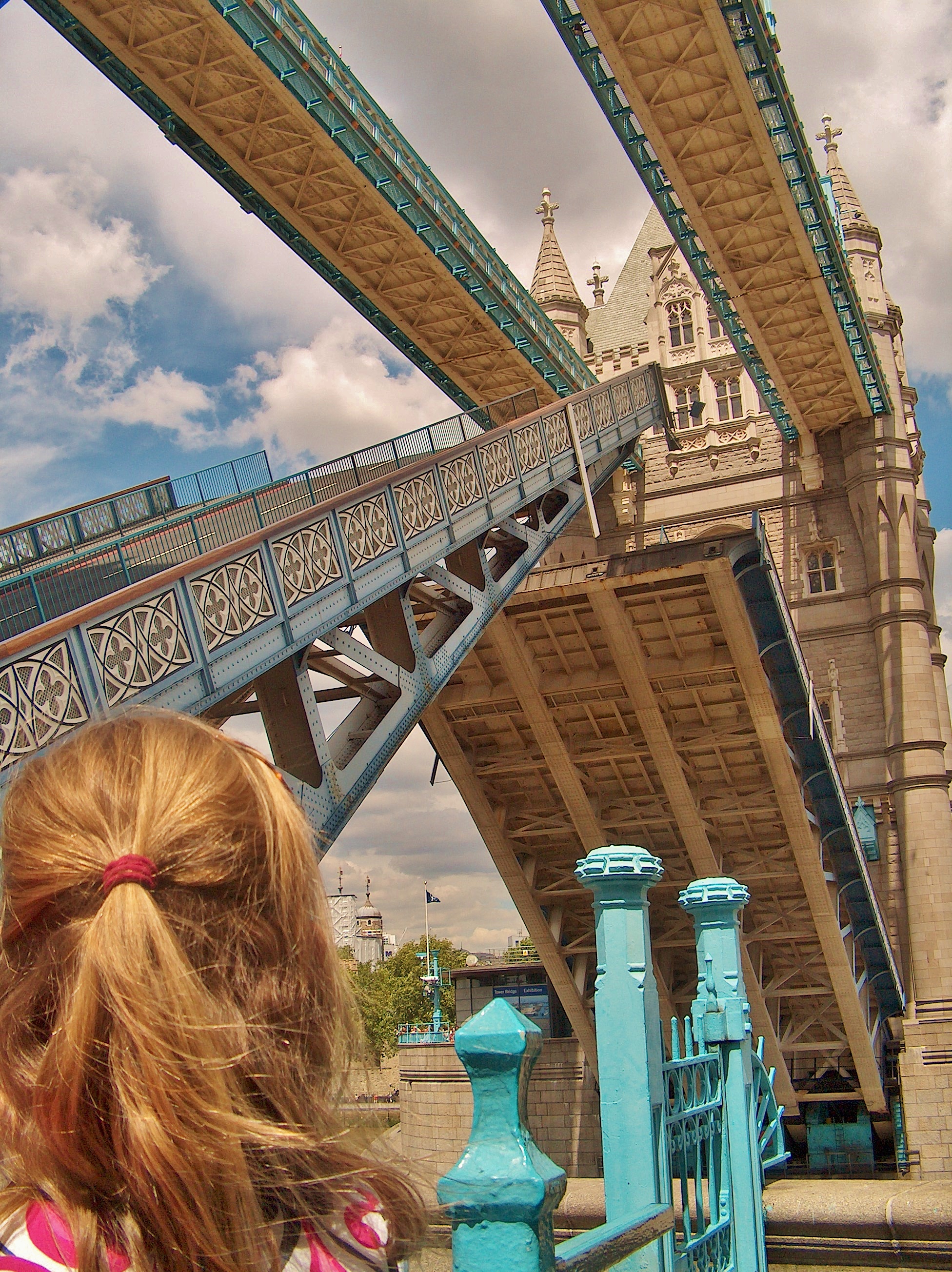
Here’s a lucky moment for Throwback Thursday:  the summer of 2008, on the Tower Bridge of London.   They say it brings good luck to witness the bridge opening (it doesn’t happen frequently)–and we were standing right on the bridge for the opening on this gorgeous summer day.

The bridge is iconic, but people often confuse it with “London Bridge”:  Tower Bridge is the visual you get when you think of London bridges, but the London Bridge (actually, a series of bridges over the centuries) originally stood about a mile west of the Tower Bridge. (More importantly, London Bridge continues to stand and fall, over and over and over again, on every children’s playground, everyday, in the Western world.  The origins of that nursery rhyme undoubtedly lay in some historical happening, but that’s a story I haven’t delved into.)

tower bridge wiki commons
Tower Bridge–the view we all know, courtesy Wiki Commons


The Tower Bridge  was opened 1892–at a time when London’s population was growing exponentially and a Thames River crossing bridge that could accomodate more traffic was desperately needed.

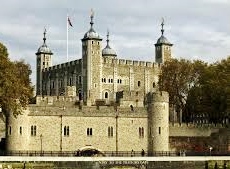
Tower of London
Tower of London

The beauty of the bridge lies in its appearing  to be made of stone–making it the visual twin of the Tower of London (just beyond it, on the shore).  However, the bridge is actually formed of tons (and tons and tons) of steel. After the steel structure was formed,  granite and stone were added to cover the exterior and create the signature look.

So there you go–a little history and a lucky moment.  Happy Thursday!


Engineers and Van Goghs–The Cogs and Brushstrokes of Language

m twain awful german lang


Another chapter in my struggle with the German language–a tragicomedy.

I’m back in a rudimentary German class and progress is slow.  I am learning. . . just not quickly.  And it doesn’t help that I spent the first two months sitting next to a Scotsman who looked like a young Paul Newman.  Honestly, Deutsch can’t compete with that.   So I’ve moved seats.

I sit closer to the back of class now, and I find it very interesting how different people react differently to class exercises.  There are only a few of us left in the class–where we started out with 25 or 30 in October.  That number was cut in half by Christmas, and has shrunk even more now.  (Apparently, I’m not the only one who finds German difficult.)  But here’s what I’m seeing:  Some people take nary a note and just listen to the exercises and explanations. Other people write down every syllable spoken in class, never lifting their heads from their notebooks.  Some fall in between (like me)–but each with their own quirks.  One classmate has made copious “cheat sheets” to refer to to help him with articles in various cases (nominative, genitive, accusative, dative); one has written down every vocabulary word we’ve ever spoken and highlighted the genders of nouns; one rocks back and forth slightly whenever trying to remember the gender of a noun.

Me?  I fall in the middle ground lot–writing and pausing to listen; listening and then trying to catch some notes on paper after the fact.  But my quirk is spacing out.  Now that Paul Newman is less of a distraction, I’m people watching my fellow students’ classroom habits.  But I’m also constantly pausing over the whimsy of the language.  I lost a good ten minutes in class the other day after learning the word “Fernseher“–TV set.  The minute it fell from my teacher’s lips, my hand shot up.  “How does that translate literally?”  “Far see-er.” she said.   How fabulous and retro!  The TV set, that box in the corner of the room that opens a window into other people’s worlds or other cities’ news–the far see-er box.  I was consumed for a few minutes by images of people sitting around the earliest TV’s, like characters in a sci-fi B-movie, gazing at far away places through static and wiggly lines.  Magic!   How great is that?!  I suddenly liked the German language again. . . and then I started wondering about other funny words.   There’s the stuabsauger (dust sucker–the vacuum).  And , oh–Kindergarten!   That would literally mean “children’s garden.”  A place for all of the little buds to grow tall and bloom!  How funny–perfectly logical and spectacularly whimsical and visual all at once.   And then, I started wondering about other words in English that I’ve never really thought about.  Well, “television,” for one.  I suppose that means “seeing from a distance.”  Well, there you go.

And there I went–having missed 5 or 10 minutes of what was going on in class while I pondered the whimsy and logic of language.  And while my classmate studiously referred to his charts and cheat sheets on cases and declensions, while the person to his left concentrated and rocked slightly.

And so it seemed crystal clear to me that there are two basic types of people in a language class:  the engineers and the Van Goghs.  The engineers get the specifics down precisely and probably become very efficient at running the language in the direction and at the speed that it should best run.  They build their language skills cog by cog.    The Van Goghs are a different beast.  We enjoy the broad brush strokes of language.  We are intent on communicating, and would like to do it well–we are just less geared (excuse the pun) toward the efficiency of communication and more toward the bright colors, the swirl and flow.  I tend to fall into the structure of German fairly well (okay, rudimentarily well)–the crazy, slipperiness of German verbs that like to come first, last, or middle of a sentence, depending on the sort of message you convey.  I get that on an intuitive level.  But noun genders, and German cases and article and adjective endings, they are less intuit-able to me.  They take a chart, or a precise cog in the brain (cut to measure and carefully placed just so).  They take a mind that sticks to its charts and does NOT slip, trip, and travel over the whimsy of a word in the middle of class.

It might be nice to have an engineer’s mind when you are trying to communicate with the travel agent or sort out your power bill at the municipal power office, under the stern gaze of the German office worker.  But, all in all, I wouldn’t trade it for the slips, trips and whimsy of the brain I have.    Efficient?  Hardly!  Amusing?  To me . . . and that’s enough to keep me happy, and to keep me going back to German class for the time being.