All I Want for Christmas is a Ghost

It’s been a long time since I’ve written a This Old House post, but here goes.

We loved the atmosphere of this house from the first moment we saw it.  We have continued to love those moments when you turn the corner toward our house and– “Ta Da!”– you see the oh-so-European red stone castle (albeit diminutive) that we call home.
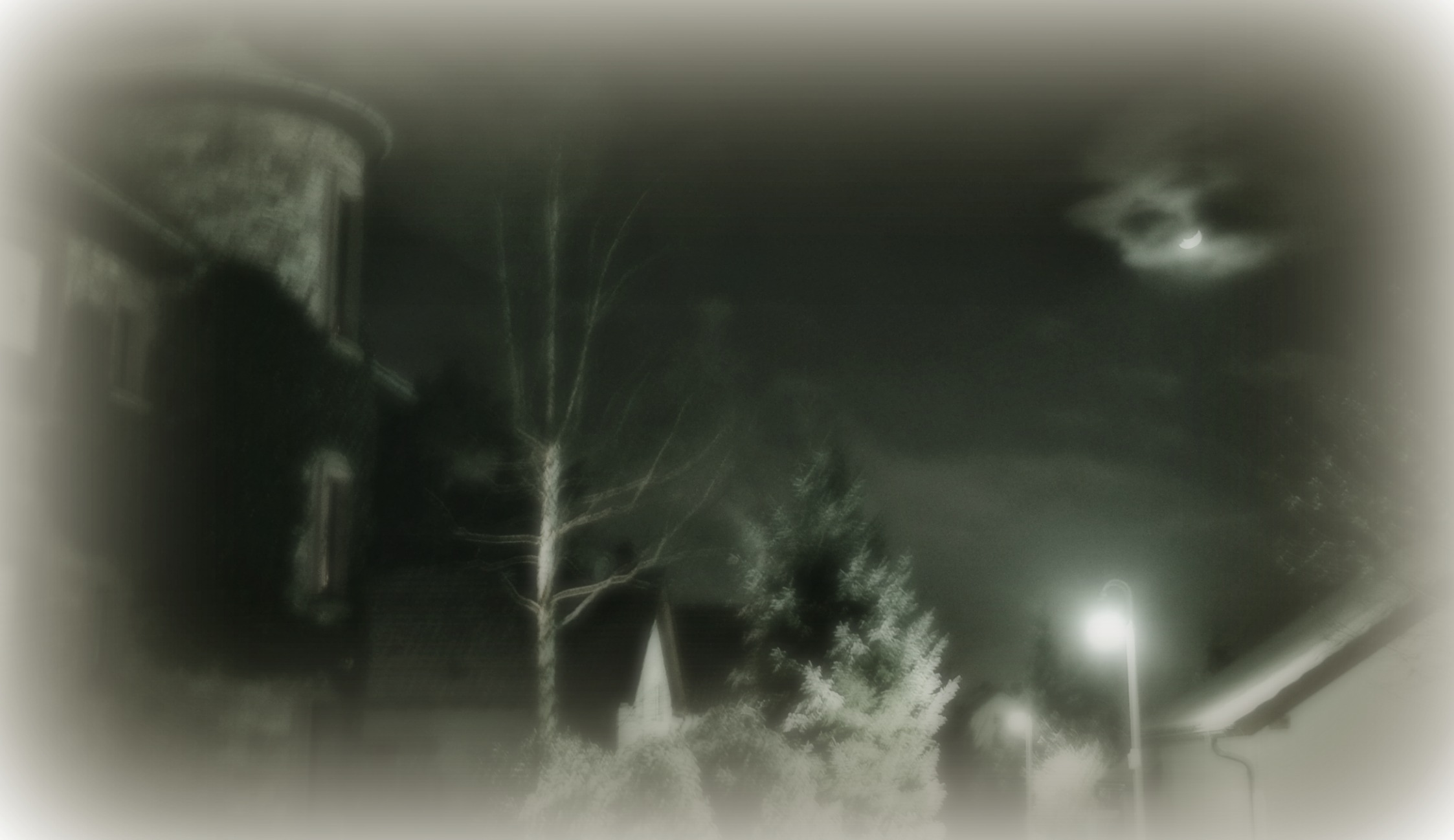
ghosty snow house moon
A foggy winter night at “the castle.”

We moved into the house a year and a half ago, fully aware that an old house would have its share of issues: hot spots, cold spots; inefficient utilities; old bathrooms; pipes that occasionally clog; and light fixtures that give up the ghost.

But we also considered that the ghosts of this house might not be the giving up kind.

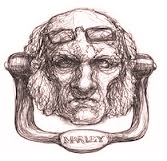
“Marley was dead, to begin with … This must be distinctly understood, or nothing wonderful can come of the story I am going to relate.”  Dickens, A Christmas Carol

Creative Commons licensing

 When we first moved into this old home, I harbored a secret fear and longing–a uncomfortable pairing– that the place might be haunted.  It was the right sort of house for that:  imposing, old, creaky, and definitely situated in a country with its share of ghosts.

I was terrified that we’d be plagued by eerie happenings.

 But then nothing happened.  

Eventually, I became simply curious about whether eerie things might happen.

Still, nothing happened.  

After a while, I was just put out that nothing, not one darn thing, spooky had happened.  What a rip off!  I have to live with old (I mean OLD) bathrooms, and I don’t even get a good ghost story out of it!?  Not a fair trade off if you ask me.
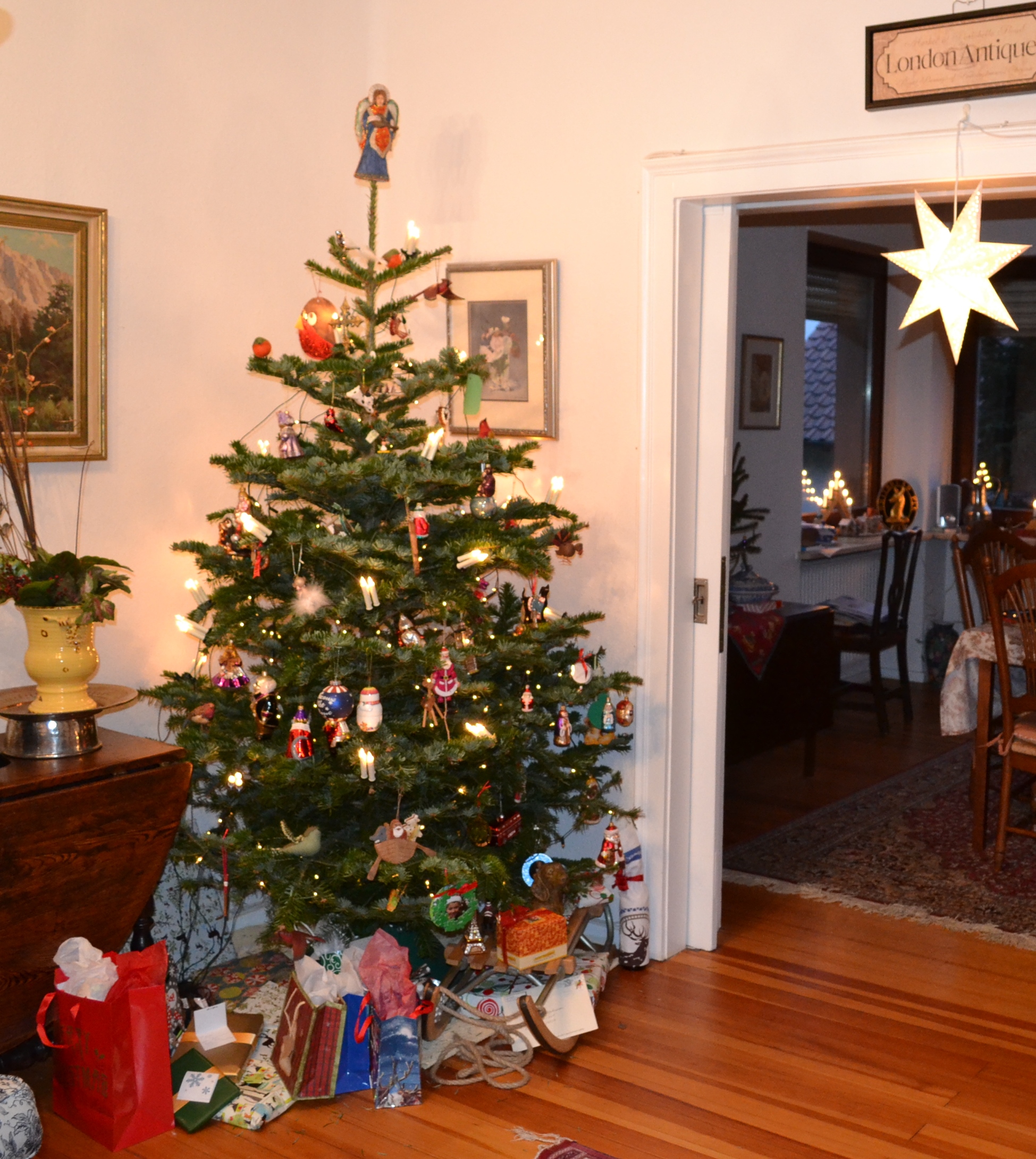
DSC_0300 - CopyBut ghosts are people too, and they have their own agendas.  I remember putting up Christmas decorations last year and wondering what sort of celebrations this house had seen over the century-plus of its life.  It’s no manor, but it’s grand enough that the original owners must have lived a fine life.  What was Christmas like for them?  Did the Christmas Eve table gleam with silver?  Was it loaded with salmon, goose, and sausage?  Did the children go to sleep fat with gingerbread and the parents groggy with spiced wine?

And what of the years after World War I, when French troops occupied the area?  Was this a dramatic change, considering this area has always been a source of border disputes?  Was the occupation a barely perceptible weight on the shoulders of the locals who must have been haunted by their own grief, so many young soldiers lost in the war?

And this interplay of politics and personal life certainly wasn’t diminished in the years that crept toward World War II.  What about those Christmas dinners?  Were there rousing nationalistic talks around the table, was there support for the Third Reich, or was there dread at the creeping dark?  Were Jewish friends hidden in the cavernous basement to keep them safe?  Were Nazi armaments held there? This is the era whose ghosts send icy chills through me.  I want to know the house’s history, but I don’t want to know the house’s history.
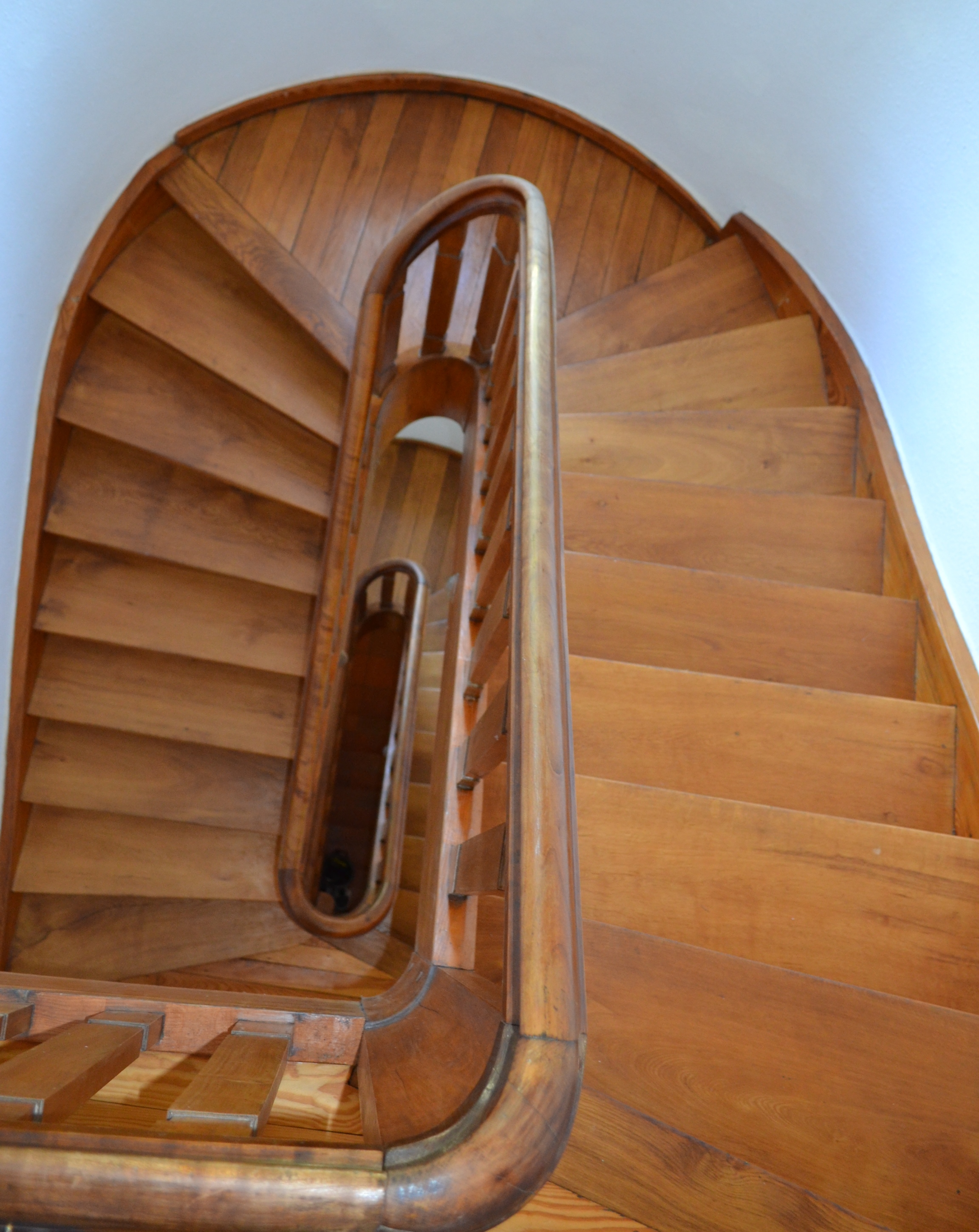
Staircase between floors/apartments

And then after World War II, when the house was divided into apartments on each level–still lovely, but divided,  like Germany itself, by the rise and fall of its fortunes, ambitions, and fate.

Reverence or dread–the families who have lived here might inspire either.  I would revel in the one, but stoop under the weight of the other.

It’s better not to know, I tell myself.

Still, I want a ghost for Christmas.  I can’t shake that feeling.  It’s part of the old house package.

“The past isn’t dead.  It isn’t even past.”  -William Faulkner

I had a ghost once, a few years ago.

I know, I know–just hear me out.  This is a story that is usually told under different circumstances.  The general rule: you must be at least a glass of wine or two into the evening; for that matter, I must be at least a glass of wine or two into the evening; at that point, it all makes more sense.  And one more thing–the children aren’t around.  If they heard the story, they’d never sleep again.

I’m taking a risk in telling this story: first, I can’t be sure that you’ve had any wine (strike one); second, it’s 8 a.m., and I’m nursing a semi-cold cup of coffee, which is a much starker place to be than wrapped in the warmth of a wine glass (strike two); and third, my children may read this (although unlikely, as they find this “mommy blog” vaguely ridiculous) (strike three on two counts then).

So here’s the deal–I’ll tell you my ghost story tomorrow.  That gives you a chance to grab a glass of wine, if you are so inclined.  It gives me a chance to write this post in a foggy evening state, instead of this stark-morning-coffee-mind that has its current grip on me.

Meet me here tomorrow, if you dare, and I will tell you my ghost story.
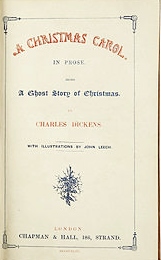
chistms carol page

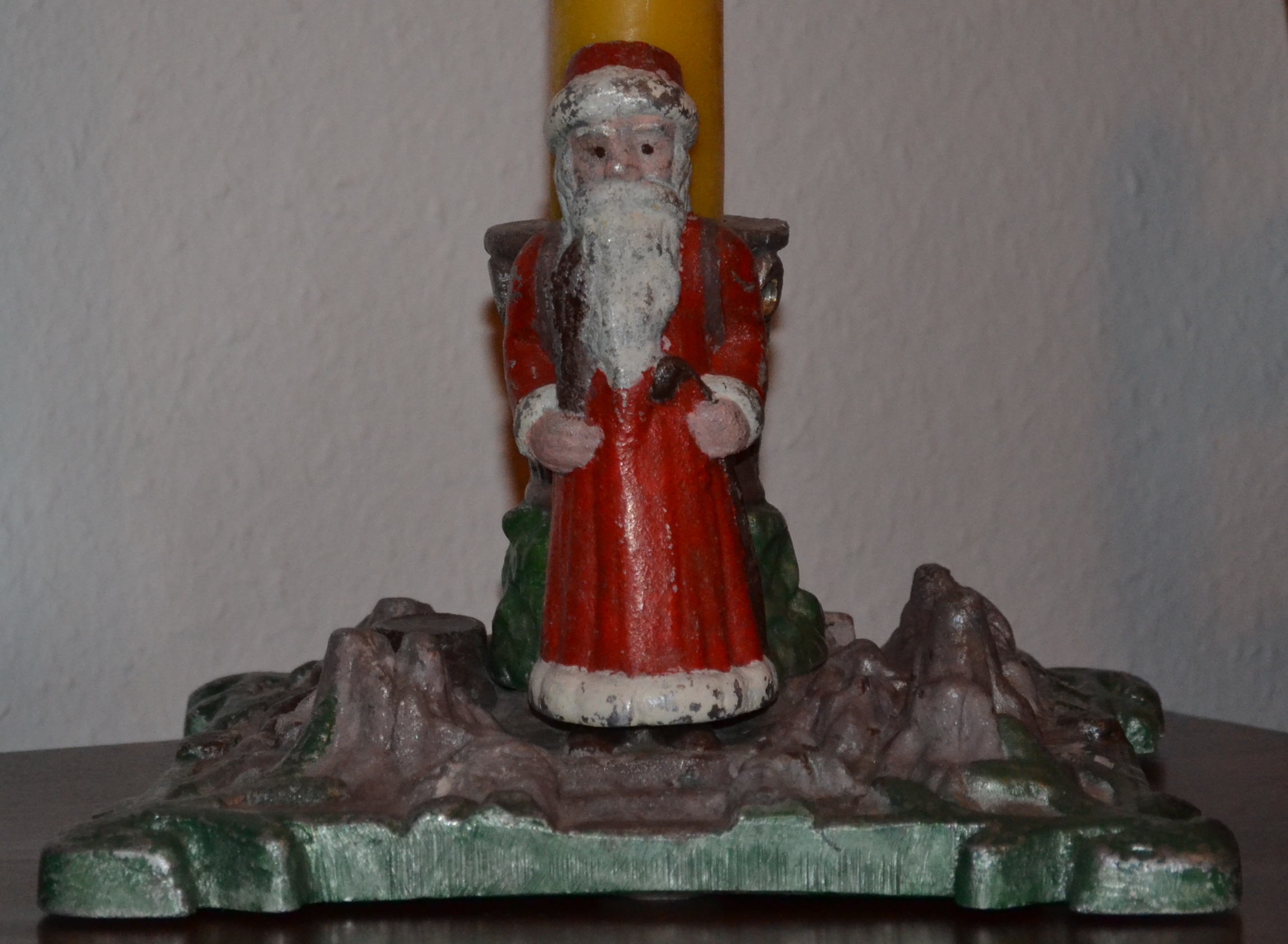
Jolly Old St. Nicholas

I’ve been thinking a lot about our friend St. Nick lately.

DSC_0116 - Copy

About his many incarnations; about his naughty and nice list; about the fact that some of his incarnations belong on naughty lists themselves; and about the actual man that inspired this mythical being with modern day rock star status. Really . . . just what kind of mortal could inspire so many, and such enduring, legends?

Who was Saint Nick?  Nikolaus* of Myra (present day Turkey) was a Greek bishop during the 4th century.  Many miracles are attributed to him, but his most enduring legacy is probably his generosity.  As legend has it, he sought to relieve poverty through the giving of secret gifts.  Most notably, there is a story that he sought to ease the plight of three young girls.  Their father could not afford to pay a dowry, so they were doomed to a life of poverty and, quite probably, prostitution in order to survive.  Nikolaus secretly tossed three purses of gold coins through the window of their home (this, obviously, before his chimney shenanigans in later centuries).  One version even posits extra detail–some of the gold fell into a stocking that was hanging up to dry in the house.

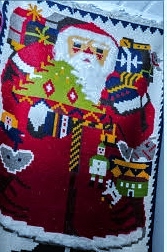
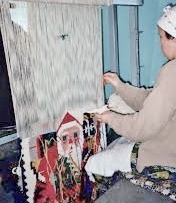
It is a long and winding road from the life of the actual man to the variety of legends that we find today–and it is a great variety–but they all contain the kernel of his truth. turkish st nick kilim There’s not much I can add to that truth–I’m no scholar on saints or on Nikolaus.   I can, however, tell you that he is still remembered in Turkey as a great man.  He is also embraced, to some small extent, in his modern Western guise–albeit largely for profit and the selling of kilims.  There is a town in the eastern Mediterranean region of Turkey (I wish I could remember the name, but it’s been 16 years since I was there!) where we watched women weaving Santa Kilims.   We bought a number of them, for ourselves and for our family.  We still hang turk st nick kilim at loomours proudly each Christmas season. . . but we spray it with Lysol each year. (Sorry Santa, but I think you were woven with some raw wool, and you do carry a distinct old world smell that requires a little airing out. I don’t really mind–the way I see it, you bring a little of the Bethlehem stable into my house with you, and that keeps me focused for the season.)

About that variety of legends–I don’t think that we feel it much in the States.  Our Santa is a homogenous and modern being–jolly and round, always in the same red and white costume,  and, yes, generous to a fault (is there such a thing?).  The menace of his judgment (his naughty and nice list) seems hardly menace at all–unless you’ve been outrageously naughty.  It happens.  Still, with late season penance, it all turns out well.   Seems straight forward.

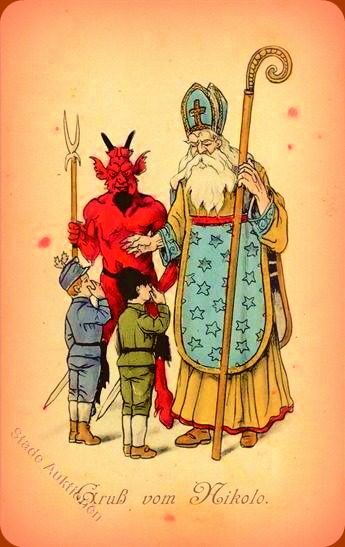
Victorian St Nick and Krampus

But it seems less simple in Middle Europe.  Here, the judgment is real and the  punishers are frightening.  Easy salvation?  That’s for American weenies.  Here, you’d best practice good German diligence and industriousness, and even then the day will come when you have to stare down a devil for your Nikolaustag (St. Nikolaus Day) chocolate.  Yes, a devil.  Where goes Nikolaus, so goes his dark counterpart (with many faces and names, depending on the region of Europe).  Good and evil, naughty and nice–they take it seriously in Germany.

I won’t go into great detail here about St. Nick’s draconian counterparts, as I’ve written a lot about them in the post Saints and Devils, Fire and Snow .  However, I will add a few insights from a conversation I had recently with a Bavarian woman.  I met her on December 5th– Nikolaustag Eve (“boot night” in Germany, when children put out   boots for Nikolaus to leave candy in . . . but sometimes get visits from the grim sidekick instead or get ashes and coal if they have been bad).   She told me

Friend or foe, funny or frightening?

that the children around Rothenburg ob der Tauber have traditionally not celebrated on December 6th, but rather on November 11th.  When she was young, that was when Belsnickel (or Pelsnickel) would visit.  Belsnickel was a fur-cloaked character, rather scruffy, who seemed to combine both the surly (Krampus, Ruprecht, etc) and the kind (Nikolaus) into one being. He carried a sack with both treats and switches.   Belsnickel might judge the children and either punish or reward them; he might toss candy around the floor for them, and then paddle their backs with twigs as they scrambled for the candy; or he might be more elfin and be more mischief prone than malice prone.   He might be a lot of things, said my new friend; however, when November 11th came around the children were really quite scared of what would come for them.

I asked this woman, once more, “And he came on November 11th?” “Yes,” came the answer.  That seemed so  early in the season to me.  I looked the date up later and found that November 11th is not only Belsnickel, it’s also Martinstag– that’s Reformation Day, a celebration of Martin Luther and the Reformation.  Ah, yes, this was beginning to make more sense to me.  If you are celebrating the Reformation, why not scare the pants off of the children, and then reward them with goodies?  Spare the rods, spoil the souls of the children.  So very German, this Christmas cocktail: hell fire and brimstone, followed by a chaser of sweets and gingerbread.

Never a dull moment with these old European traditions.  Is it awful that Christmas time boasts its own terrors and devils?  Is it harsh?  Absolutely. . .but, then again, it has some appeal.

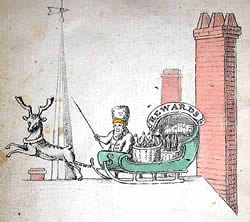
Sante Claus The Children's Friend, 1821 William B. Gilley, publisher
Sante Claus
The Children’s Friend, 1821
William B. Gilley, publisher

I could do without Krampus devils giving my kids nightmares, but I do start to think that the American Santa is a bit fluffy.   I don’t mind him being “the love-meister,” if that’s really his focus, but when it’s all about giving out the stuff, and then more stuff– well, the guy needs to stand up for his principles.  Let’s get back to the core of the man: not necessarily a tale of saints and devils who come for your children, but at least the tale of the saint.

Be jolly–yes, please be jolly– but also please be Saint Nicholas.

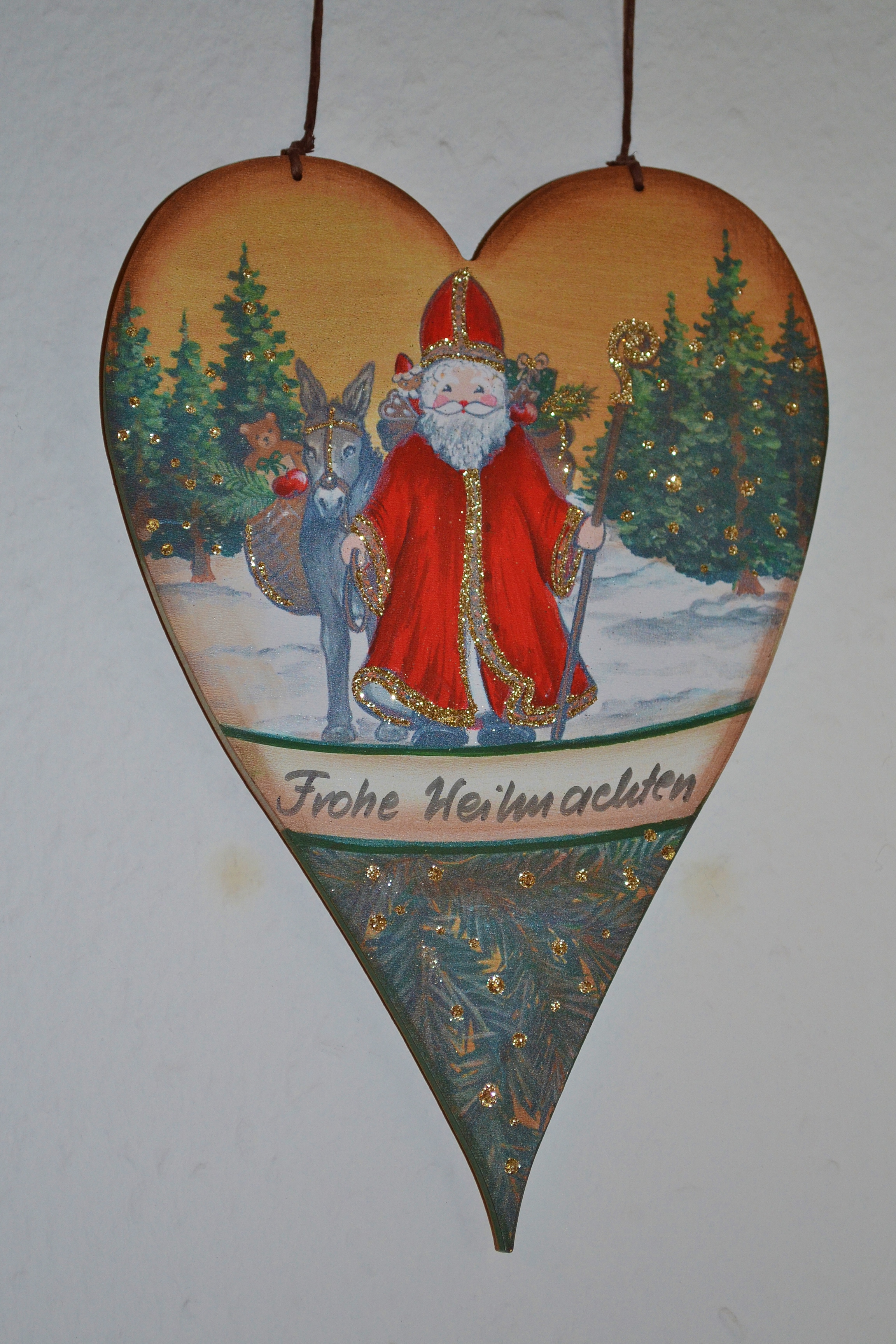
Merry Christmas, Joyeux Noel, Frohe Weihnachten . . . 

DSC_0195

*Nikolaus, Nicholas, Nicolas–so many traditions, so many spellings.

Christmas Markets: Germany, Luxembourg, France

Now that we are knee deep in December, Christmas Markets are in full swing.  So far, I’ve cruised through four of them.  Here are some photos and observations.

DSC_0072
Bernkastel-Kues

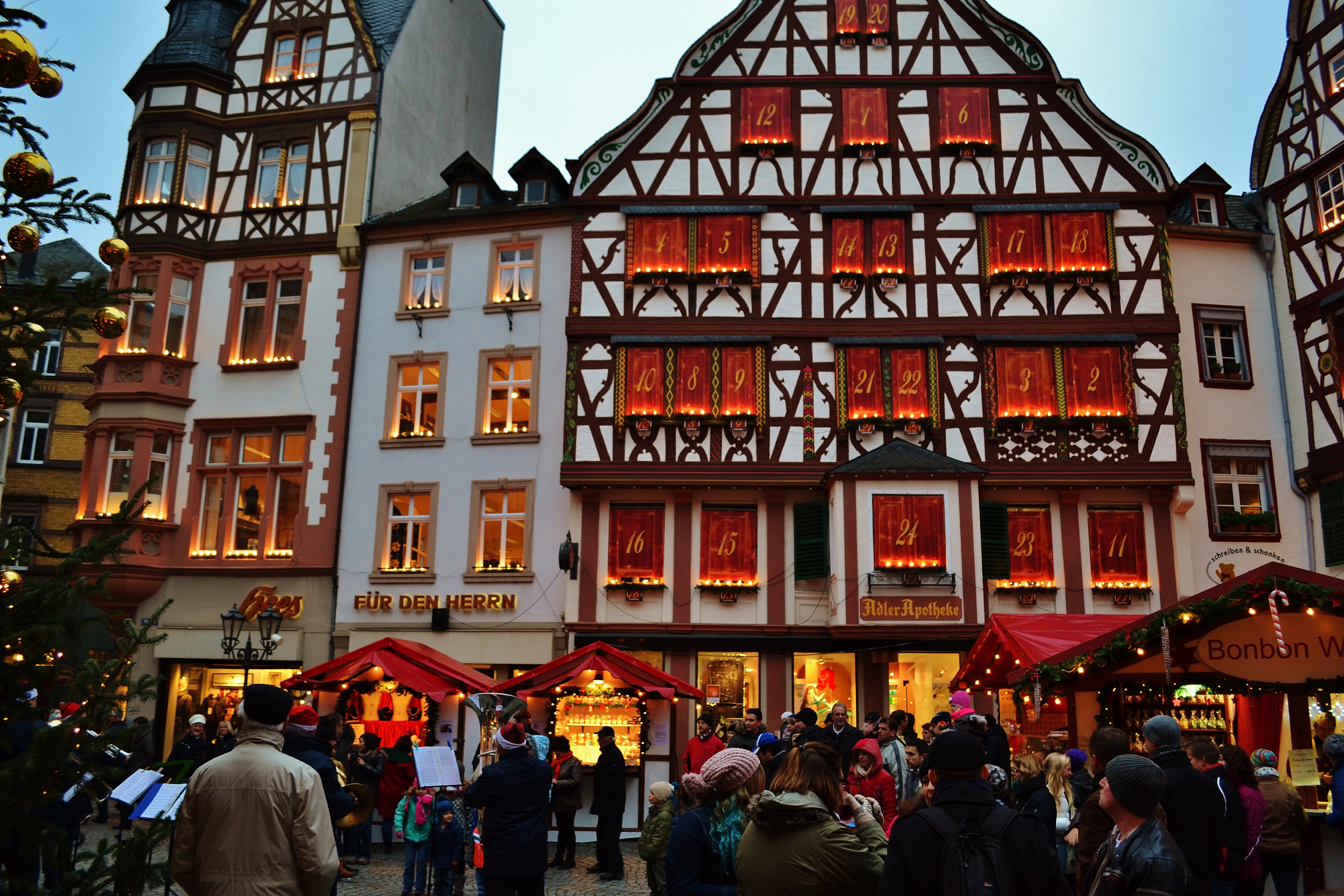
Our first market of the season was Bernkastel-Kues, on the Mosel River, which I wrote about in my “And the Season Begins” post.  It’s one of my favorite small German towns, and the market is equally fabulous.  Being there in the evening, or just as dusk falls, is the best–the markets (all of them, as far as I’ve seen) really become magical when the lights are twinkling at dark, or in a hazy swirl of snow.  Plus, Bernkastel has an old world feel that’s undiluted here, but often more watered down in  larger cities (where busy, modern shopping areas stand side by side with older architecture).

DSC_0666
Luxembourg City

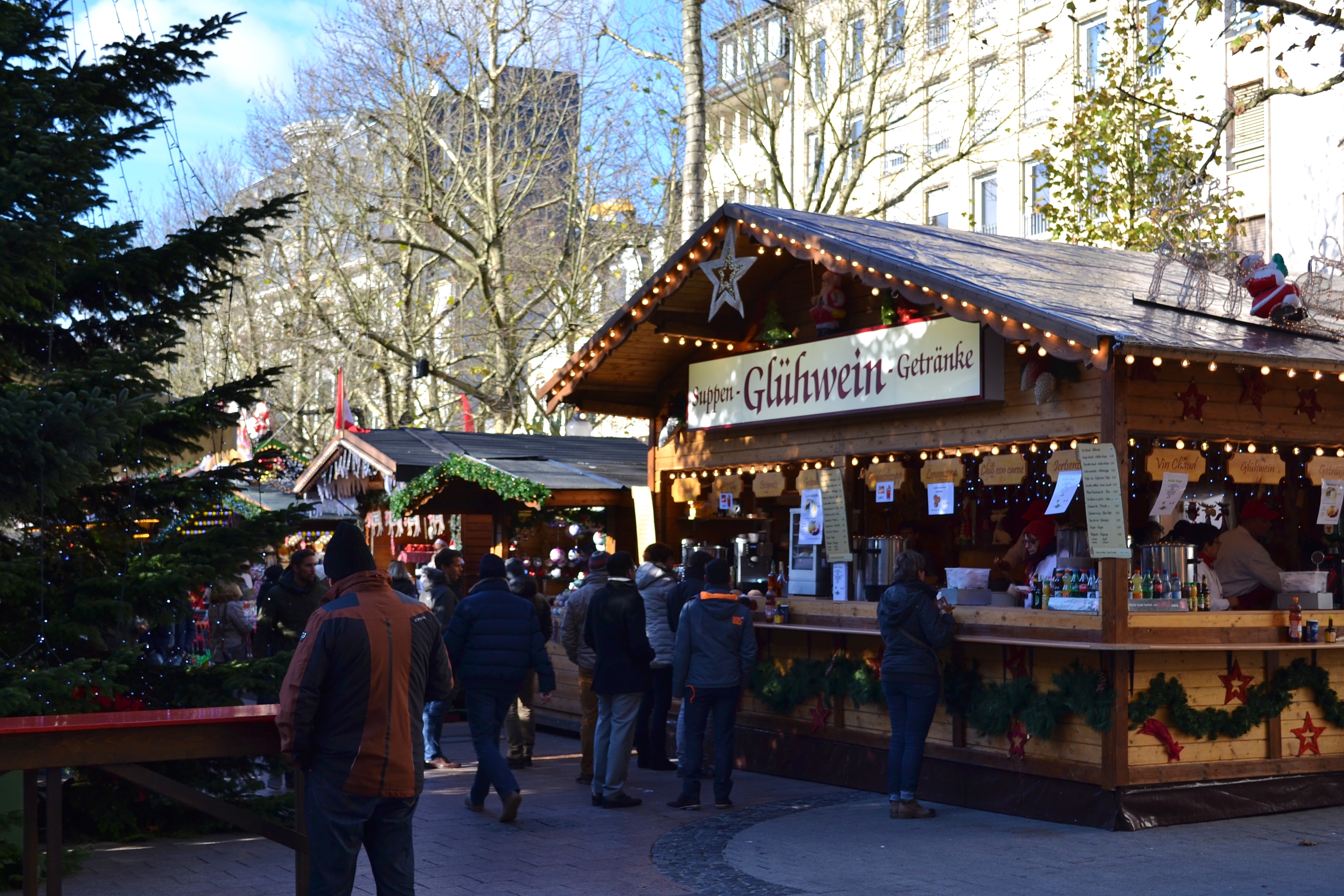
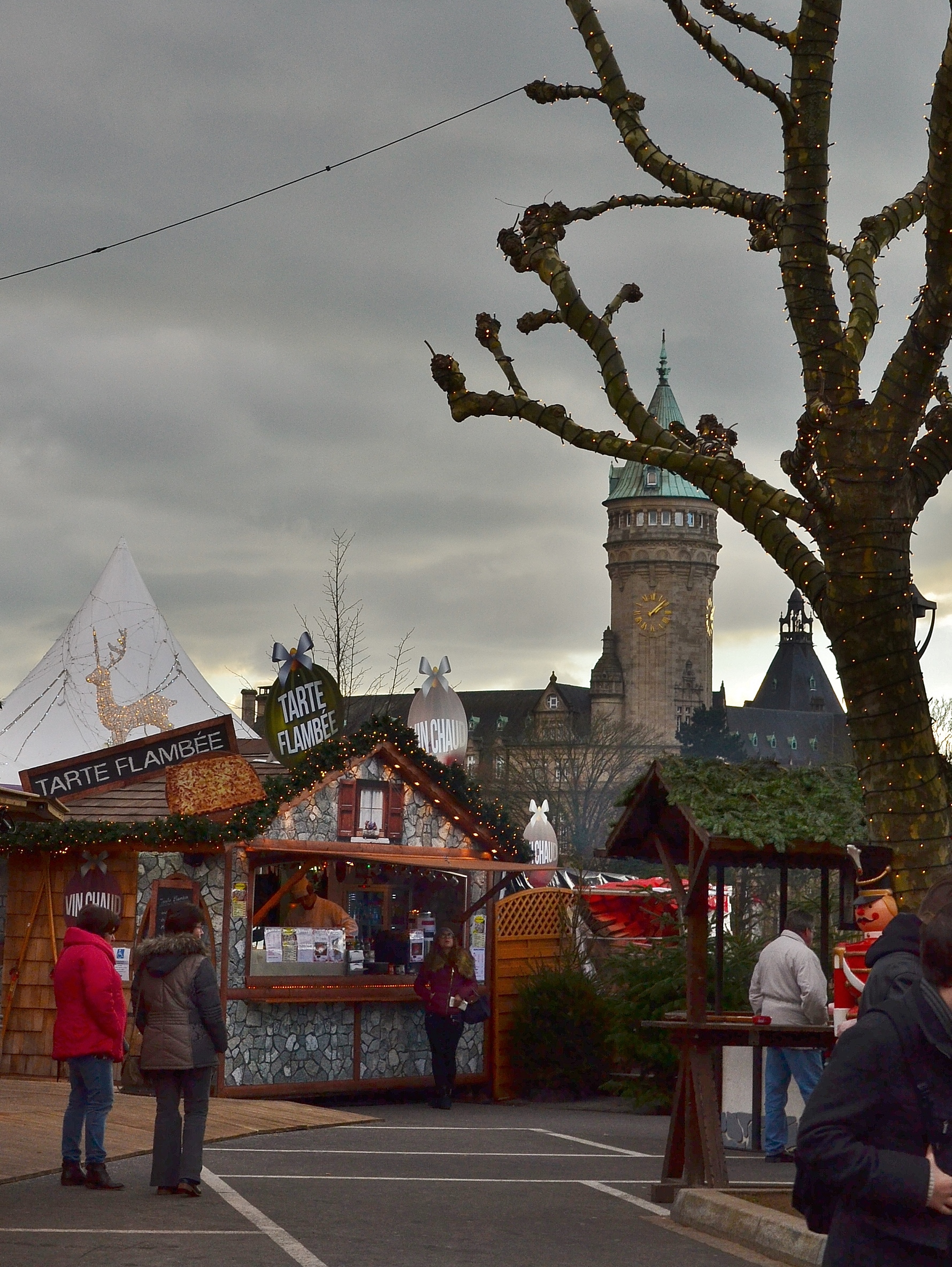
DSC_0673My next adventure in Gluhwein and Gingerbread was in Luxembourg City, the week of Thanksgiving.  It was a sleepy Monday, and the market was just beginning to wake up for the season.  The day was bitter cold, so the hot gluhwein and potato pancakes there were greedily gobbled out of both desire and necessity.  And after a glass of gluhwein, I wandered into a store with a friend and bought a big fuzzy mohair sweater.  Later that night, I wondered if that was a wine-induced mistake:  I look a little like giant grey blueberry (greyberry?) in it. . . but I’ve worn it a lot since then.

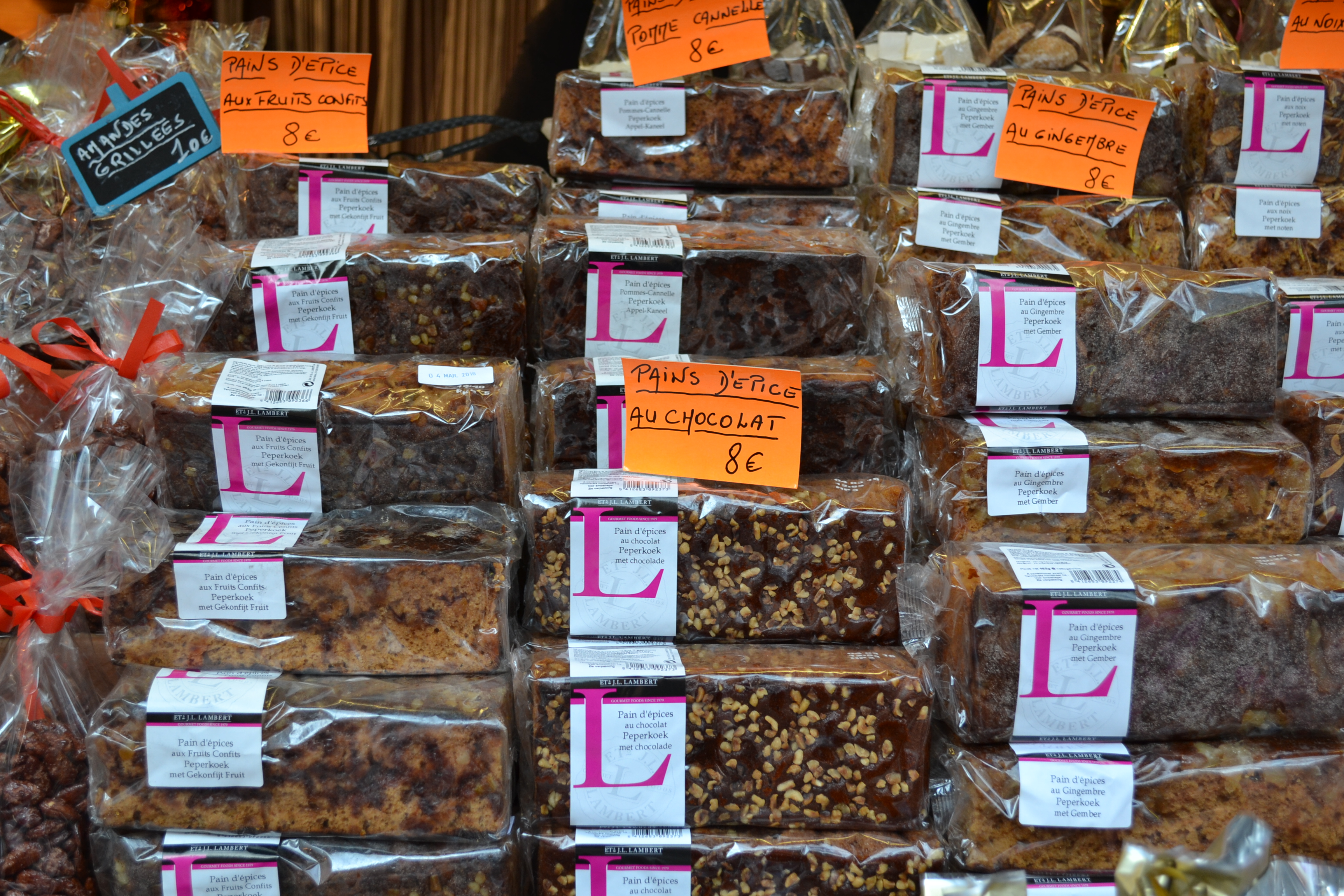
Pain d'Epices (gingerbread) in Luxembourg
Pain d’Epices (gingerbread) in Luxembourg

Turns out that, ridiculous as it looks,   it is very warm and cozy on a winter day, and sometimes that’s not a bad trade off for looking like a Fruit of the Loom character.  It also hides any extra pounds you might accumulate walking around markets eating potato pancakes and gingerbread.


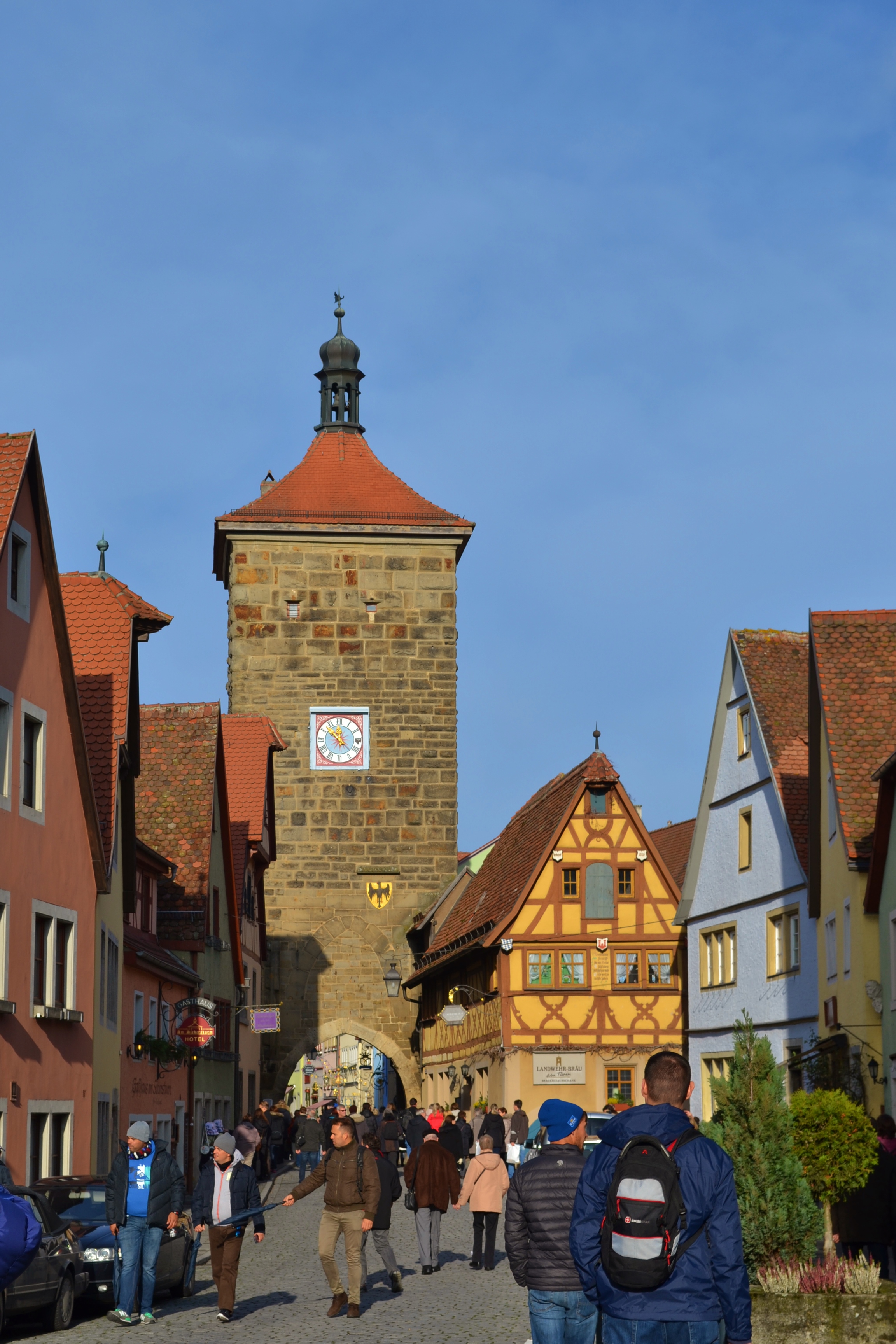
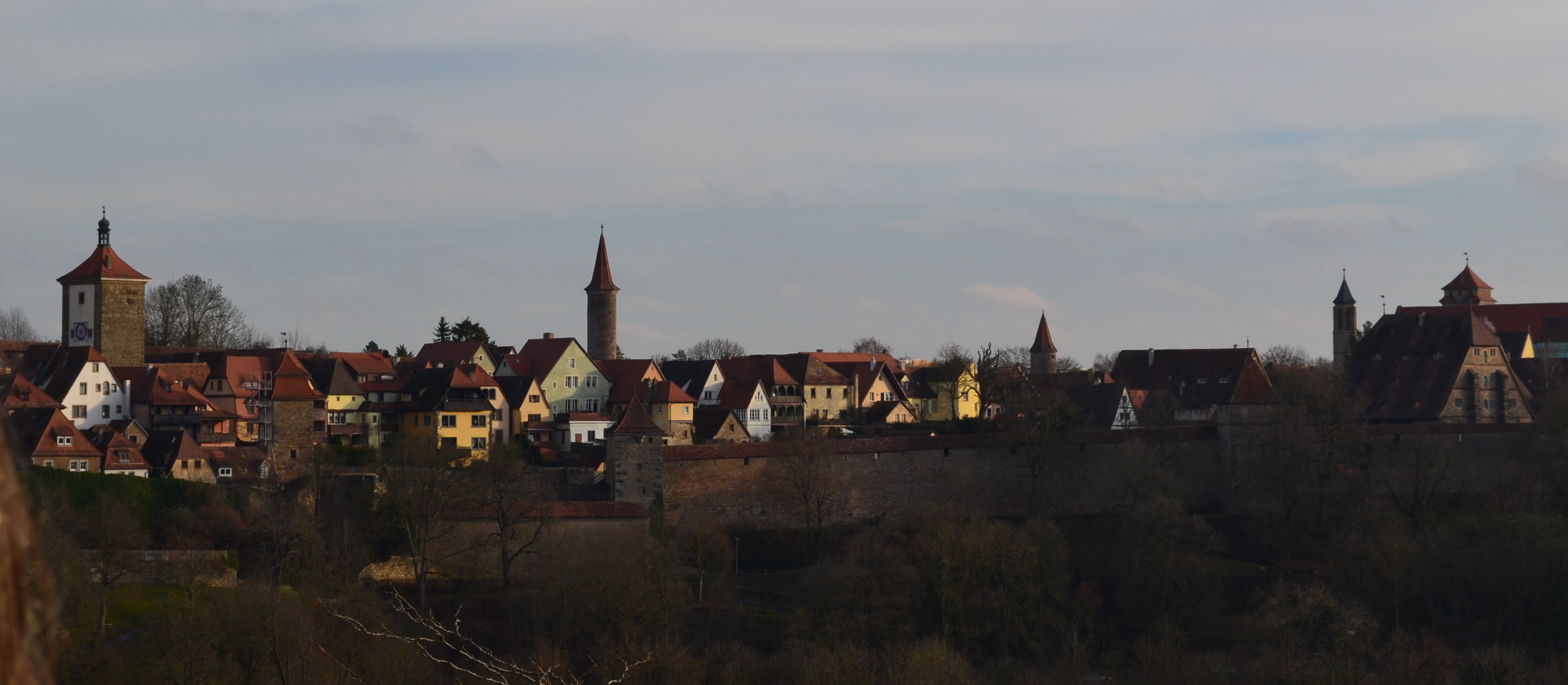
On to the third market of the season:  Rothenburg ob der Tauber, Germany. If you grew up on Chitty Chitty Bang Bang, then you’ve already caught a quick

Rothenburg
Rothenburg

glimpse of Rothenburg– a charming, walled, 13th century town in Bavaria.


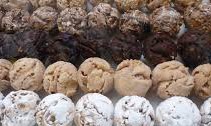
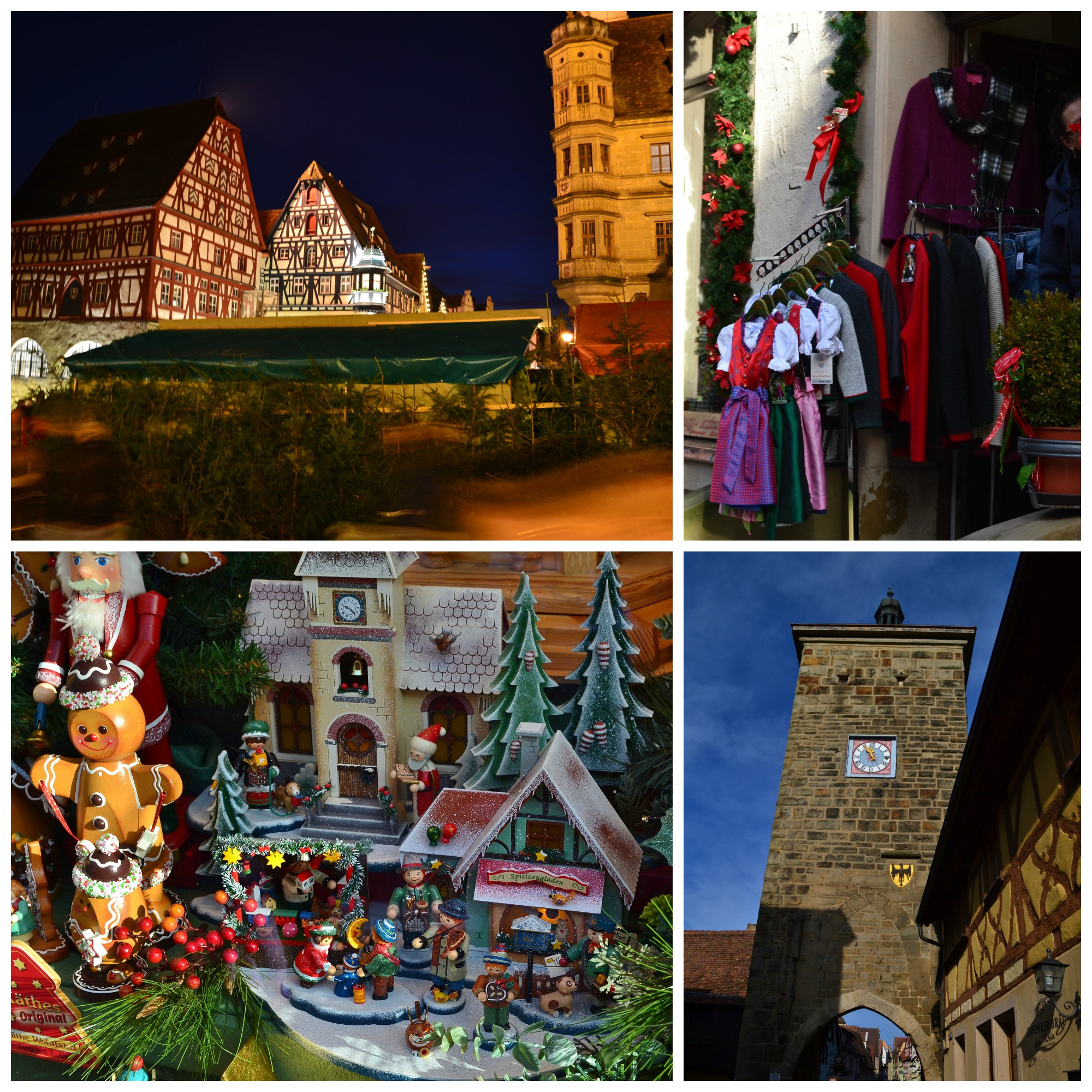
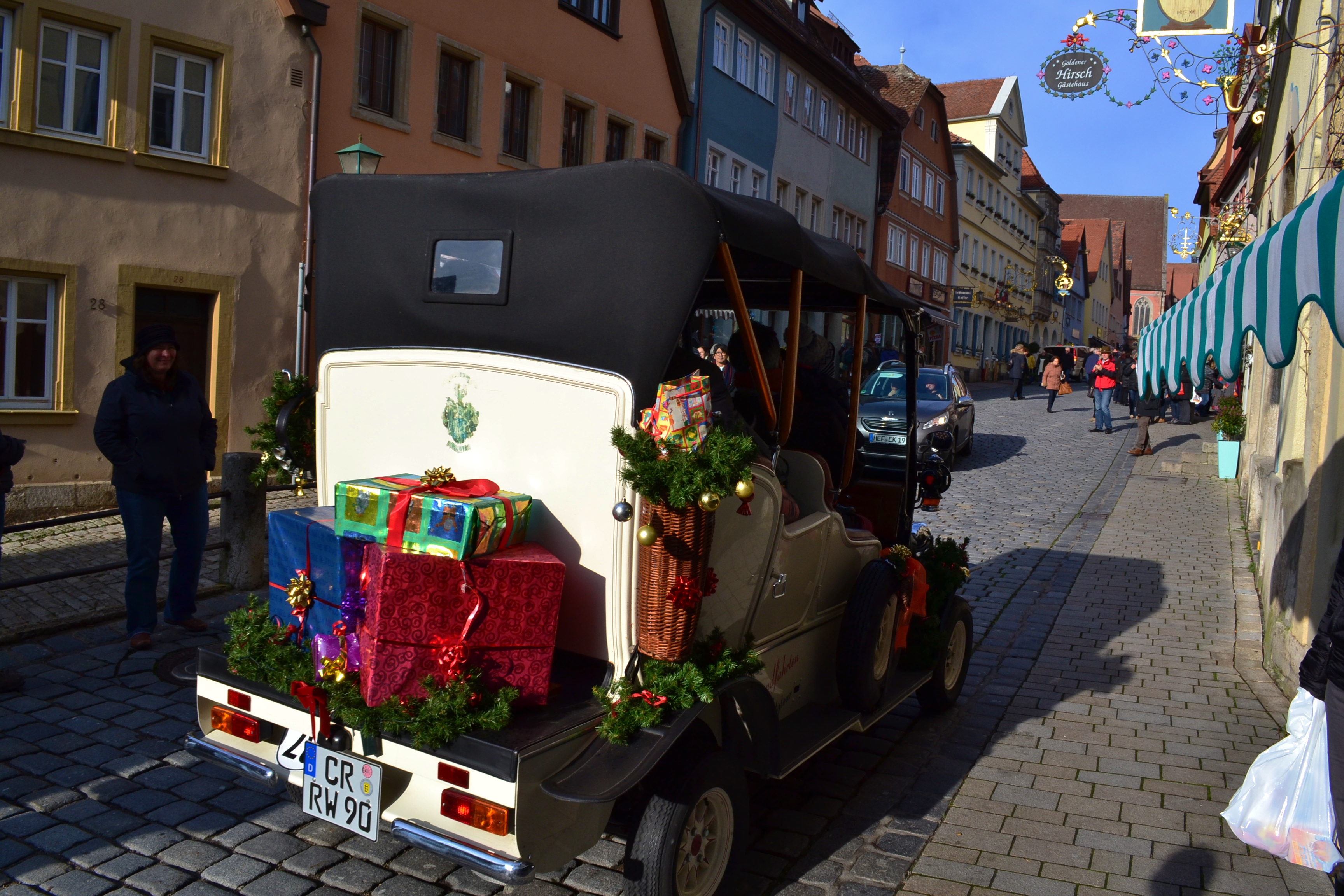
Any time of year that you visit Rothenburg, you will feel that you’ve stumbled on to Christmastown.  It is quaint and visually perfect, and peppered with small stores selling Christmas decorations.  It’s also famous for Schneeballs (“snowballs”) –a fried doughball covered in (most often) chocolate, cinnamon sugar, or powdered sugar.  They can be delicious, but on our first trip to Rothenburg a schneeball single-handedly took down my husband for an entire evening.

Schneeballs
Schneeballs

We skipped the schneeballs this go round and headed straight for the market and the spiced wine and candies.  The town was crowded, but not overly, and we enjoyed just milling about, eating, drinking, and taking in the sights.  On our first trip to Rothenburg (over a year ago), the kids and I had taken the Night Watchman’s Tour at about 8 pm  (while my husband was at the hotel in Schneeball hell).  It was fantastic–lots of history very charmingly and entertainingly told by an actor in the character of the town’s medieval nightwatchman.  We weren’t in town overnight this time, so we took a daytime tour of the city with a German woman who was probably well schooled in her history, but was

DSC_0152 fairly hard to understand.  Some of her phrases just didn’t translate.  No worries, though–a stroll through Rothenburg ob der Tauber is never a mistake.  The view from each corner is fantastic.

rothenb collage
Rothenburg–it really is Christmastown.

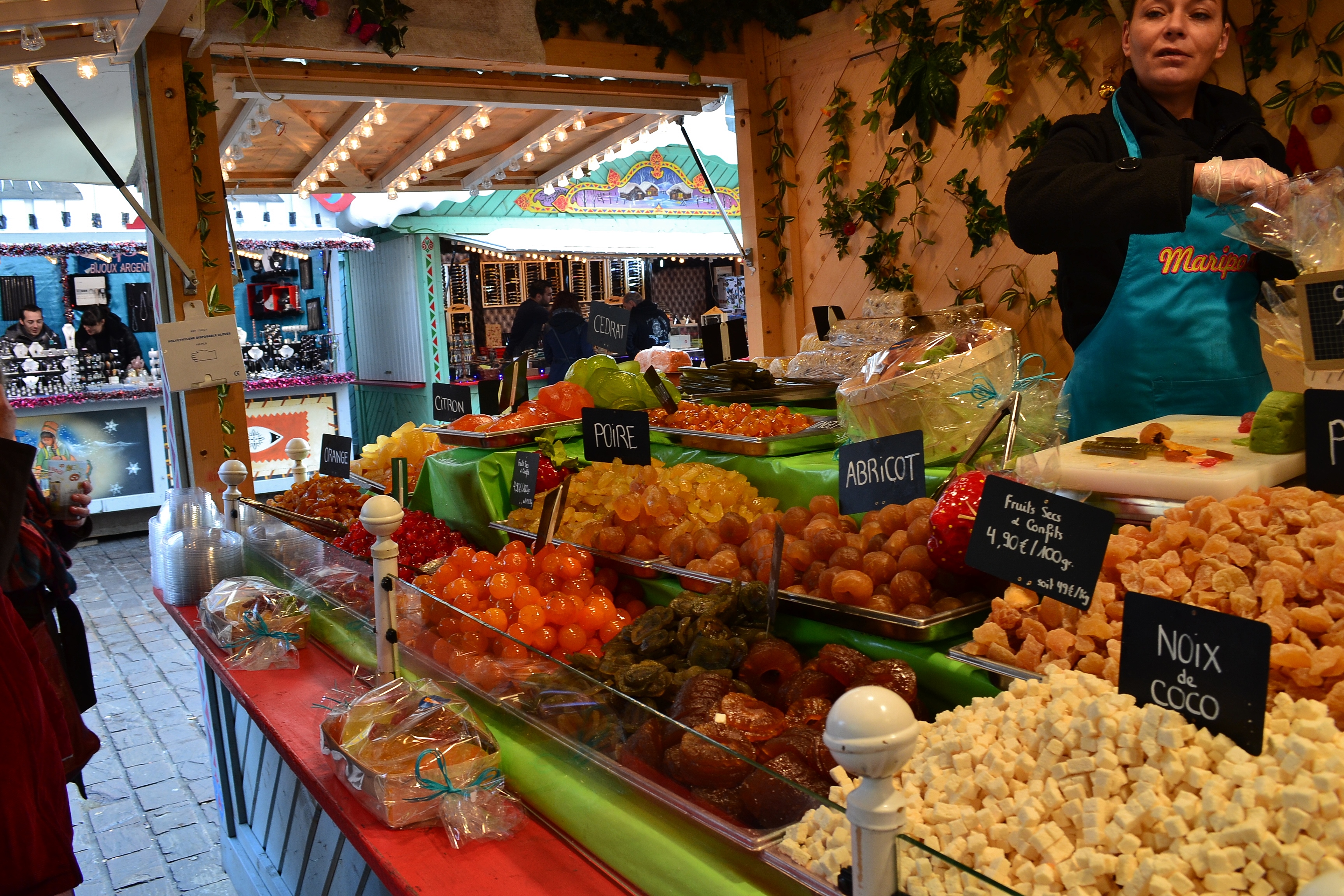
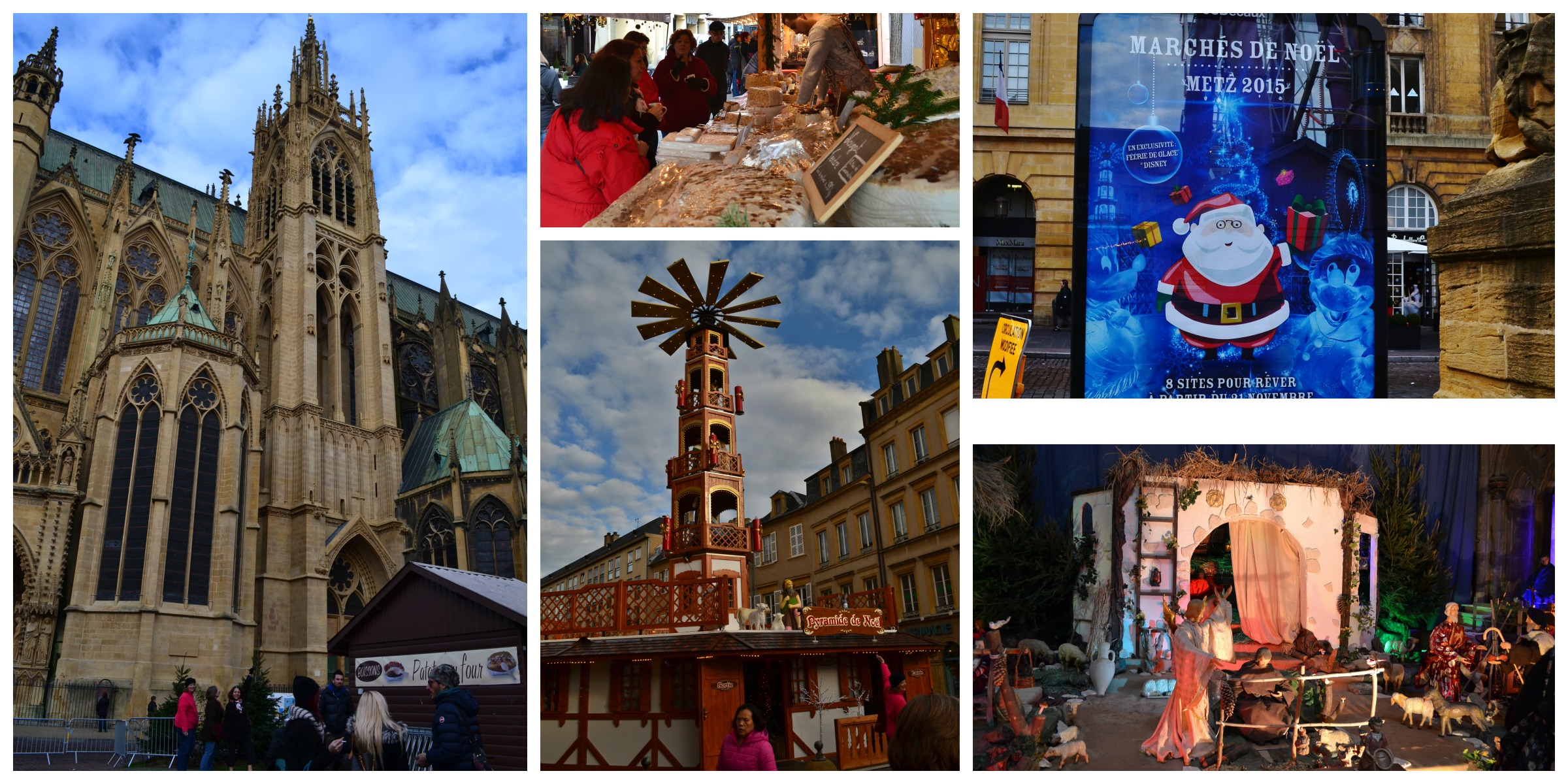
And trip number four?  Metz, France.   Metz market has an ice skating rink which our kids enjoyed last year.  This year, it has added an ice sculpture exhibit (Disney themed).  The market is actually multiple markets in different squares around the city, but we DSC_0186 lingered longest near Place St. Louis–home to stalls with table linens, butter biscuits, and outrageously good candied fruits.  Candied fruits are rarely featured in the German markets, so they were a special treat!

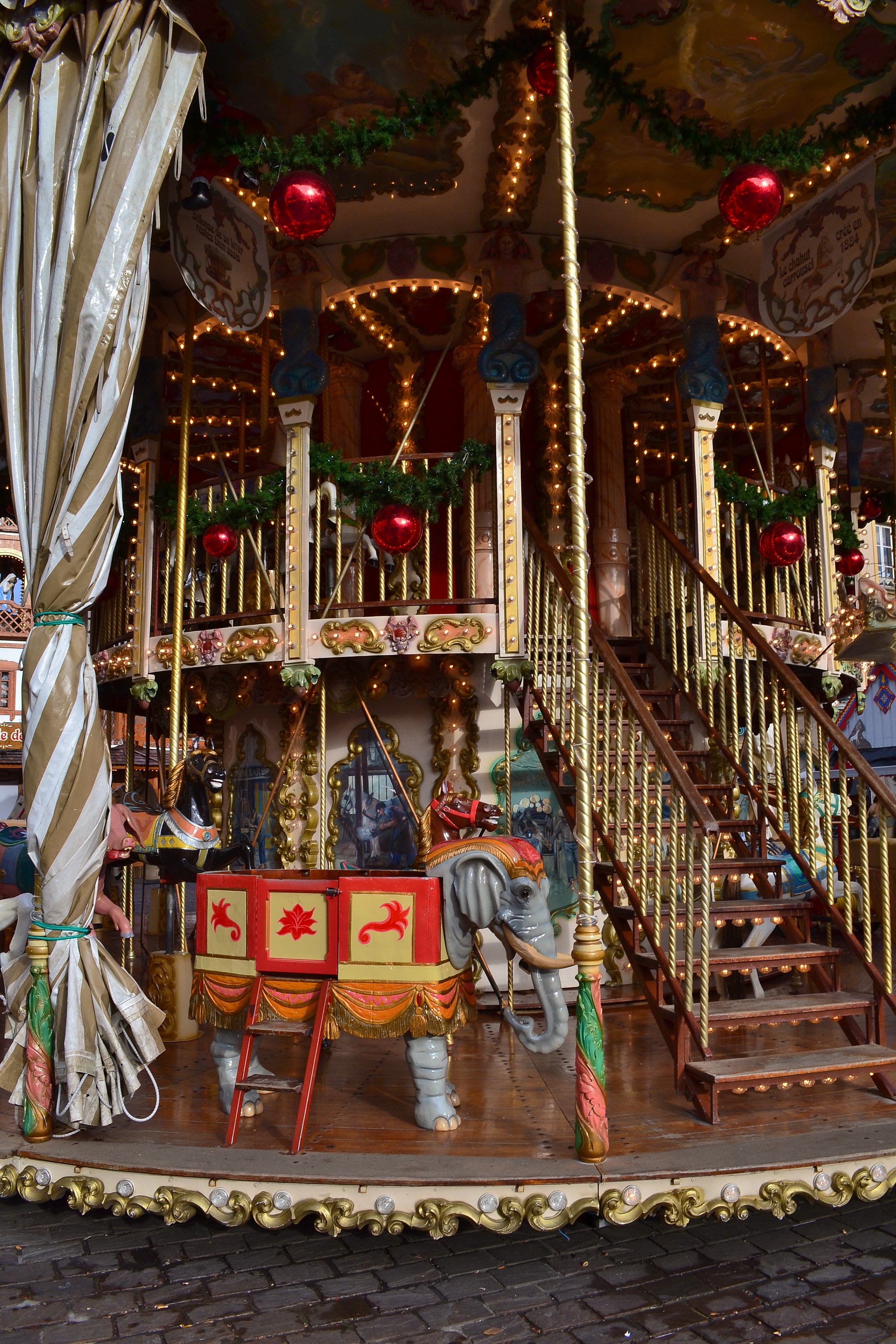
Place St. Louis was also home to one DSC_0187 of the most beautiful carousels I have ever seen.  (We’ve noticed vintage carousels in so many French cities–always a delight for the eyes.  One of my favorite photos of my kids around age 4-6 is on a carousel in St. Malo, France.)  This carousel in Metz boasts a balcony–fancy stuff!

Truth be told, most Christmas markets have a similar feel.  They are best suited to a day (or better yet, an evening) of meandering, nibbling, and sipping.  The ambitious (or tipsy) among us may revel in the shopping experience, but it’s the general atmosphere that most of us go for.

Frohe Fest (Happy Holidays!) and see you at the markets!

Metz Market
Metz Market


And the Season Begins . . .

DSC_0656
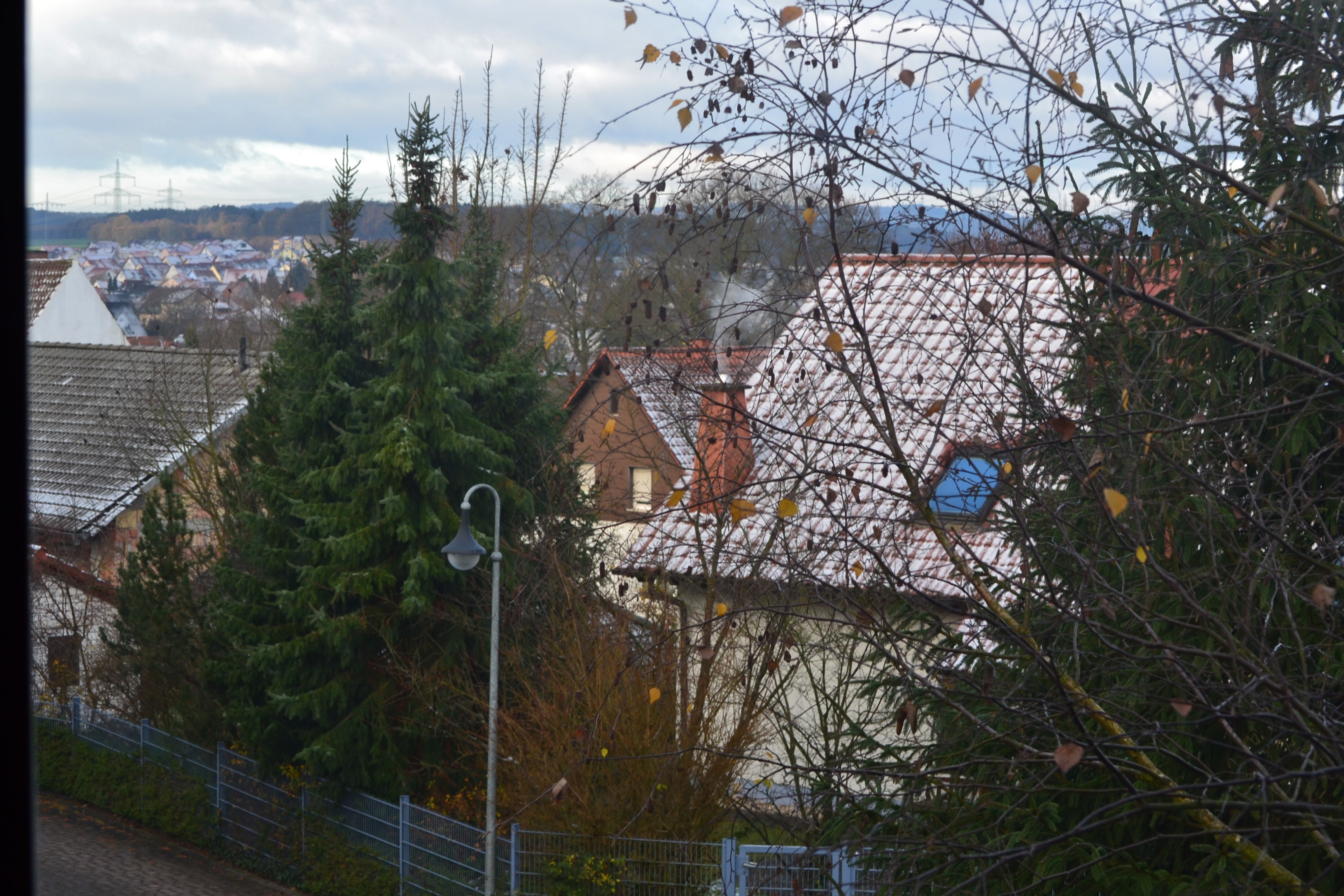
Snow on rooftops, smoke from chimneys– winter is here.

We woke this morning to a dusting of snow and ice in the Rhineland-Pfalz.  The cold had swept in yesterday, and we were beginning to feel the holiday spirit.

Late yesterday afternoon, we zipped over to Bernkastel-Kues, on the Mosel River, to catch the opening salvo of their Christmas Market. DSC_0072 We drove from cold and drizzle, through a snowy pass, and down into the town of Bernkastel, which seemed to be gripped in an arctic cold.

The market opened just that day (and will continue through December) and it was much less crowded than when we visited last year– which left us able to enjoy the beauty of the town without having to dodge the crowds.  All sorts of food and gluhwein were on offer– and we sipped the hot wine, but not too quickly (it was a great hand warmer!).

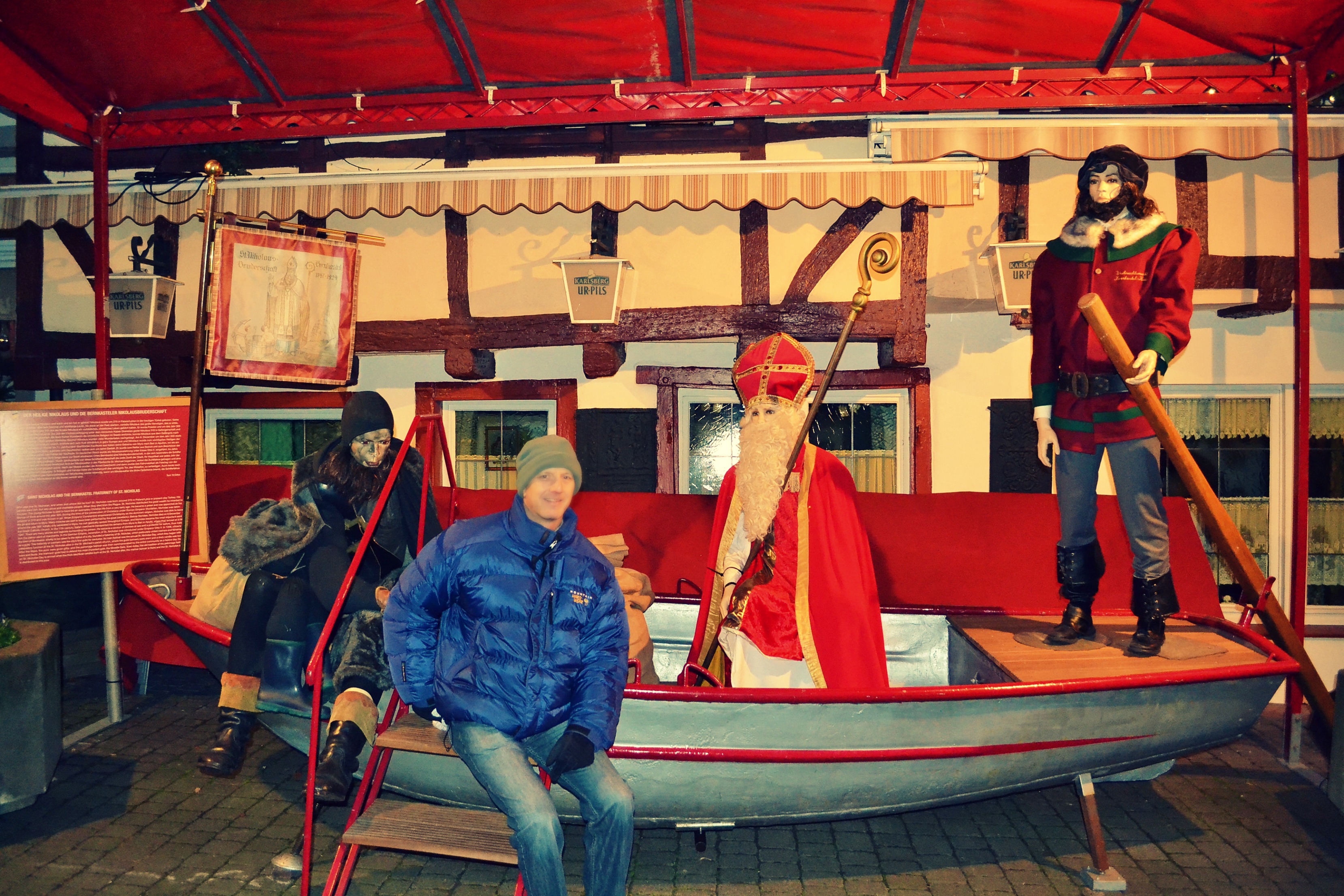
At one point, we had to clear a narrow lane to let St. Nikolaus and his horse-drawn carriage and entourage of mariners and fire fighters pass.  We had read that St. Nick was the patron saint of mariners.  In fact, I read that last year after visiting Bernkastel’s Christmas market and seeing Nikolaus and his sidekick Knecht Ruprecht in a boat.  Here’s a photo of last year’s boat display with St. Nick and his ominous sidekick (the mannequin to the left, in the black cape and boots).

St. Niklaus and Knecht Ruprecht--sit between them. Were you naughty or nice this year?
St. Niklaus and Knecht Ruprecht–sit between them. Were you naughty or nice this year?

It’s too bad that I didn’t have my camera with me yesterday  because Knecht Ruprecht was even more ominous this year.  This year, that sack he’s carrying wasn’t just stuffed with something out of sight (coal and switches was my assumption).  This year, someone’s been really naughty–there was a child’s leg and boot sticking out of the sack.   Yikes!  These draconian sidekicks of St. Nikolaus (Knecht Ruprecht, Krampus, or Schwarz Peter, depending on what region you live in*) often whip naughty children or give them coal and switches instead of candy.  But occasionally the children have been so bad that they are abducted (dragged to hell?) or carried off to be thrown into the cold river.  This could make a good child of the worst of us, because the Mosel River is VERY cold right now–polar bears aside, no one wants a dip in that.

I am breathing a sigh of relief today, because Nikolaus gave me a friendly wave as his carriage passed last night.  Pretty sure I’m on the good list this year.

Being American, my family begins our Thanksgiving week today, so the holidays are now in full swing for us–how nice to have that echoed by the weather and the Christmas markets here.  My oven was cranked up to full tilt today, the house smelled great, and the holiday candle arches were set up in the windows.  We’re getting ready!

Now, if we could just conjure up a little Peace on Earth . . .


*If you want a little more background information on Nikolaus and Knecht Ruprecht, see my post from last year Saints and Devils, Fire and Snowhttps://travelsandtomes.wordpress.com/2014/12/09/saints-and-devils-fire-and-snow/ )