Saints and Devils, Fire and Snow

st nick kramp cookie cut jazzup

You need only scratch the surface of modern Europe to see the pulsing of its medieval veins.  This can be a little unnerving, but it’s also deeply gratifying in a way that’s hard to pin down.

Take Christmas traditions as an example.  In America, we embrace a jovial, generous Santa Claus (who, for all of his good character points, does seem to team up with Coca Cola, Hollywood, and the rest of the commercial establishment a little too often for comfort).  He surrounds himself with other agreeable characters– Rudolph and Frosty–and they have a jolly time.  Sure, adversity must be overcome, but their stories never really cross to the dark side.

Would you like a little saccharin with that sweet?
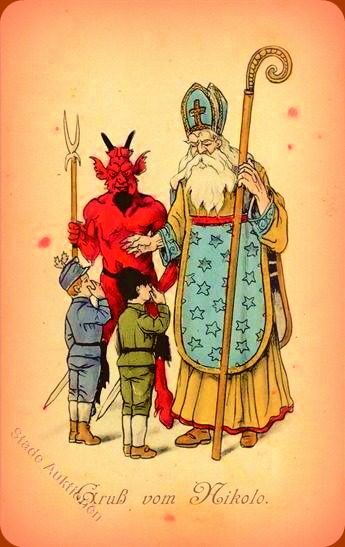
krampus st nick victorian postcard
Looks like St. Nick brought his scary friend. (Krampus and St. Nick on a vintage postcard)

Not so in Germany and Austria.  Oh, they’ll serve you sweets at each turn this time of year, but you’re never quite sure what they are fattening you up for.  You might cheer your good fortune at stumbling upon a kind old lady in a gingerbread house!  You might anticipate a visit from St. Nicholas on December 6th (Nikolaustag) with unbridled joy!   But wait.  What if the good fortune is not what it appears?

Because sometimes it’s not.

Sometimes, you walk into a Salzburg sweet store in late November to see this: 2_Milka_Nikolo_16Bg_dd.inddSt. Nicholas in all of his chocolatey goodness.

But the next thing your eyes fall upon is this:
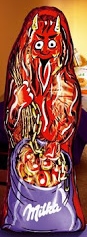
2_Milka_Krampus_16Bg_dd.indd

Holy camole!  What’s that all about?   Well, simply put, you are in the Old World now, the land of the Brothers Grimm, where every light casts a shadow.

candle pyramidYes, there’s always a dark underbelly in Germany.  For each saint, there’s a devil; for each sweet, there’s a reckoning; for each life, there’s a death.  Each candle-strewn Christmas pyramid holds back the dark of a frozen winter, and each yin has its yang.

Many unlucky children have found themselves, not on Santa’s lap, but staring down a devil named Krampus. (You just met his likeness in foil-covered chocolate, above.)   A demon who, at best, humiliated children with twigs instead of candy at Christmas. At worse, beat them heartily with those switches.  And at worst, dragged them down to Hell.  (Well, they had been naughty, you know.)

This is stern stuff.  A little shocking to those of us raised on Miracle on 34th Street or T’was the Night Before Christmas.  Well, my friends . . .welcome to Middle Europe, where St. Nick is often accompanied by a sinister sidekick: Krampus, Knecht Ruprecht, or Schwarz Peter.   Krampus is horned and devilish, Knecht Ruprecht and Schwarz Peter are more recognizably human, but sooty, uninviting, and coal and switch-laden.     (Whether this surly sidekick is malevolent or simply mischievous is entirely dependent upon whose hands he is in. . . or possibly on how naughty the child has been.)

Our first run in with Krampus was in that sweets store in Salzburg, but last weekend we ran into him again–this time at the Christkindlmarkt at Bernkastel-Kues.  His boat was parked among the market stalls.
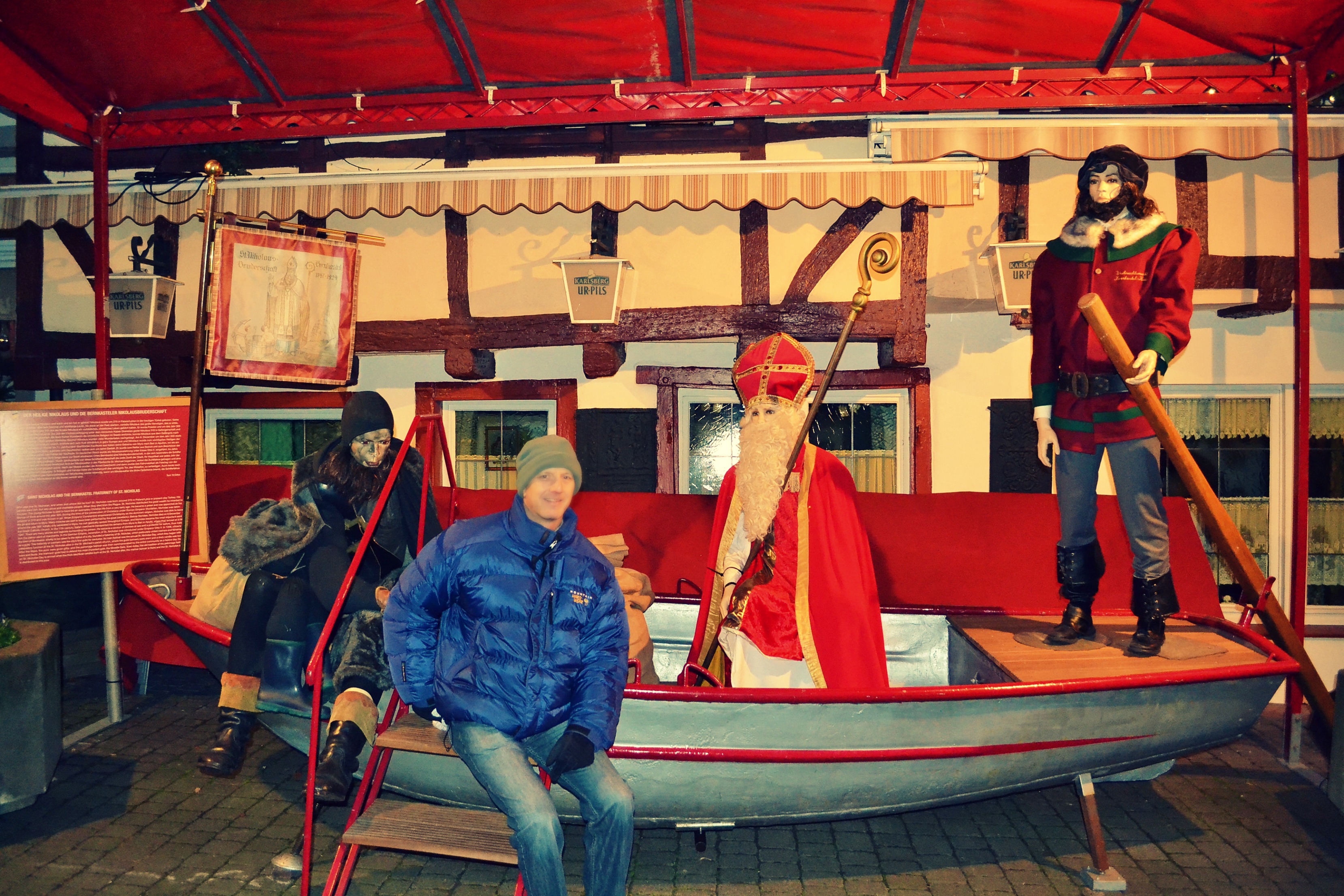
St. Niklaus and Knecht Ruprecht--sit between them.  Were you naughty or nice this year?
St. Niklaus and Knecht Ruprecht–sit between them. Were you naughty or nice this year?

I’m not sure what the boat motif is all about.  We were on the Mosel River…but my sister has (rightly) suggested that this looks more like something from the River Styx, where the ferryman will guide you to the afterlife…right after St. Nick and Knecht Ruprecht decide your fate!!  Oh, and Merry Christmas!
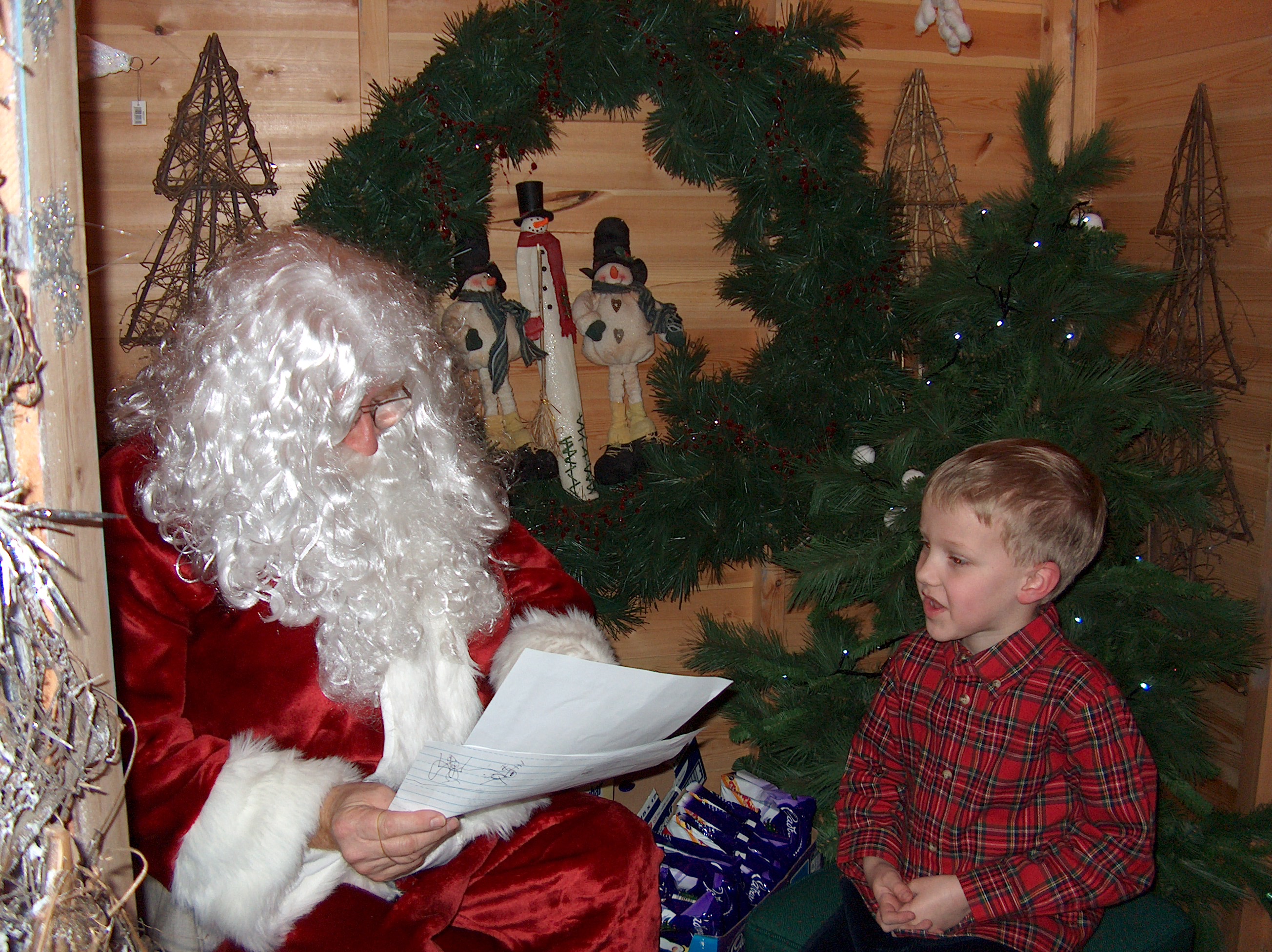
December 2008 at The Black Sheep Brewery, N. Yorkshire, England

We laughed about this, but for those of us   who remember Santa as all love and no menace, this is jarring.   Our “Christmas judgment” was always at the hands of this guy:

He was rumpled and happy, and he smelled of candy canes.  If we got tongue tied, it was only because we were overcome by his largess.   It was never because we feared for our very souls.

Honestly, if I had found myself, at age six, sitting between St. Nicholas in his starchy Pope’s hat and some vaguely human entity who looked like this
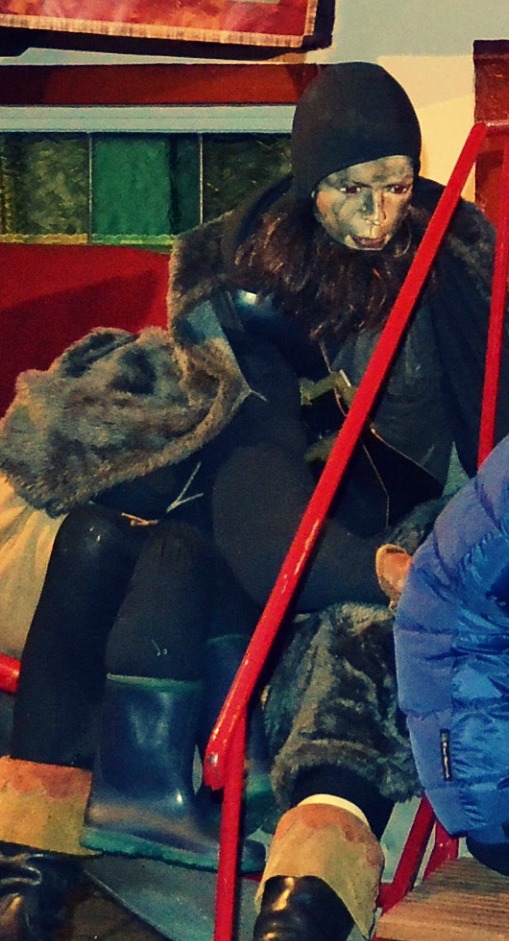
Is that a sack of coal?

swarthy vagrant. . . well. . .

Well?

Hmmmm. . . I don’t know how that would have worked out.  I certainly wouldn’t have produced a long list of “things I’d like for Christmas, because I want them, or I need them, or I saw them in the Sears Wish Book, or the Saturday morning commercial looked awesome, or Sarah’s best friend Suzy has one and I want one too!”

And so, it occurs to me that all German and Austrian children must be really, really, very, very good at Christmas time.  And very undemanding.

And very scared.

Good thing they get to stave off the dark and deadly cold of the season by going home and lighting candles on those   popular German Christmas pyramids and candle arches, and by hanging glowing Moravian stars all over the house.  You certainly need all the light you can get when Krampus is skulking around outside in the dark streets.

It’s the German way–an austere world view, gilded around the edges with gingerbread and chocolates.   The devil will always lurk in the shadow of the saint; the dark and cold will always stand sentry at the edge of the firelight. . .but if you are well behaved and diligent, you may just hold the dark at bay for a while.

So, I’ll leave you with a holiday toast: eat, drink, and be merry. . .for tomorrow, you may meet Krampus.

*Check out the video A Krampus Carol by Anthony Bourdain on Youtube, if you want a slightly disturbing holiday laugh.  And, yes, the girl does appear to get carried “to Hell in a handbasket.”  Nothing says Merry Christmas like that!
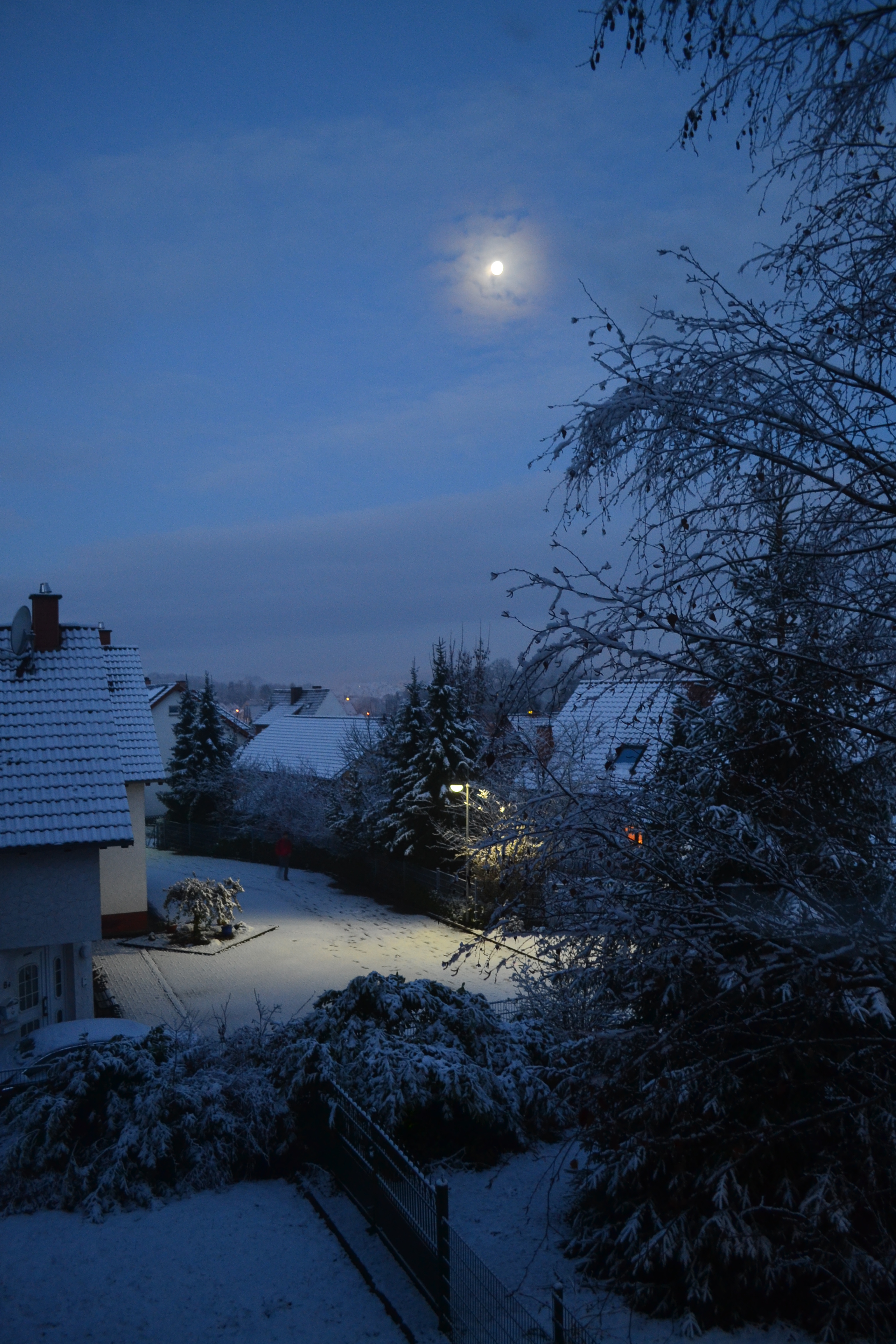
Lucky me--the dark and cold outside my window this morning was more picturesque than menacing.
Lucky me–the dark and cold outside my window this morning was more picturesque than menacing.

 *One, final, note: this dynamic duo of St. Nick and Krampus seems to own the holiday of Nikolaustag (Nikolaus Day and Eve, December 5th and 6th).  After that, Weihnachtsman, Kris Kringle, Santa, the Christ child (Christkind), or some other regional “santa” takes center stage for Christmas.  I can’t say that I understand these myriad traditions yet…but maybe I can shed more light on this by next Christmas.

Frankenstein Rocks, Nigella Bites, and I Have Trouble Staying Focused

frankensteinI’ve picked up Mary Shelley’s Frankenstein, after stumbling upon Frankenstein village last week.  I believe in the seemingly random “suggestions” that life whispers in your ear.  So why not play the card that life pitched my way?  We’re having a bout of cold, gloomy Gothic weather anyway—so the stage is set.

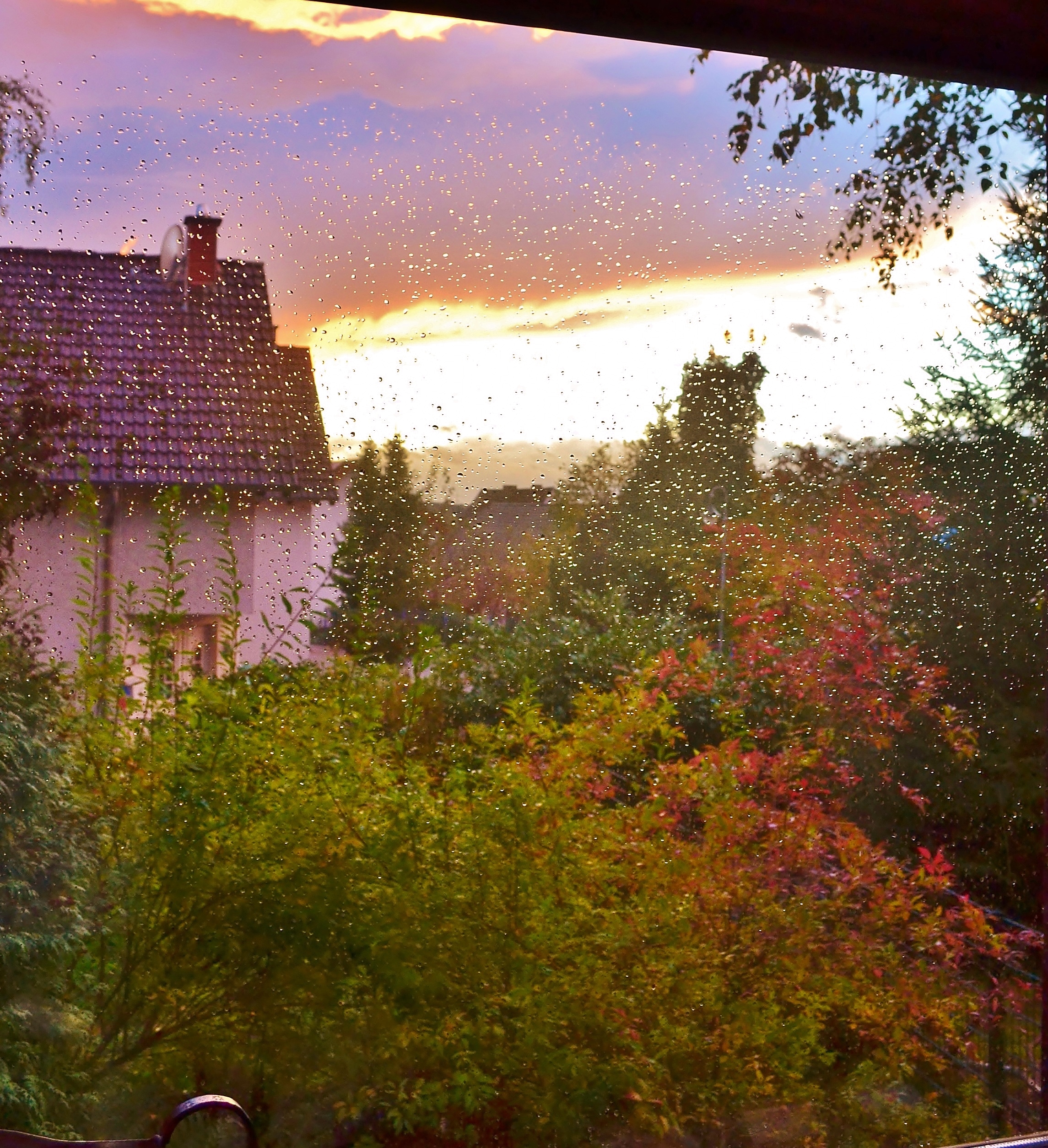
A storm blowing in outside my window.

The book was sitting on my own bookshelf, but where, exactly, I wasn’t sure.  Three months in a new house and only my daily- and weekly-use possessions are in obvious places.  The rarely used objects in my life still take a full-on three day manhunt to find.

And I was going to the library anyway.  (There’s an American library close by—you know my German falls far short of Dr. Seuss at the moment, much less Mary Wollstonecraft Shelley.)

So I went looking for Frankenstein, but found myself, instead, in the cookbook aisle.  This will surprise no one who knows me—I’m easily distractible.   But this was different, I thought—another whispering in my ear.  Some days we are more ripe for some experiences than others, and this was one of those days when something  solid and sensual was needed to catch my attentions.  The seasons are beginning to turn in Germany: the light is swinging away from us, there’s a damp chill creeping into the air, and my body is registering this on many levels.  It’s dark before 7 pm, and I’m growing sleepy far too early.  Birds are migrating, and my own psyche is being tugged at by that hibernation reaction—I want to cozy in already.  And my stomach is whispering its own suggestions: time for soup, time for autumn foods, and nearly time for holiday cakes and ale.

When my stomach speaks, I listen.

It began whispering a week or two ago, and I pulled a Julia Child book off my bookshelf.  I’m totally lacking in the sort of culinary ambition that led to “The Julie and Julia Project,” but I told myself that I’d cook whatever I happened to open the page to.  It would be a delicious adventure.

I closed my eyes and opened the book.

To the chapter entitled “Mayonnaise.”

I closed the book quickly and resolved to serve leftovers for dinner.

But yesterday my stomach was speaking again, and this time with a back up chorus:  all the senses were alive and singing.  “It’s autumn– we want the tastes, the outrageous  spiced aromas, the feeling of being held close and warm.”  There’s no denying the call.   I was on a mission.

And I found my helpmate in Nigella Lawson.  I already have many of her cookbooks on my own bookshelf, but I picked up the library’s copy of  Nigella Bites and tucked it under my arm for the trip home.
Once my kids were home from school and had enveloped themselves in that quiet hour they often take—to nibble on snacks, to relish their private “cone of silence” after a day of overstimulation—I picked up my book and fell into a comfy chair for my own moment  of communion  with Nigella.

The moment didn’t disappoint.

In describing the cream she uses in a Ginger-Jam Bread and Butter Pudding, the author says, “nothing creates so well that tender-bellied swell of softly set custard.”   And toward the end of her chapter entitled “Trashy,” she asserts that “Trashy is a state of mind, a game of mood: the food itself deserves, demands, to be served and eaten—unsmirkingly, unapologetically and with voluptuous and exquisite pleasure.”

THIS is a feast of the senses.  And, if Nigella has built her fame on being a bit of a strumpet, the truth is that she’s dead-on right about the comforts and sensuality of food.  And she’s as good  a reading companion as she is a cook.  (Nigella’s Christmas cookbook was my first foray into her vast library, and, although I have cooked some recipes from it with great success, I love it even more for the witty, intelligent read that it provides.)

Anyhoo, back to the senses.

DSC_1055
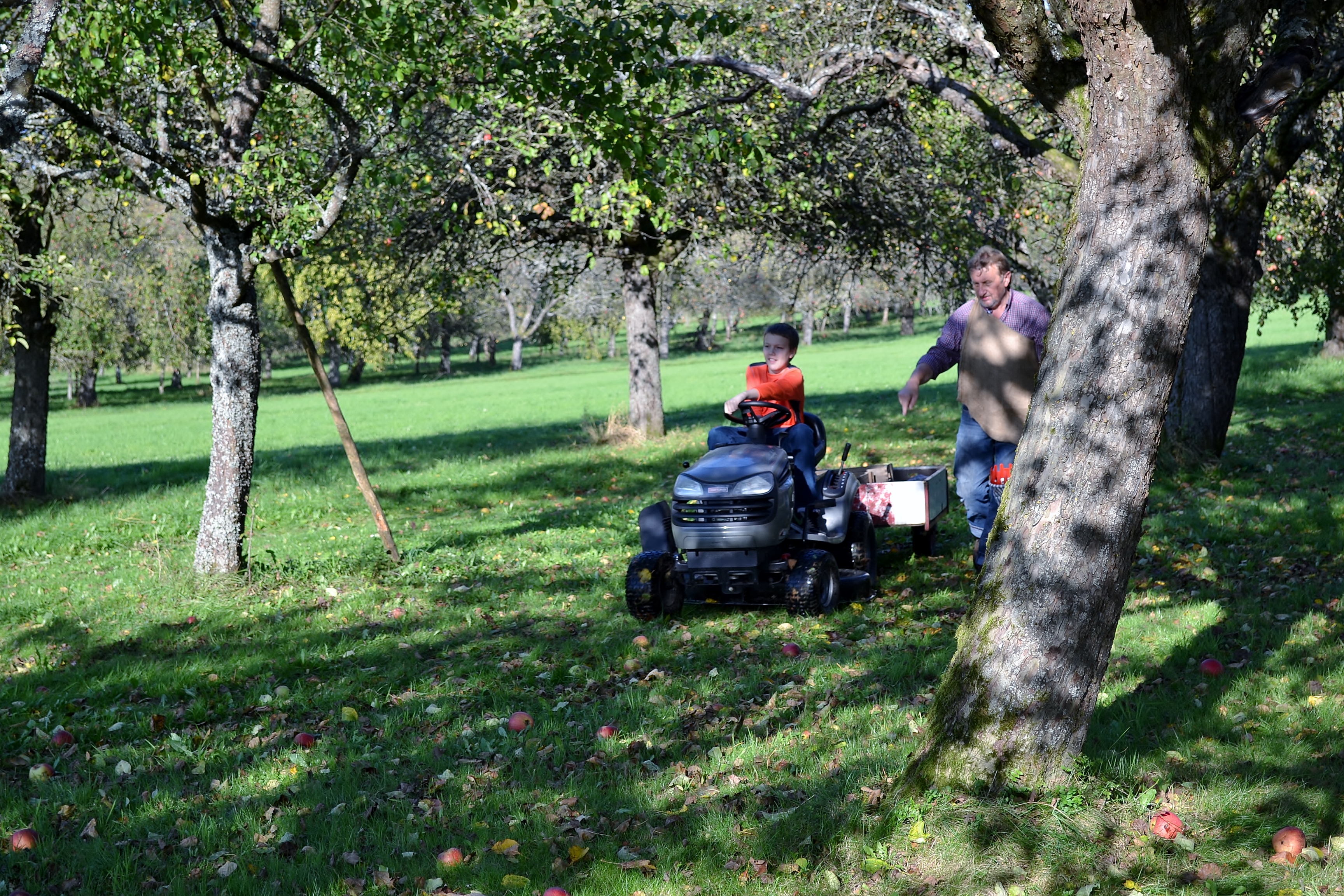
Picking apples in Helmut’s orchard

We were apple picking in our landlord’s orchard last weekend   and brought home wine crates full of apples, so cakes and cobblers have been flying out of our oven.  It’s time now for a shift to something savory.  I’ve scanned Nigella Bites, and, aside from some lovely desserts,  I’ve dog-eared a recipe called  “Granny Lawson’s Lunch Dish.”  An inauspicious name, but the recipe was speaking to me nonetheless.   Yum–spicy beef, savory smells, flaky pastry–oh, oh, wait a minute,  I know!  What I really want is a steak and ale pie–a really, really good one.  And I have just the recipe. . .somewhere in my house.  I haven’t found some of my recipe files yet.  That will take a three day man hunt, of course. (Grrr.)  But  I have  started looking for those recipes.

They haven’t turned up yet, but the good news is that Frankenstein finally jumped off my bookshelf at me.  I think that must be the universe whispering to me (again)  that I’m supposed to be reading Shelley’s book.  So I’ll just relax, read the complicated Gothic tale now and worry about savory pies later.

Unless, of course, I get distracted again.

I really do need to go out and rake the back yard. . .

Lightfooted in Lederhosen

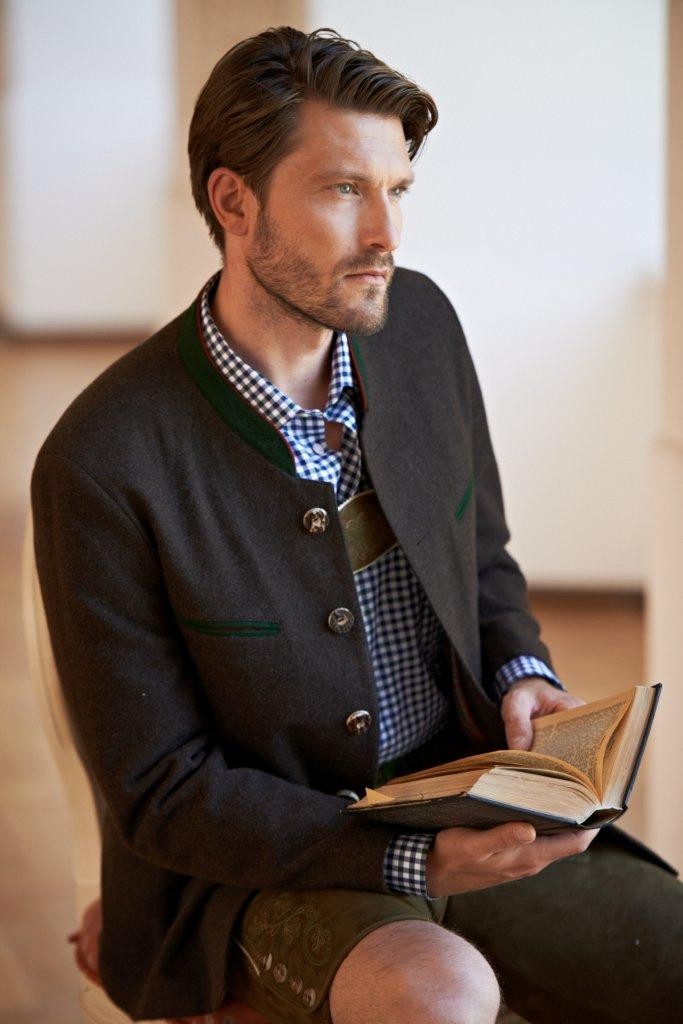
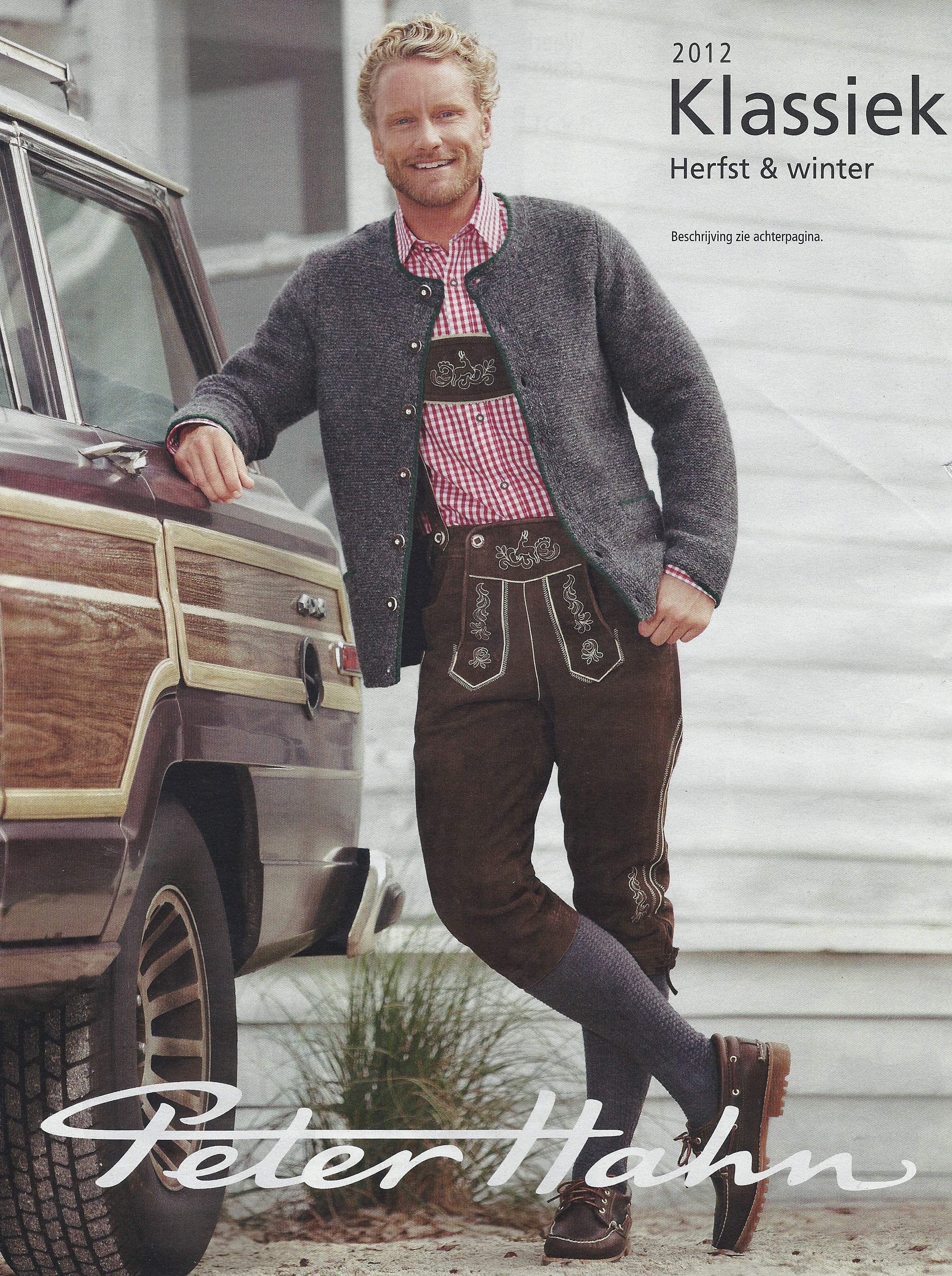
High Fashion Lederhosen from Peter Hahn

Go ahead. . .I know you want to laugh, to sneer, or to feel yourself superior to that poor sod who’s had a lapse of judgment (or an outrageous amount of beer) and decided to put on lederhosen.   The ill-conceived costume of Oktoberfest.

Well, idiot that I am, I LOVE lederhosen!   So far, I’ve resisted the urge to buy any dirndl or lederhosen for myself or my husband…actually, I’ve resisted with the gentle coaching (scolding?) of family and friends.  “What are you thinking?”  “You’d really wear THAT?”  The ever popular, “BAAAAAD idea.”  (But the  inner voice that says, “You know, your cleavage would look awesome!” keeps my heart in the game.)

And, now that Oktoberfest is upon us, it’s open season for leaderhosen in Germany.

So what are  lederhosen and dirndl and when/why/how did they become traditional?  You’ve always wondered, haven’t you?  Just been waiting and hoping that someone would bring you the story.   Well, wait no more–I’m your girl.

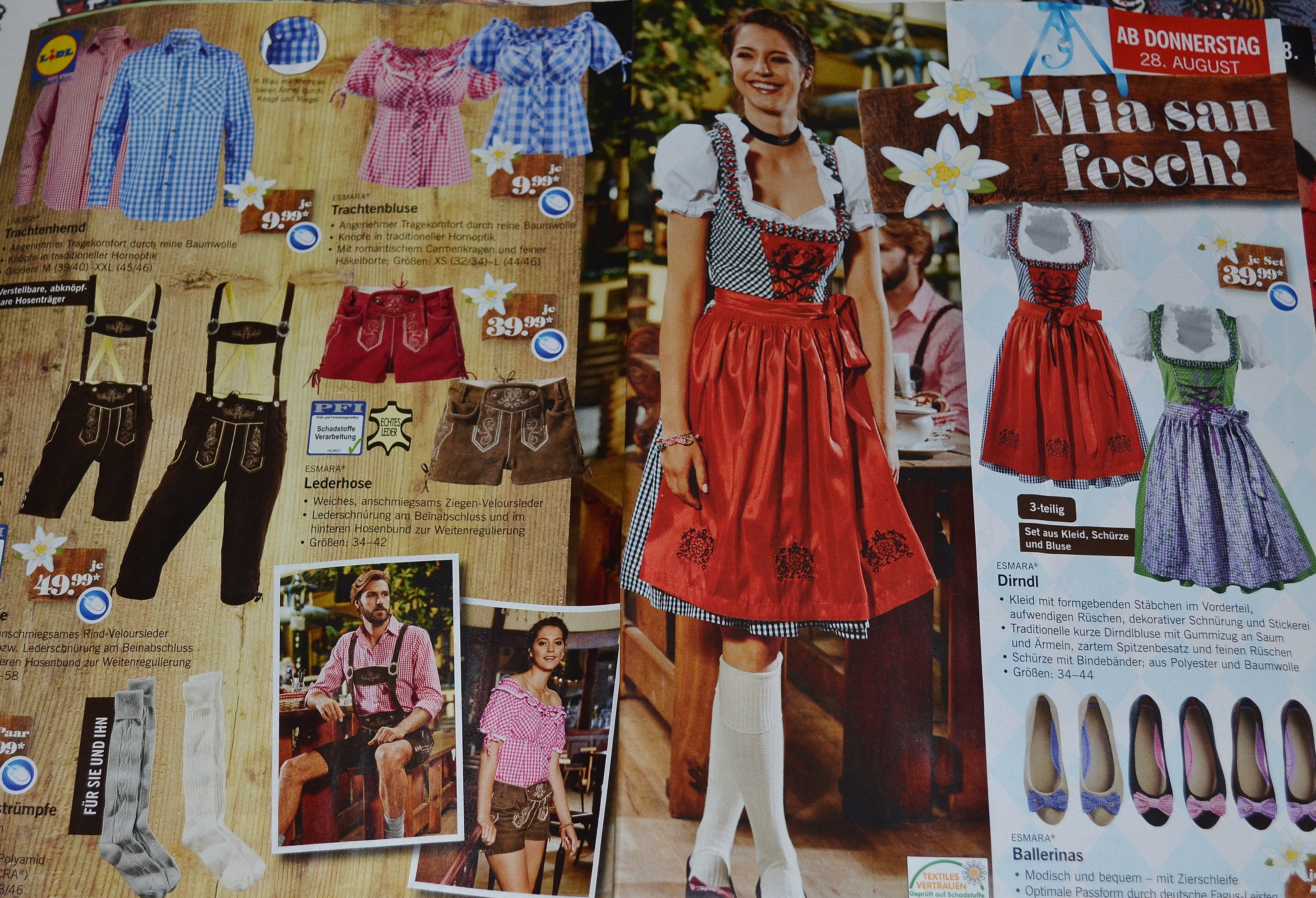
Some outlet Lederhosen
Some outlet Lederhosen from Lidl

Here’s my five cent version of the history of lederhosen:

Lederhosen (for men) and Dirndl (for women) are both called Tracht.  “Tracht” derives from the word “tragen” which means “to wear.”  Very practical origin, right?  Well, that gives you a hint about the clothing’s past.

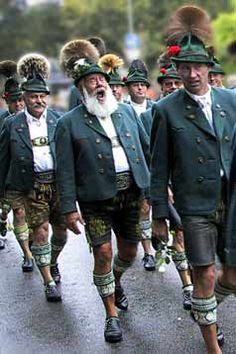
A photo of Bavarian Trachten from Pintrest

Tracht originated in the southern area of Germany and Austria.  This sort of clothing (especially the leather pants)  was associated with the working class/peasant community, and it seems to have grown out of 18th century traditional clothing.  It was, above all else, very sturdy and practical garb–both for working and hunting.   It’s possible that this clothing, most often associated with Bavaria, was also influenced by French fashion.  Whether or not that’s true, it did take a “high brow” turn when it’s popularity rose and it became not just working clothing but fine, festival clothing, sometimes richly decorated and embroidered.  (But, not to worry, it can be had on any budget.  Mass produced Trachten can be found at discount stores, but some specialty stores sell very expensive, and very beautiful, outfits.)

Of course, the female version of Tracht, the Dirndl, isn’t characterized by leather pants.  It comes from the 18th century peasant’s or maid’s dress: it has a blouse, a bodice, a skirt, and an apron.  Winter dirndl would, obviously, have been heavier, and wouldn’t have featured the same (summer weight) tailored bodice and plunging neckline that has made St. Pauli Girl beer so famous in the USA!

I’ve read that some villages produce a regional Tracht that locals like to wear on festival days. It sounds like Tracht is to Germans what Tartan is to the Scots: a sign of cultural and regional (or clan) pride, as well as a festival costume.  And that makes me like it even more!  And no wonder that it may look silly to outsiders–anything that goes deep into your own personal, cultural psyche will ellude the grasp of the universal imagination. Roots that go deep don’t spread wide.

Despite my love of cultural costume, my husband is unlikely to wear a kilt or leather knee-britches anytime soon.  It’s just too hard of a sell.  I’m holding out some hope–based only on the fact that he’s recently taken to drinking good Scotch Whiskey. . . so some sort of cultural roots are beginning to grow.  Maybe a small sartorial concession will come. . . A Tweed jacket in his future?  A Bavarian wool jacket or a German gingham shirt?  ( A spirited Scot or a barmy Bavarian?  I’m not sure he’ll like these options–he’s more of a fanatical francophile.)

Well, regardless of who wins the wardrobe wars at my house,  I love lederhosen!   And, anyway, if it must be left to the Germans to carry that cultural torch themselves. . . I suppose that seems fitting.

Lederhosen from Fendt catalog

A One-Woman Tower of Babel

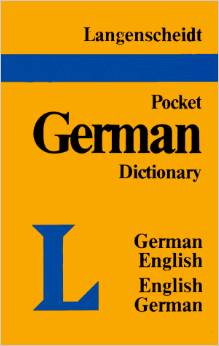
german dictionary

That’s me.

I open my mouth in a European market, and out comes a confusion of speech, a jumble of gibberish–here a French word, there a German, then a mischeivous Turkish phrase.  I’ve lost all control over my tongue.

I’m trying to reign in this problem, but it is hard.  We stepped over the border into France again Saturday, and this is where the big troubles always begin.  In Germany, I speak lots of English and the splattering of German that I can manage so far. (Still studying up!)  Sometimes French or Turkish words sneak into my speech, but they are the odd escapee from under the fence.  I have some control over my language.

Then I step over the border, and all hell breaks loose.  My brain seems incapable of releasing only the French words from their cell block.  No, that would be too orderly.  The gates fall and all the imprisoned words escape at once–a melee of language, a fracas of phrasing.  A mess.  Really.  Or is it?

Mess-peranto.  A new international language for people who make a mess of languages.  Let’s start a movement!  This could be like Esperanto for people who are enterprising enough to know smatterings of a few languages, but too lazy to actually order and develop their linguistic skills.

Bad idea?

I’m pretty sure the French cashier I practiced on thought so.


Making the Best of the Wurst

wurst

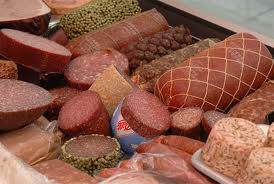
Recently, another blogger I follow took note of the Germans’ penchant for pork.  Took issue with it, really.  And, while I think taking aim at another cultures’ tastebuds is a thorny undertaking at best, I do feel a little sympathy for other people who are swine-averse in Germany.  There’s no easy way to steer clear of  the pig when in the Palatinate.

And I should know.  I am not a sausage eater.  I don’t mind the aroma, the spice, the bite of garlic or pepper–those are all fabulous…seductive, even.

Not sure I like the idea of sausage, but sausage is not really one of those things anyone should think too closely about, so that’s not the problem.

I’m just allergic to pork.  So I avoid it.  No biggie.  Up to this point in my life, there have always been lots of options.  In the South, I go to BBQ joints and order shredded chicken or beef.  I take a pass on bologna, and I feel no great loss.   However,  in the land of beer and brats, you find yourself adrift on a sea of sausage… absolutely schwimming in schwine.

The boys in my family think this is fabulous, and I won’t contradict them.  But it does make for some awkward moments for me.  I feel funny always asking what’s in a dish that I don’t recognize–it feels a little high maintenance.  And, since my German is very rudimentary, I often don’t understand the answers I get back.  So there’s a lot of just steering clear–taking the widest path around anything that might possibly contain pork.

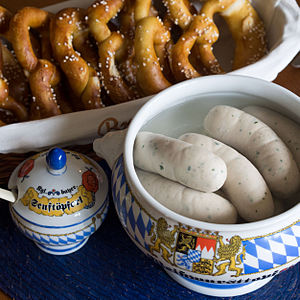
en.wikipedia.org, weisswurst

Which knocks out a lot of things in Germany.  (I thought my Ritter chocolate bar smelled slightly bacony the other day…but I ate it anyway, and I’m still standing.)

So here’s the plan:   Germany may be a swine-fest 24/7, but it’s also a chocolate and pastry and spatzle fest, so I will not suffer (although my waistline might).   My household will savor all that Germany has to offer by the age old “Jack Spratt technique.”  What I won’t eat (pork), my husband will relish; what he will only nibble around the edges (pastries), I will greedily gobble.  You’ll recognize us if you sit nearby at a restaurant:  we’ll be the people who’ve licked our platter clean.

Guten appetit!


A little sampler of facts about German Wurst:

*A wurst is a German or Austrian sausage–it is not necessarily made of pork, although pork is the most frequent ingredient.

*Wurst is sold both raw and cooked; it can be sold as a sausage or as cold cuts.

*If you happen to be near New Braunfels, Texas, you can go to the Wurstfest in November.  It bills itself as “the best 10 days in sausage history”–the best of the wurst.  Or the wurst at its best.  And then, later, you can confuse people by saying, “I was once in Texas and had the best wurst.”   ?!    The Pocanos also advertise a Wurst fest, complete with Polka Bands, Bavarian dancing, Lederhosen, and hotdog races.   The wurst at its worst best wurst …whatever.   Chicago also has a three day Wurst fest.  (This begs for a windy city joke, but I’m trying to be mature.)

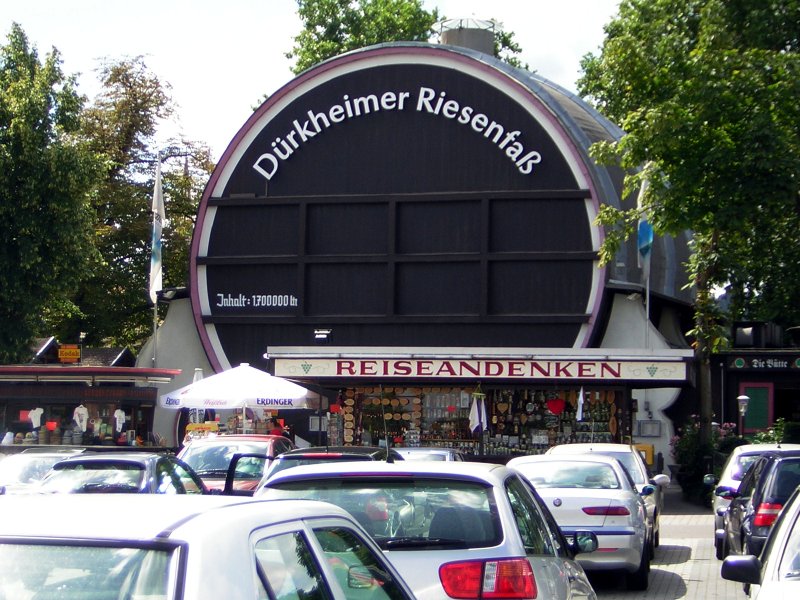
*Bad Durkheimer, Germany (in the Pfalz, which is part of the Rhineland-Palatinate and close to where I live) has a Wurstmarkt wine and wurst festival in September.  Part of the national Oktoberfest fervor, but with wine. (And, I’m told, the wine is served in half-liter sized glasses, like beer.  Ouch.)  The Durkheimer Wurstfest is famous for being the biggest winefest in Germany.    It bills itself as a nearly 600 year old festival.  (The flyer should read “the best 570 years in sausage history”–that would show Texas!)  

Bad Durkheimer
Bad Durkheimer


*Apparently, there are over 1,500 types of wurst available in Germany. It can be found on a German table at any time of day or night.  It is the subject of festival and poetry.  (Well, if Robert Burns can write a poem about Haggis, then sausage is certainly fair game!)    

* Holzhausen, Germany boasts the Deutsches Bratwurstmuseum–yes, a wurst museum– which houses documents that can date the beginning of wurst  from the year 1404.   So there you go; plan your pilgrimage now. 


**If this is the wurst post ever, I apologize.  Consider the subject.