I’m sure there is some sort of Universal Karmic connection between my children’s behavior and the long history of border disputes between France and Germany. Just hear me out.
We made another jaunt over the border into France this weekend. (I’ll write more about that soon.) We live less than an hour’s drive from the border…but the border wasn’t always the border. In fact, given the history of the French-German border, I think they should just call it the Sorta-Borda, because (if history is any predictor) it will be shifting again any decade now. It’s like the San Andreas Fault in California—once the pressure builds, it will shift. It’s like my kids that way too…but more on that later.
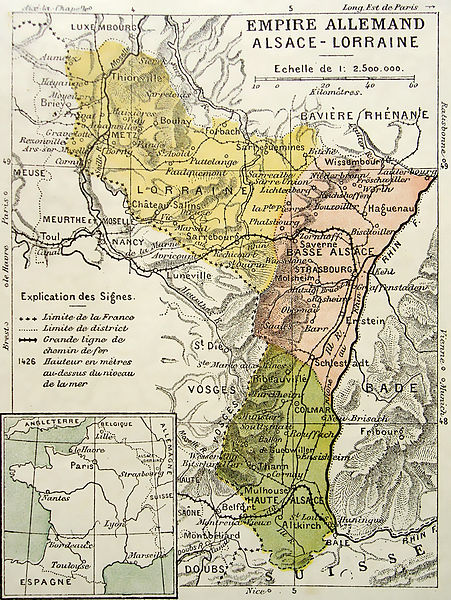
About the “borderlands” of Germany and France: I recall some long-ago history class lecture about the Alsace-Lorraine region of France being passed back and forth between German and French hands over the centuries. The cuisine, town names, and architecture make this blatantly obvious.
But I’ve only just learned that this geographic game of “hot potato” has continued into the 1900’s, and included some areas of the Rhineland-Saarland in Germany. In the 1870’s, the French lost much of the Alsace region—as far in as Metz—to the Germans, and it wasn’t returned again until 1918. On the flip side, my husband tells me that parts of the present-day German Saarland were only “re-Germanated” in the 1950’s.
About Snarky Siblings: This historical perspective makes me feel a little better about the “border disputes” that have been going on in our family since we moved into our Scooby Doo castle-house—we seem to be stuck in the “Hassle in the Castle” episode. The kids are constantly arguing about which room is better, who gets which room, who then lays claim to the room that falls between the two rooms, who gets dibs on the top floor of the house, etc.
Holy Crum! I think we are heir to two legacies here—the teen/preteen gimmees, and the French/German borderland disputes. That equals “land-grab squared,” and it ain’t pretty. Whatever developmental/hormonal forces are at play with my kids are ramped up by some sort of historical/geographic energy field that is beyond our control.
That’s how it seems… and it makes for the better story. Who’s to say that it’s not true? With a little parental intervention, our in-house border disputes seem to be slowly working themselves out. Let’s hope they hold more firm than their European historical precedents.
You have to draw a line somewhere, right? And we’re a funny species…we draw lines everywhere. But lines, once drawn, just ache to be crossed. I’m not excusing this conduct, I’m just saying it seems to be a pattern of human behavior, or human misbehavior anyway.
So when you build a massive defensive fortification on your country’s border–though it may be a project of mind-boggling innovation and preparation, though it may seem impenetrable–well, it just seems like pressing your luck to call it The Maginot Line. You are just begging for trouble.
But, of course, no one had to go begging for trouble in Europe in the late 1930’s. Trouble sat on your doorstep with a capital T. And I’m sure all of France slept better at night knowing that the Maginot Line held its eastern border safe when the Third Reich escalated its rumblings in Germany. Slept. . . until the rumblings got louder and louder. Until countries to the east fell: Austria, Czechoslovakia, Poland. Then the north: Norway, Denmark. The border: Belgium. Until the line did not hold.
For the most part, our local expeditions these first two weeks in Germany have been uncomplicated: vintage car shows and pastry shops. . . and more pastry shops. Mindless, sleek, or sugar-and-cream-filled offered a nice counterpoint to the stress of the frantic first two weeks: jet lag, radical re-orientation, frantic house hunting, and a litany of drivers’ tests, briefings, and meetings. But as life is beginning (just beginning) to normalize, it seemed time to pull our heads out of their eclair-induced stupors and really SEE something. And the first something that we really ventured out to see was pretty heavy stuff–perhaps not so much as a statement of gravitas on our part, but just owing to proximity and rainy weather.
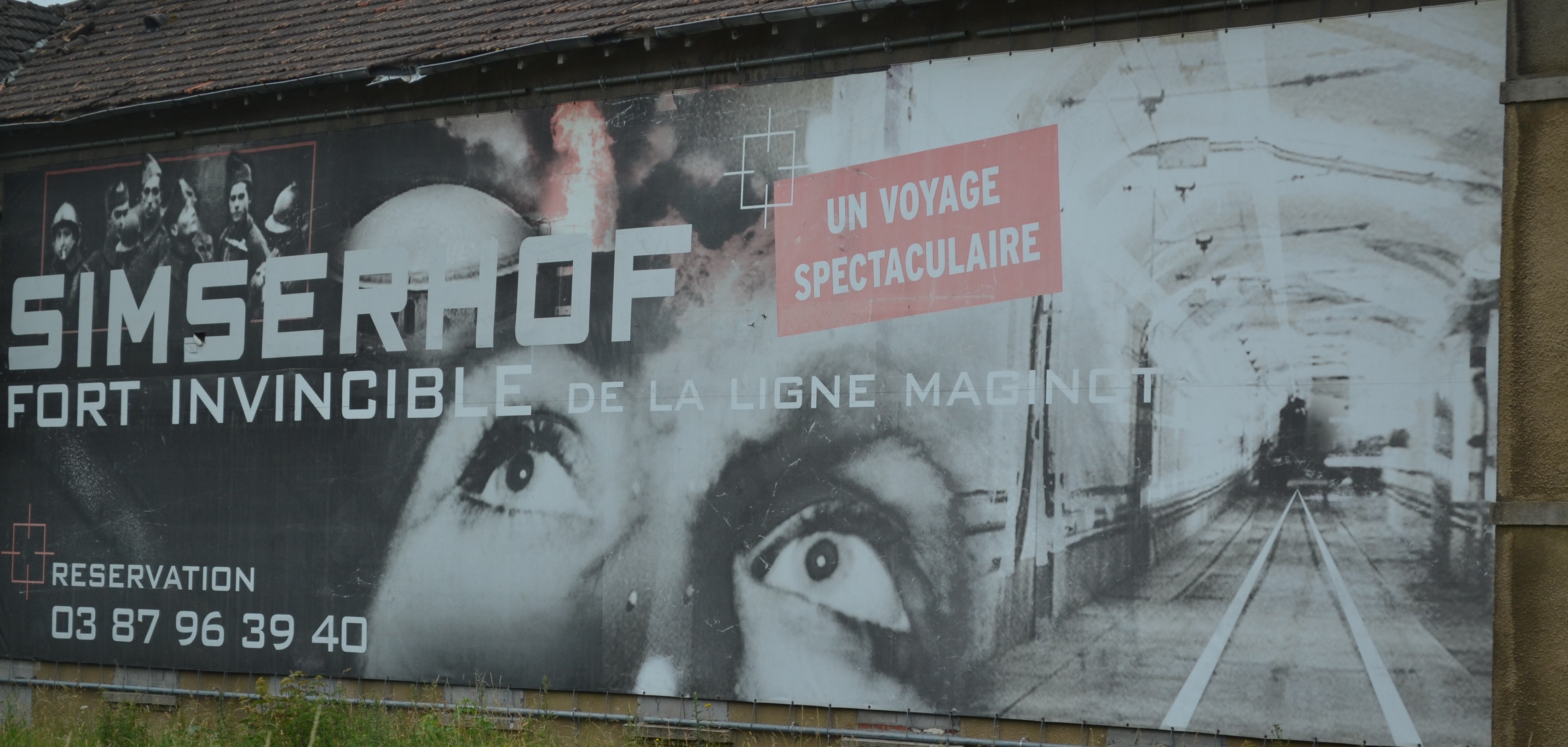
We ventured just over the French border to Simserhof, to tour a fabulously intact section of the Maginot Line: a series of unfathomably huge underground fortifications that were built to defend the French border from the sort of threat that had manifest itself in the nightmarish realities of World War I.
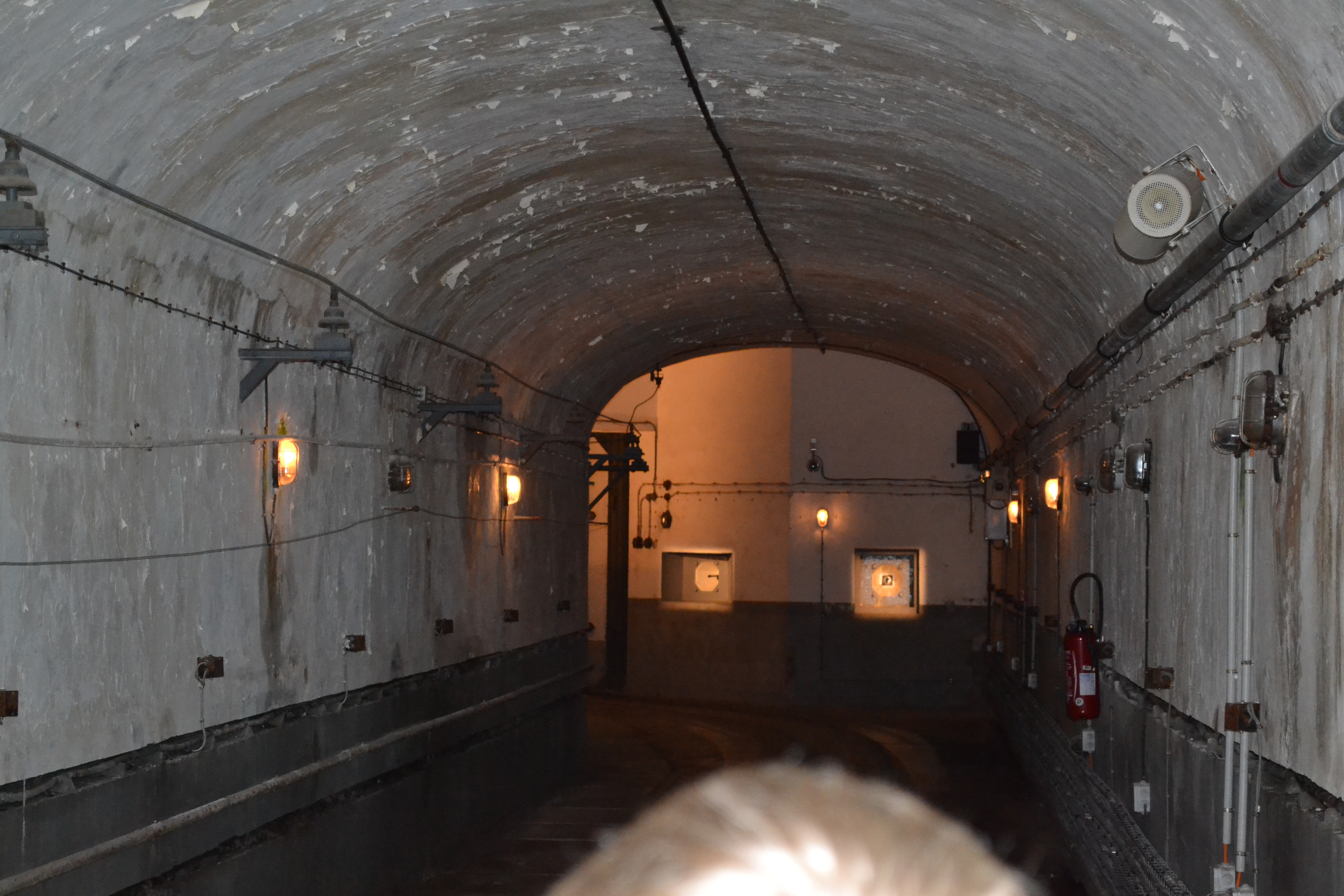
A tunnel into the living and working areas underground at the Maginot’s Simserhof location.
For all of the brilliance of these fortifications–and they are truly amazing–the battle that arrived at their doors was not the First World War’s long drawn out trench warfare, but some new beast. Where “the line” was static and uber-hardened, the blitzkrieg was fast, arguably precise, and offered an element of surprise. And surprises abounded: many thought the Ardennes Forest of Belgium was impassable to German tanks. Mistake. The Ardennes proved passable, and because of the break in Maginot line (it did not run along the border of Belgium), the Germans simply came around the fortifications.
It doesn’t pay to judge: hindsight is always 20/20. But foresight is harder won. (It’s true in our national foibles, and it’s true in our individual lives. Personally, I’m questioning the decision to buy an entire box of eclairs at Cora Market in France–it’s calling to me as I drink my morning latte and just begging to be polished off before lunchtime. Ouch.)
I wish I had taken more photos inside the facility, as it was fascinating and extravagant— not in it’s lavish interior (the interior was austere) but in the audacity of its scale and hopefulness. It is like a military base built underground–with weapons and munitions, electrical generators, a “trolley system,” a filtration system for gas attack defense, multiple levels and elevators, chow halls and a modern (for its time) kitchen for officers, a pantry stocked with wine and cheese, bunk rooms, a state-of-the-art infirmary, etc. It was optimistic: after the hellacious First World War, this facility contained the hopes and promises of a secure border and a fighting force that could be effective from the shelter of a secure and dry “trench” stocked with coffee and wine, with relatively warm beds, with fresh air to breathe, full bellies, dry limbs, etc. It was a desirable set up, but flawed. War is a trickster and a shape shifter, and the Maginot Line was inflexible.
I didn’t take more photos because my hands were shoved into my pockets and shaking. This underground facility is very cold! Our walking tour lasted maybe an hour, and the chill had plenty of time to seep into my bones. If one hour of subterannean life and lack of sun can do this to you, what would it be like to be underground for months on end, even without a battle raging above and around you? Mmm, I shudder just thinking about it.
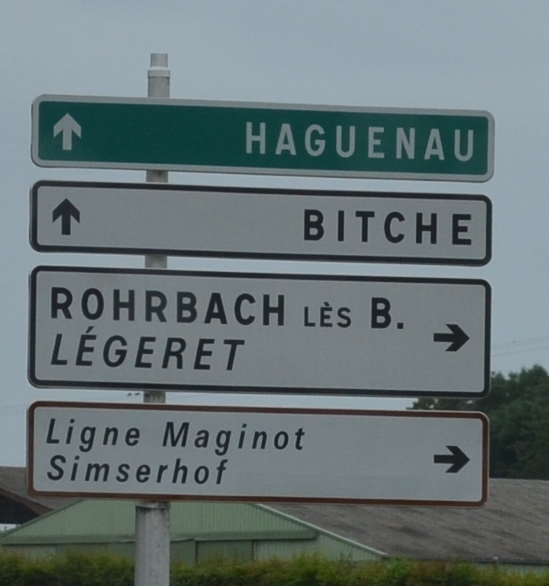
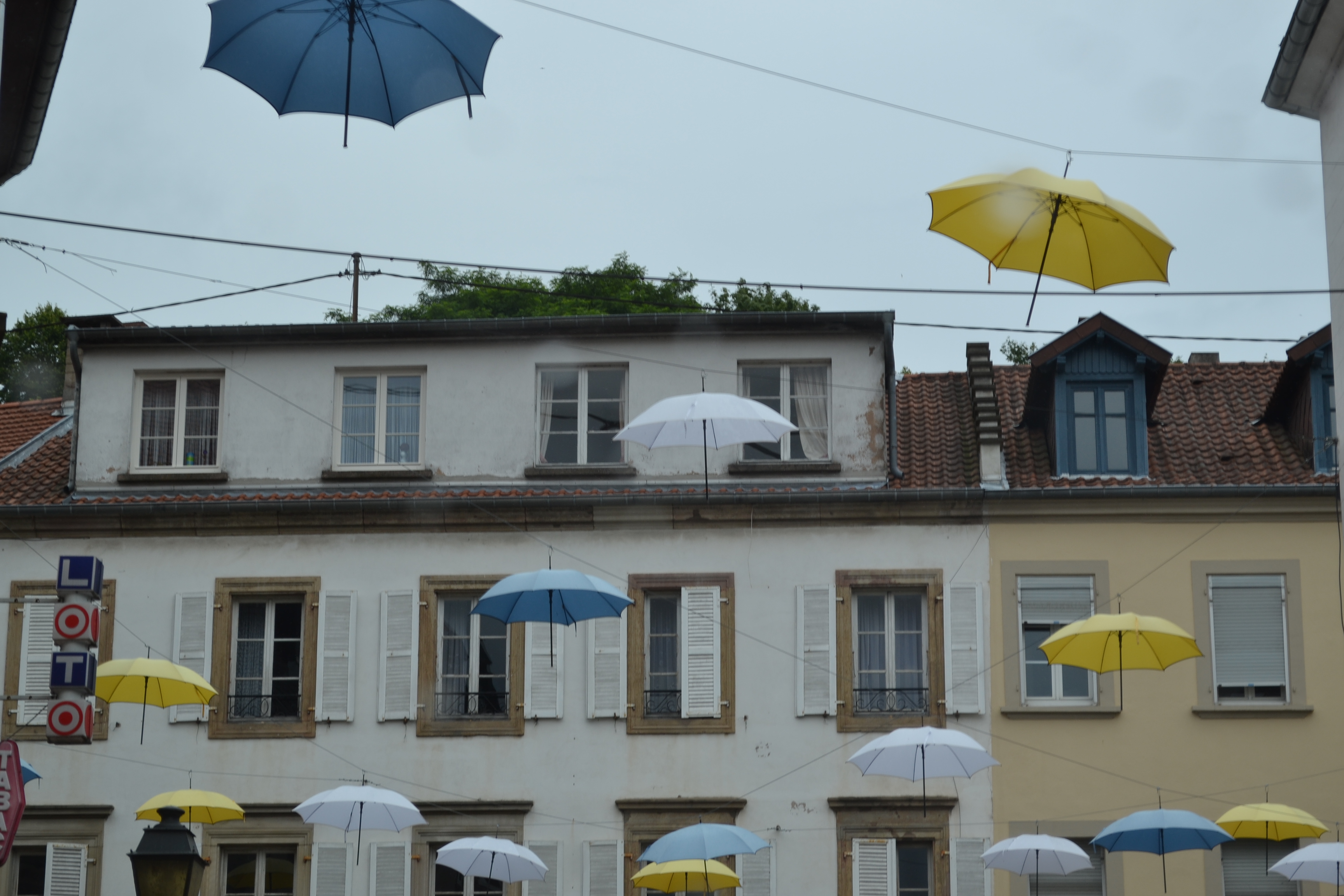
It’s a somber subject, but a fascinating place to visit. Simserfhof is located in Northeastern France, near Bitche (yes, Bitche) just over the border with Germany. Bitche offers it’s own sights to see–most notably its citadel on a hill. It was too rainy for us to tour the Citadel yesterday, but we drove through the town on our meandering way back home, and were delighted to see the following art above one of the town’s squares. A little levity was just what we needed as we left the Maginot Line and planned our own attack on the pastry counter of the Cora Market.
Saying goodbye to our home, our family, our continent—it’s been tough. Right, right, we’ve been really excited about moving to Germany–and it’s great to be here having adventures. GREAT. Still, these things are bittersweet: bitter and sweet, not one or the other. My daughter’s heart is still breaking because she misses her friends back home. My son aches for a familiar friend to skateboard with in front of our house. And I’m still mourning the hope of having Thanksgiving with family, of playing golf with my gang, of walking back into my classroom for fall semester at AUM. The list goes on for each of us.
But these lists aren’t ours alone, and they don’t apply only to us itinerant types. You can live in the same state all your life and still experience moments of overwhelming loss: when you walk into a room full of laughing relatives and expect to see your uncle, the consummate storyteller, sitting in the center of the laughter (but he passed away last year and his seat is empty); when you step out into a balmy southern evening and hear the cicadas and tree frogs and have an overwhelming sense that you’ve just stepped out of your grandmother’s house, headed to the backyard with a glass of sweet tea in hand (but she passed away 29 years ago); or even when a Violent Femmes song at high decibel puts you right back into a moshpit of a party with your high school and college friends (but you are driving up I-85 with your kids in the back of a station wagon). Memory is a sticky substance–thank God. And I think that, as much as it sticks to us, we stick to it also.
I’ve been mulling this over all morning after being hit by the sting of a lost “momento” of my life story. It goes like this: Yesterday, we picked up our car from a port on the North Sea. We’d shipped it from the States about two months ago. (Despite paying a hefty–h-e-f-t-y– sum to send it over the Atlantic and through customs, it seems that the shipper inflated a small raft underneath the chassis and paddled it over the ocean himself. This is the only explanation I can offer for the insane timeline. But back to my story–) I had the car inspected before getting German plates put on this morning, and it passed with the stipulation that I scrape the dealer’s decal, indicating a city in North Carolina, off of the back of the car. They had their reasons–logical enough, if uninspiring–but my heart sank a little as I scraped away.
I am a Carolina girl. I may look like a vagabond to you, with a crazy long list of places I’ve called home in recent years: Chicago, DC, Connecticut, Texas, Georgia, Alabama, England, Turkey, Germany. Each of those places has left an indelible mark. I wouldn’t want to lose any of them, but especially not my roots in North Carolina.
However, I lose a little bit of each of them in unexpected moments–like bits of produce that spill from my cart as I bump along a country road, I shed bits here and there–and I hate that. So this morning, I obediently scraped the North Carolina decal from the back hatch of my wagon, mourning that badge of “who I am” that I’d been carrying around for over a decade. I am still a Carolina girl, but I’m no longer emblazoned on the highway–that shouldn’t sting much, but it does. Like everyone I’ve ever known, I like to hold tight to who I am and what (and whom) I’ve loved. And the artifacts of life are dear to me for that reason. But like everyone I’ve ever known, I find life prying little bits of this away from me.
As a postscript, I offer up the words of Elizabeth Bishop’s beautiful poem about loss–in all of its incarnations, big and small. She said it so much better than I can, so I’ll let her words stand:
And every German person will know it when I open my mouth.
Here’s the thing: the German language makes me nervous. I’ve traveled in Germany before, and my tourist-German is passable. Mostly passable. When I throw in some charades and a German-English dictionary in pocket. I can do this. Yes, I can.
But I am, somewhere deep down, terrified of the German language. It comes from freshman year German classes at Davidson College. Well, no. . .it comes from my sad and sorry performance in freshman year German classes at Davidson. Out of nearly a year of German classes, there was only one week when my professor complemented me on my accent and abilities. And I was on death’s doorstep with the flu. Strangled by phlegm and fever, but excelling at the guttural language. (Too bad this week didn’t coincide with the German presentation I had to deliver weeks later where I not only didn’t have the phlegm working for me, but I was uncharacteristically gripped by stage fright and began speaking in French…a language at which I am also no genius.)
I know that I can become a competent communicator in German. After all, I learned to muddle through in Turkish, with no previous background. Do I anticipate erudite and articulate? No, I’m being realistic here. But I want to be good enough. Respectful of the country, the culture, and able to move freely about and really talk to people.
But this memory of freshman year German is a problem. Perhaps I’m just not capable of speaking German. Or perhaps I spent too much time at the fraternity court and not enough time studying. Maybe my mind just doesn’t process the German language? Or maybe the way to absorb all of those 1980’s language lab audio tapes wasn’t to sleep through them and trust in the quasi-science of learning by osmosis. Or maybe. . .
Maybe I just need to crack open some books and study again–but then mostly just throw myself into it.
Here’s what I know about myself now that I didn’t really understand before. I can’t effectively learn declensions and conjugations from books and lists. My mind doesn’t function in charts and graphs and conjugations–that section of my brain left on vacation 40 something years ago and it isn’t coming back. What I can do is listen. I like sounds. I like cadence and intonation. I can gather up vocabulary like pebbles by a pond, and once I watch and listen for long enough, I can send them out skipping and skittering over the water gloriously. I will be an eccentric speaker, perhaps–with Frankensteinian grammar–but I will speak readily and joyfully and maybe even, should I be so lucky as to suffer from a cold or the flu, brilliantly.



 Travels and Tomes: One Expat's Amblings and Ramblings