Jedi Language Master . . . Or Not

calmgerman

I wrote, but never published, the following post a few weeks ago.  My final German class has now wrapped, and my time in Germany is slipping through my fingers at an alarming rate.  I’m still a thousand miles off the shores of fluency, but I am still bouyed by a sort of wonder at the language.  Das ist mein Schicksal; this is my lot.

Call me Yoda.

I am not wise; I am not green; I am not cute and pointy-eared; I am not short.

But language I do speak,  in foreign and fitful patterns I do.  German is like that– its subjects and verbs bounce around depending on meaning, subordination, etc.  It sounds cute when Yoda does it.  And I actually find it enchanting when German does it–  infuriating, but enchanting.  But this doesn’t help my plight in language class.

We are rapidly moving into our final weeks here in Germany, and I’m still attending German class . . . but not flourishing.  I will make my excuses up front.  Let’s start with my teacher. (She is very nice, but just ill matched to my learning style)

I’m back with my original teacher who is all about book work and learning all declensions, conjugations, variations, grammaticalizations  . . . which is not a real thing, but you get the picture.  I’m stuck back in class with the engineers and their precision-cut cogs of language (if you have no idea what I’m talking about, you are more sane than me look back at my past blog post–here).  This class doesn’t really suit the way I learn, but I’m hanging in there, most days.  (I have been known to play hooky a little.)

Still, the truth is that I am languishing horribly.

I like the word “languish,” it’s kind of visual for me.  I see a boat stuck on a windless part of the sea, which of course is just a few days away from disaster and decay . . .but let’s say the wind eventually picks up, and disaster is averted (happier story).  So, anyway, “languish” means “to lose or lack vitality, to grow weak or feeble.”  And this is me in German class right now, but it occurs to me that the word “languish” sounds like the word “language” if spoken by a drunk person. This somehow makes me feel better.  Like the word was specifically invented for my situation–as if it’s a natural thing to languish in a language when one is somehow lacking in mental power, for whatever reason.  A reason like stress brought on by an impending move.

Or like sitting in a book-learning class with my head down in a page, when I can only absorb words by speaking and hearing and bandying them about like a game. It’s a messy, garbled way to learn, but I’m a messy, garbled person.

I like language– I bloomin’ love language, honestly– but not because of its precision bits.  I love it for the most idiotic, but sonorous, reasons– like the fact that “languish” sounds like a drunkard saying “language.” That makes me happy.

And language makes me happy.

But today I sat in German class, having missed a few classes (for various reasons: some good, some bad, some worse).  I was lost.  And the verbs and nouns were jumping all over the place in sentences–like fleas on a dog’s back–for reasons I couldn’t quite understand.  But I liked it.  It made me laugh.

So there I was, some of my classmates scratching their heads and trying earnestly to grapple with the language, others following dutifully and expertly along, and me–the village idiot–just thinking how cool these slippery constructions were, although I understood them not one bit.

And then, at the end of class, came the best moment, the icing on the cake.  My teacher brandished her eraser and said, “I vill vipe die blackboard.”

My ears were in heaven!  While everyone else noted the homework and closed their books, I struggled to stifle my giggles.   The word-fleas jumped, the teacher “viped avay” at the board, and I just laughed.

danke Master, I am not.  Amused, I am.


Surviving the Holocaust: Selma van der Perre


From projeckt-ravensbrueck.de webpage

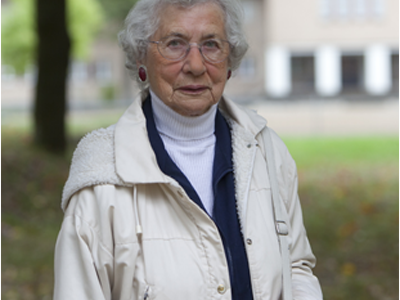
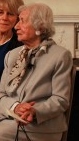
Last Friday, I had the good fortune to hear the 94 year old  Selma van der Perre speak about her experiences as a Jewish woman during the Holocaust and a survivor of Ravensbruck Concentration Camp.  I braced myself for difficult stories and a somber afternoon, but what appeared on stage was an absolute spitfire of a woman who radiated hope, energy, and life abundant.  I fell in love with Selma the minute she walked on stage–with a cane and on the arm of a younger person, wearing a neat suit, chic French scarf, and white beret.

She was chic, sharp, and a delight in every way.  Some of the stories she had to tell made your blood run cold and your stomach clench into a knot, but everything about her being shone bright and radiated hope.

Selma-vanderperreShe was a young woman growing up in the Netherlands when the Nazis came to power.  Her family was pulled apart, her father died in Auschwitz, and she became a courier with the Dutch resistance, taking a false identity and dodging the authorities while helping the cause.  Eventually, she was caught and sent to prison, then transferred to Ravensbruck.

Selma could, and eagerly would, tell you stories all day about those years–each story more fascinating than the last, and many of them heart-wrenching. They are her stories to tell, and I couldn’t do them justice, so I won’t try to re-present them here.  You may use this link to hear her tell some of her stories in her own words (from a BBC program on Ravensbruck– “Surviving Ravensbruck”).  I promise you that it is well worth your time.

What I will tell you is how she answered a question about what gave her the strength to go on and to not give up, although she was quite ill and weak much of the time.  She answered this very simply, taking little personal credit.  Yes, what she did in the resistance was dangerous, but it was a difficult time and she wanted to do her part and help people.  And besides that, she didn’t want to give the Nazis the satisfaction of crumbling– she wanted to “stick it to them.”

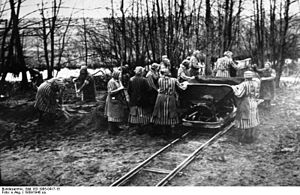
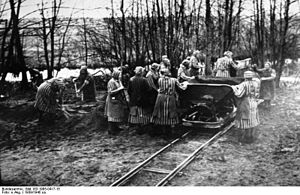
Ravensbruck prisoners, from Wikipedia

Even as a factory worker in Ravensbruck work camp, she and her colleagues would sabotage the gas masks they manufactured for the Third Reich, not screwing them together properly.  Anything they could do to undermine their captors, they did.  And they showed each other kindness–she was adamant that kindness from other inmates (and even a prison guard early on–a guard who was later incarcerated and killed for her part in helping inmates) kept her going during tenuous times.

There are very few survivors of the concentration camps still around, and, like Selma, they have reached a ripe age.  It is so important that we hear their stories whenever and wherever we get the chance.  I very nearly missed hearing her talk.  I had a busy day Friday and her talk wasn’t at a convenient time for me . . . and, as you can imagine, I felt a little discomfort about going.  It was a beautiful, sunny Friday afternoon, and the Holocaust is a heavy, horrific topic which anyone might, understandably, want to avoid.   But that would have been a mistake.

When I left the theater and stepped back into the bright afternoon, I was uplifted.  The horror of the history had been laid out unquestionably in her talk–I flinched time and again as she told stories– but, I tell you this, the lesson was transformed in the person of Selma van der Perre.  “This cannot happen again,” she said, “we must be very aware of such things going on still in our world.”  Her message was clear and serious, but in her capable hands it was uplifting and resilient.  Our lights should all shine so bright.

Thank you, Selma van der Perre.

Holocaust Remembrance Day

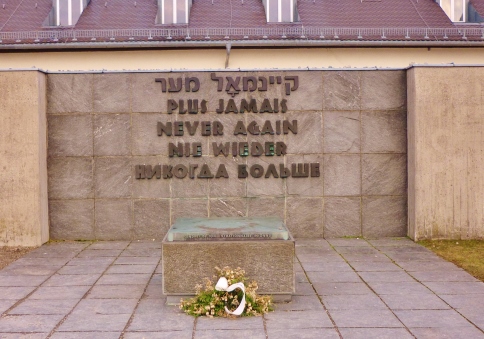
The evening of May 4th through the evening of May 5th mark Holocaust Remembrance Day, Yom HaShoah.  In honor and memory of the millions of souls lost in the Holocaust,  this simple photo of a wall at Dachau.  Never again.

nvr again dachau